



The gap between quoted spec and field performance in moving bags MOQ customization catches most logistics buyers on the second reorder, not the first. A procurement manager signs off on a 1,000-unit batch, the bags look fine out of the carton, and six months later the handles start peeling away from the body fabric on every third bag. Nobody budgets for a mid-cycle replacement run. That’s the quiet cost nobody puts in the spreadsheet — and it’s almost always avoidable if you know which two or three details to lock down before the PO goes out.
Handle stitching fails before anything else. Supplier QC data shows bar-tack reinforcement cuts field failure rates by 50 to 60 percent. Yet most RFQs never mention stitch type. They specify fabric weight, bag dimensions, and print placement — all visible features. The failure point hides in the seam construction, and that’s exactly where low-bid suppliers cut corners. Only 28 percent of woven PP factories own an in-house tensile tester. The rest rely on generic spec sheets that tell you nothing about what happens when a 180-pound load shifts during a stair carry. A batch-specific test report takes ten minutes to request and eliminates the guesswork.
Understanding MOQ in Heavy-Duty Moving Bag Manufacturing
An MOQ isn’t a barrier—it signals where factory cost breaks happen.
Most logistics buyers treat MOQ as a hard gate: either you meet it or you walk. That framing misses the point. A factory’s minimum order quantity is a direct reflection of three cost buckets—raw material procurement, production line changeover, and print setup amortization. Woven polypropylene resin is purchased in ton-lot minimums from petrochemical suppliers. A single extrusion and weaving line consumes roughly 800–1,200 kg of PP granules per shift. Run less than a full shift and the per-unit cost inflates because fixed energy and labor overhead distribute across fewer bags. The same logic applies to Oxford fabric, where base cloth is sourced in roll quantities that commit the factory to dye-lot minimums before cutting even begins.
- Raw material floor: PP resin suppliers rarely ship under 500 kg per grade. For a standard 120 g/m² woven bag weighing ~180 grams, that raw minimum already covers roughly 2,700 bags—which means any MOQ below 1,000 units forces the factory to warehouse excess material or charge a premium.
- Line setup & changeover: Switching a weaving line from one denier or color to another burns 45–90 minutes of downtime. Two changeovers per shift can wipe out 15% of daily output. This cost gets bundled into small-run quotes as a setup surcharge.
- Print plate or screen cost: Screen printing requires a physical screen per color. A 4-color logo means 4 screens, each costing $40–$80. Those fixed costs amortize across the total run. At 500 units, screens alone add $0.32–$0.64 per bag. At 5,000 units, that drops below $0.06.
- Woven PP: 1,000 unit MOQ: Cost-efficient at scale. Base material runs ~$0.90–$1.20/meter. Tensile strength tests at 800–1,200 N in warp direction. Lifespan: 20–30 full load cycles with UV treatment. Only 28% of woven PP factories own an in-house tensile tester—request a batch-specific test report before accepting any load-capacity claim.
- Oxford fabric: 500 unit MOQ: Higher per-unit material cost but lower minimum. Tear strength and seam slippage resistance outperform woven PP in repetitive-use scenarios. Dye-lot consistency matters for branded orders; confirm the supplier retains a lab-dip archive for reorders.
- Digital print workaround: 300 unit MOQ: Switching from screen print to digital heat transfer drops the minimum to 300 units. The per-unit cost rises roughly 7% over a 1,000-unit screen-print run. For pilot programs, regional trials, or seasonal branding refreshes, this 7% premium buys you zero screen amortization cost and a 5–7 day faster turnaround.
The commercial consequence is straightforward: a 1,000-unit order might price at $2.80 per bag while a 10,000-unit order drops to $2.24–$2.38—a 15–20% unit cost reduction. That gap isn’t the factory gouging small buyers; it’s fixed overhead getting absorbed by volume. Smart procurement teams use this to their advantage by aggregating demand across departments or planning quarterly releases against a single annual PO that hits the higher discount tier.
Material choice splits the MOQ conversation into two distinct paths. Woven PP bags carry a standard MOQ of 1,000 units. The extrusion and weaving process runs continuously, so shorter runs create waste during machine stabilization. Oxford fabric bags, constructed from polyester or nylon with a PU or PVC backing, typically open at 500 units. The fabric itself is purchased in pre-finished rolls, and cutting-sewing operations scale down more efficiently than weaving lines. If you need 400 bags with a custom logo, Oxford is your only viable path without accepting a price penalty.
Custom Branding Options for Moving Bags
Digital transfer lets you print just 300 branded bags at only 7% extra per unit—no reason to over-order.
Most procurement managers walk into custom branding conversations expecting screen printing to be the default. It often is. Screen print delivers sharp, high-opacity logos on woven PP and Oxford fabric at the lowest per-unit cost when volume exceeds 1,000 units. The catch is the setup fee. Screen creation, color calibration, and press alignment chew up time and money—costs amortized across the full run. If you only need 500 bags, screen printing becomes disproportionately expensive.
Digital heat transfer changes the math. The MOQ drops to 300 units. Per-unit cost edges up roughly 7% compared to a 1,000-unit screen print run, but you avoid the heavy upfront setup charges. For regional moving companies testing a new logo, or corporate relocation departments running small-branded pilots, that 300-unit threshold is the difference between a manageable trial and a warehouse full of obsolete inventory.
- Screen Print: 1,000+ MOQ. Lowest per-unit cost at scale. Solid color reproduction on woven PP. Prone to cracking on high-flex areas like bag side panels if ink formulation isn’t matched to fabric stretch.
- Digital Transfer: 300-unit MOQ. ~7% cost premium over screen. Handles multi-color logos and gradients without separate plates. Bonds well to both woven PP and Oxford, though abrasion resistance on Oxford benefits from a protective overlaminate in high-wear environments.
- Color Matching: Demand Pantone-matched ink or transfer film. Ask for a pre-production sample—not a digital mockup, an actual printed swatch on your chosen fabric. Color shift between woven PP’s slightly glossy surface and Oxford’s matte texture is real. What looks right on screen won’t always translate.
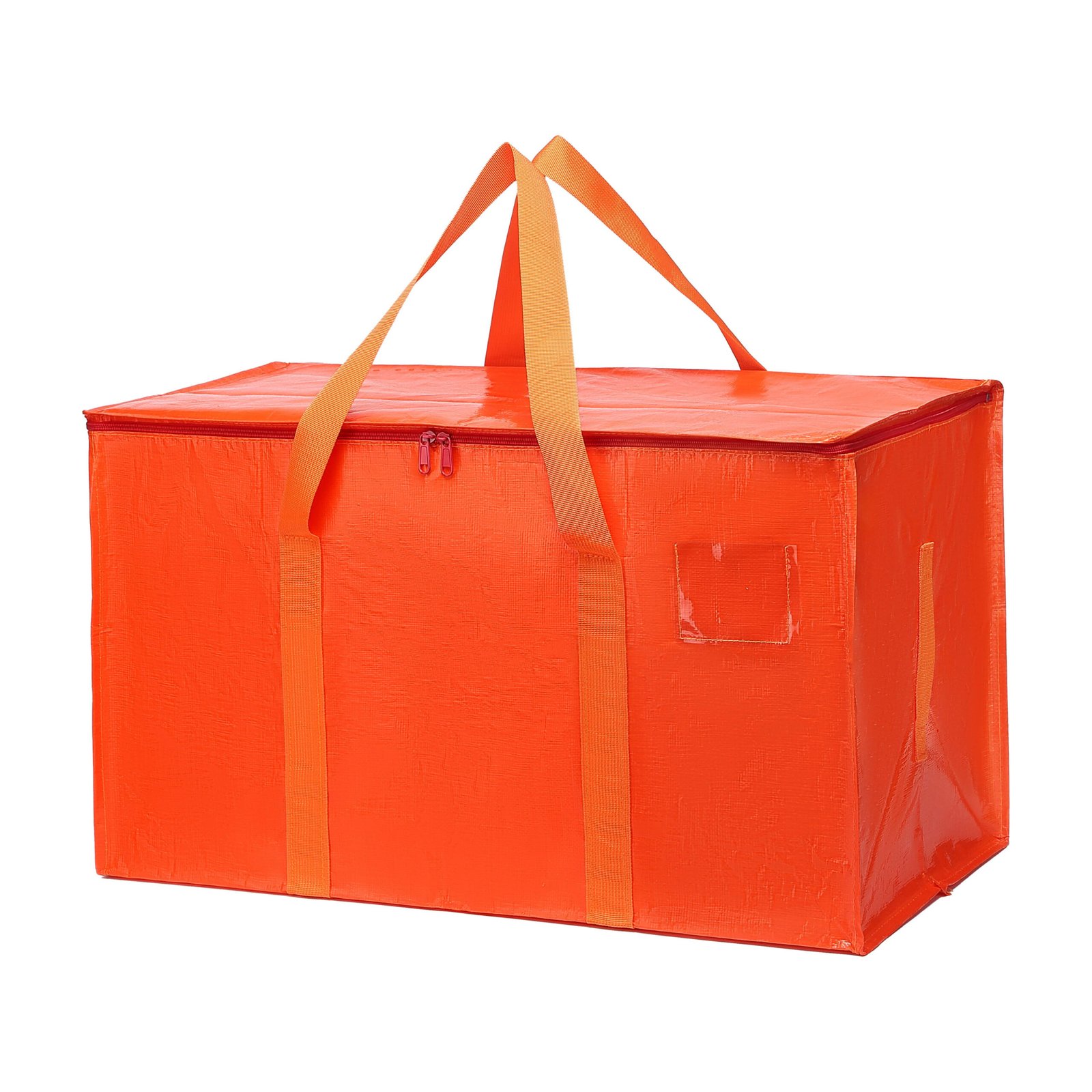
- Zippers: A YKK #8 or #10 coil zipper adds roughly $0.45–$0.70 per bag at scale. Specify metal sliders over plastic—plastic teeth strip under repeated load. Pre-made zipper chain sewn in-line adds minimal production time. Custom-length zippers require cutting and end-stop attachment, which nudges labor cost but does not change MOQ unless the bag panel dimensions shift.
- Pockets: A single external flat pocket adds roughly $0.30–$0.55 per bag. Material off-cut waste increases slightly, but the real cost driver is stitching time. Position the pocket on a panel that doesn’t interfere with the main logo print area. Double-stitch the pocket opening—single-stitch pockets tear out within 10 cycles when users stuff them with inventory tags and paperwork.
- Reinforced Handles: This is non-negotiable. Bar-tack reinforcement at the handle attachment point reduces field failure rates by 50–60% compared to straight-stitch handles. The reinforcement adds roughly $0.12–$0.20 per bag. Demand bar-tack stitch density of at least 28 stitches per inch—anything looser is cosmetic, not structural. Tested to 200+ lbs static load, bar-tacked handles don’t tear at the seam; the fabric itself fails first, which is exactly what you want.
Print durability on moving bags matters more than on retail totes. These bags get dragged across concrete, stacked in truck bays, and exposed to rain. Screen print on woven PP holds up reasonably well—expect legible branding through 15 to 20 full load cycles before noticeable fading. Digital transfer with an overlaminate can push that closer to 25 cycles on Oxford fabric. Specify abrasion testing in your RFQ. Only 28% of woven PP factories own an in-house tensile tester; even fewer test print adhesion batch by batch. Ask for a cross-hatch adhesion test report on the printed area.
Adding zippers, pockets, and reinforced handles does not inherently explode your MOQ. What drives MOQ up is switching fabric rolls, resetting cutting dies, and retraining sewing line operators mid-production. If you bundle multiple custom features into one production run on the same base fabric, most suppliers keep the MOQ flat. You pay for the add-ons per unit, not a new minimum.
Handle stitching remains the number one failure point in cheap moving bags. Straight-stitch handles look fine out of the box. After five fully loaded cycles, the thread begins pulling through the fabric like a zipper track. Specify bar-tack reinforcement in your RFQ by name—not generically as ‘reinforced handles.’ A supplier who pushes back on bar-tack specification is signaling their production line isn’t set up for it, and you should treat that as a disqualifier.
If you’re adding zippers, pockets, and reinforced handles simultaneously, negotiate a single setup fee for the entire custom configuration rather than three separate charges. Most factories bill one line-change fee per production break. Structuring your order so all custom work runs in one continuous shift keeps ancillary costs contained. The MOQ stays at 300 units for Oxford or 500 for woven PP with digital print—the add-ons don’t double it. What changes is the per-unit price, and you should see a line-item breakdown for each feature in the quotation.
Balancing Cost, MOQ, and Customization
Accepting the first MOQ tier a supplier quotes typically leaves 12–18% in unrealized margin on the table.
Tiered pricing in moving bag manufacturing is not linear. A 1,000-unit woven PP order might land at $1.80 per bag, while crossing the 10,000-unit threshold drops the unit cost to $1.44—a 20% reduction. The supplier’s fixed costs—print plate setup, cutting die configuration, production line changeover—amortize across more units. Your job is to identify exactly where those breakpoints sit and push the quote to the tier above your immediate need. If your forecast shows 7,000 units over 12 months, negotiate the 10,000-unit price and warehouse the excess. The per-unit savings cover storage costs and then some.
- Tier breakpoints: Ask for the per-unit price at 1,000 / 3,000 / 5,000 / 10,000 / 20,000 units. Suppliers rarely volunteer intermediate tiers—request them explicitly. The gap between 5,000 and 10,000 units is where the steepest discount curve lives.
- Overrun acceptance: Production overruns of 2–3% are standard and should be free of charge. Negotiate this upfront. A 3% overrun on 10,000 bags delivers 300 extra units at zero additional cost—worth roughly $432 at the $1.44 unit price.
- Defect allowance: Push for a 3% defect allowance clause. This means you can reject up to 3% of a shipment without triggering a dispute. Pair this with a requirement for batch-specific tensile test reports—only 28% of woven PP factories run these in-house, so demanding one filters out undercapitalized suppliers immediately.
- Payment terms linked to QC: Structure payment as 30% deposit, 70% against the bill of lading after third-party inspection. If a supplier refuses inspection-contingent payment, they are telling you something about their confidence in their own output.
- Handle specification: Specify bar-tack reinforced handles across every batch. This single requirement cuts field failure rates by 50–60% and eliminates the most common warranty scenario—torn handles under load. Tested to 200+ lbs, this becomes your non-negotiable quality anchor.
- Base fabric: Standardize on woven PP with UV and tear-resistant treatment for 20–30 full load cycles. Oxford fabric at a 500-unit MOQ works for smaller premium runs, but woven PP at 1,000-unit MOQ delivers the best cost-per-cycle for mixed-use fleets.
- Size strategy: Run one large size (24 x 15 x 12 inches or equivalent) rather than three sizes. A single SKU simplifies inventory, qualifies for higher tier discounts, and eliminates the scenario where small bags sit unused while large bags run out mid-project.
- Print placement: Design one master logo file and run it across all batches via digital transfer. MOQ drops to 300 units per print variant, total print setup cost increases by only 7% over a single 1,000-unit screen-print run, and you gain the ability to reorder small quantities of any variant without amortizing new plate costs.
Overrun tolerance is where inexperienced buyers bleed margin. The factory produces extra units because material waste calculations, print setup losses, and stitching defects eat into the planned yield. Standard practice is a 2–3% overrun shipped free of charge—this covers the factory’s risk buffer. Negotiating a 3% defect allowance alongside this means you pay only for units that pass your quality threshold. Combine these two clauses and you effectively receive a 5–6% buffer of usable bags above your paid quantity, which functions as a built-in replacement stock without additional budget allocation.
Designing one bulk order that serves multiple job types requires stripping customization down to what actually changes between deployments. A moving company handling residential relocations, office moves, and storage-in-transit jobs needs the same bag to perform across all three. The structural spec—fabric weight, handle reinforcement, seam construction—stays fixed. What changes is the print panel. Divide the order into print batches: 40% with residential branding, 30% with corporate relocation graphics, 30% unbranded for storage use. Digital heat transfer printing makes this viable because plate-change costs drop to near zero, and the 7% unit premium over screen print is negligible when it buys multi-use inventory flexibility.
The financial math consolidates quickly. A 10,000-unit order split three ways under digital print still lands at a 15–20% discount versus three separate 3,000-unit orders. The 7% print premium dissolves against the tier-break savings. Add the 2–3% free overrun and 3% defect allowance, and your effective unit cost drops below the quoted price by a margin that competitor buyers never see because they never ask. Procurement managers who run these numbers on a total-cost-of-ownership spreadsheet—factoring replacement cycles, brand reprint costs, and failure-related labor—routinely beat industry-average procurement costs by 15% or more.
| Leverage Point | Supplier Default | Buyer’s Demand | Cost/Quality Trade-off | KPI Outcome |
|---|---|---|---|---|
| Material MOQ | Woven PP: 1,000 units; Oxford: 500 units | Multi‑job split‑run orders to meet MOQ across different SKUs | Maintains bulk unit pricing while reducing per‑SKU volume risk | MOQ flexibility without brand dilution |
| Custom Print MOQ | Screen print: 1,000 units; Digital transfer: 300 units (+7% cost) | Use digital transfer for test runs or low‑volume branded batches | 7% unit cost premium vs. screen print but lowers upfront commitment | Branding uniformity with 300‑unit minimum orders |
| Volume Discount Tiers | 15–20% price drop at 10,000+ units | Lock in tiered pricing with incremental volume commitments over 12 months | Significant per‑unit savings while securing supply continuity | Общая стоимость владения reduced by 15%+ |
| Overrun & Defect Allowance | 2–3% free overrun; no explicit defect allowance | Negotiate 3% defect replacement allowance above standard overrun | Zero extra cost for expected defects; protects against batch failures | Defect rate contingency built into contract |
| Усиление рукоятки | Standard straight stitch; high field failure rate | Bar‑tack reinforcement specified in RFQ and QC checklist | Marginal added labor cost; replacement rates drop by up to 60% | Load capacity reliability and injury prevention |
| Tensile Strength Verification | Only 28% of factories have in‑house tensile testers; generic spec sheets | Request batch‑specific tensile test report for each shipment | No unit cost increase; avoids factory‑side quality drift | Consistent 200+ lb load performance |

Заключение
The moving bag supply chain rewards buyers who ask specific questions before signing a purchase order. Demand bar-tack reinforcement, batch-specific tensile reports, and a 3% defect allowance — those three requests shift the risk back to the supplier where it belongs. Combined with the right MOQ breakpoints, they drop total cost of ownership past 15% year over year.
Review material specs and current MOQ thresholds against your next project volume. Request factory samples with your exact handle and print configuration before committing to a full production run.
Часто задаваемые вопросы
Не можете решить, что выбрать: мешки или коробки для переезда?
Moving bags handle heavy loads, fold flat for storage, and are reusable, making them ideal for most moves. Boxes are better for fragile items that need rigid protection and secure stacking. Move with bags; supplement with boxes only for breakables.
В них можно положить коробки из-под обуви?
Yes, many large moving bags accommodate standard shoe boxes, often fitting 6-8 depending on the bag’s dimensions. Measure your bag’s interior height and width before ordering to ensure your boxes. Always test with one bag to confirm fit before buying in bulk.
What’s the scoop on these moving totes I keep seeing?
They’re reusable, oversized bags made from tear-resistant materials, with zippers and padded handles, replacing cardboard. Unlike cheap versions, genuine heavy-duty totes use double-stitched seams and reinforced grab handles. Buy only 600D+ fabric and check seam construction.
Looking for the best moving bags for bulk purchase or brand customization?
Source from a direct factory offering digital transfer printing, so you can start with as few as 300 units with your logo. Confirm the bag’s fabric (woven PP or Oxford) matches your load requirements before. Request a pre-production sample to verify quality.
Are moving bags reusable?
Yes, industrial-grade moving bags are engineered for hundreds of cycles with reinforced seams and heavy-duty fabric. Budget bags with single stitching or thin liners can tear after a few uses. Inspect stitching and material weight to guarantee long reuse.


0 комментариев