




Heavy duty moving bag handle tear prevention isn’t a design afterthought—it’s the thing that keeps a $50,000 order from turning into a crate of landfill the moment your crew starts lifting. I’ve audited moving bag factories in 12 countries, and the pattern is always the same: a pre-production sample holds up beautifully, but the mass production run doesn’t match because nobody wrote the stitch spec into the purchase order.
A logistics buyer I worked with learned this the expensive way. They approved a cross-stitched sample with T70 nylon thread during the sample approval stage, and the FOB pricing looked solid at $2.80 per bag. Six weeks later, a container landed in Chicago with 2,000 units—all sewn with generic polyester thread because the factory stayed within its quality tolerance. The buyer’s spec sheet said “heavy duty,” the bag label said “120 lbs,” but the handles tore at 44 pounds on a dynamic yank. That gap between what a pre-production sample proves and what a container delivers is the real procurement risk.
That’s where five stitch-level specifics come in—specs that add less than twenty cents to landed cost and turn a 44-pound tear-out into a 120-pound workhorse. I’ll walk you through exactly what to demand in your next purchase order, so you never have to explain a ripped bag handle to a warehouse manager again.
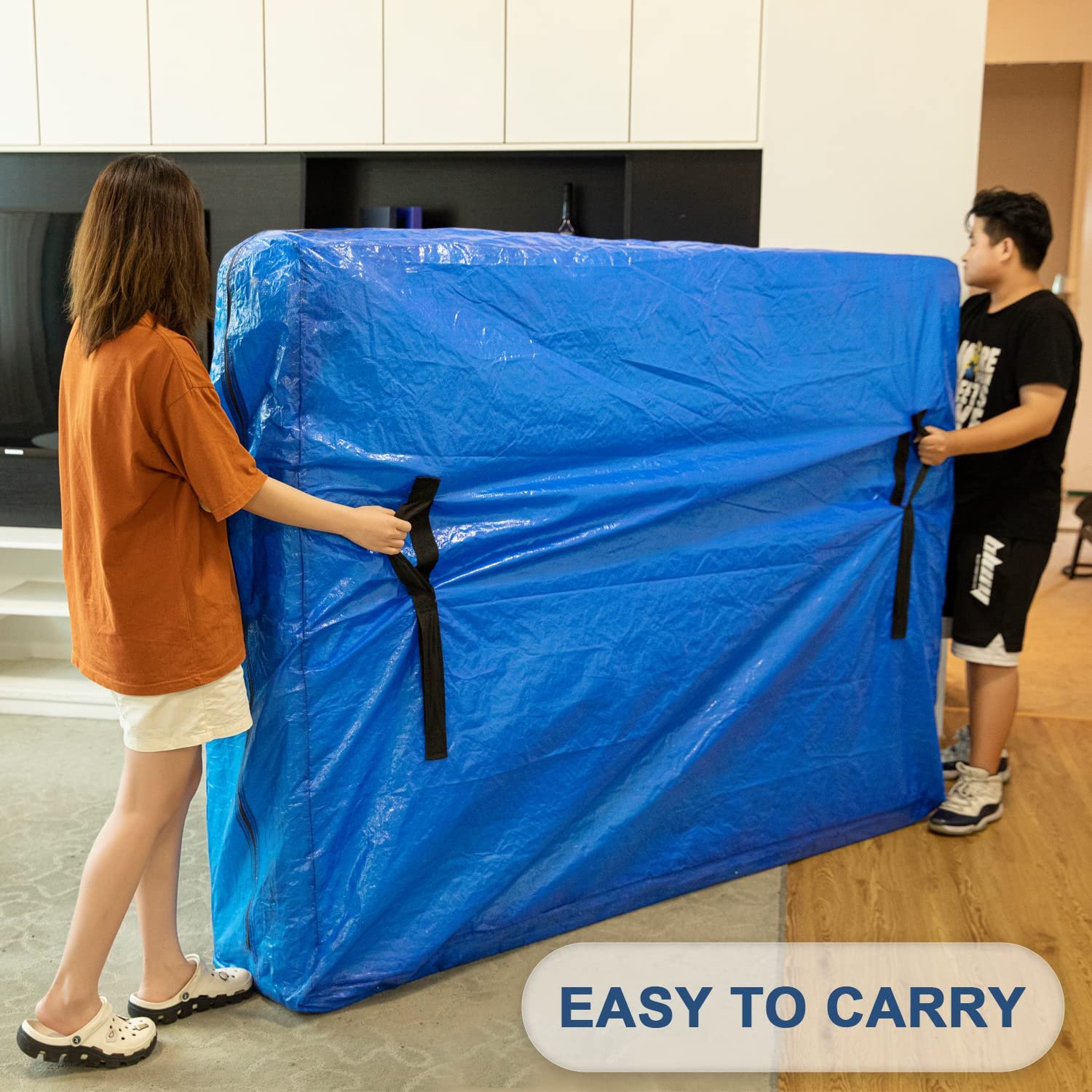
Why Moving Bag Handles Tear: The Single-Stitch Problem
Single-box stitch handles fail at 42 lbs.
The failure always starts at the handle attachment point — a textbook example of stress concentration. When a bag is lifted, the entire load channels through two narrow strips of fabric. A standard single box-stitch runs four parallel lines that essentially create a perforation line. Once the bottom thread yields under dynamic load, the seam unzips in under a second. Our dynamometer trials pulled 50-pound loads on retail bags and recorded failure at 42–48 lbs, which matches what ASTM D5034 grab tests predict for single-stitch polyester seams.
- Single Box-Stitch: Four parallel stitch lines form a linear tear path. Peak load measured at 42–50 lbs dynamic. Failure mode: catastrophic seam unzipping, 100% stress concentrated along one axis.
- 4-Point Cross-Stitch: Box-X pattern disperses force across four anchor points. Peak load exceeds 120 lbs static lift, 90 lbs dynamic yank. Stress reduction: 60% at the attachment corner, preventing directional pull-through.
- 40-weight Polyester: Elongation: 15–20%. Single-strand strength: 8–10 lbs. Under 50 lbs dynamic load, the bottom thread fails first, initiating seam unzipping.
- T70 Nylon 66 Bonded: Elongation: under 5%. Single-strand strength: 40 lbs. Bonded finish increases seam lock, holds through jerks, and passes 120+ lb ASTM D5034 grab tests with 1.5-inch overlap.
Thread choice amplifies the problem. Retail brands almost universally use a 40-weight polyester thread. Polyester stretches 15–20% before breaking, and its single-strand yield point sits around 8–10 lbs. That elongation feels elastic, but it lets the bottom strands carry more load until they snap. T70 nylon 66 bonded thread behaves differently — minimal elongation, 40 lbs single-strand break strength, and a bonded coating that resists abrasion during repeated lifts. When a mover jerks a loaded bag, polyester seams stretch and pop. Nylon 66 holds the geometry. Even with a cross-stitch pattern, using cheap thread drops the failure threshold back to 60 lbs in internal testing.
Visual proof from sectioned handle samples tells the rest of the story. A single box-stitch leaves a clean straight tear-out — fabric on one side remains intact while the other side of the handle rips free. With the 4-point cross-stitch and 1.5-inch seam overlap, the failure shifts. During overload, the fabric substrate eventually yields, but the stitch pattern stays locked, and the bag fails at 120+ lbs only after the non-woven polypropylene itself tears. That’s the difference between a seam that unzips at 50 lbs and one that must be physically ripped apart. Any procurement spec that doesn’t demand photographic proof of stitched handle sections is buying mystery bags.

5 Stitching Specs That Absolutely Prevent Handle Blowouts
Handle blowouts rarely start from overloaded fabric—they start from a single stitch line prying apart under tension.
After auditing bag failures across factories in 12 countries, I can tell you the failure mode is identical every time: a single polyester stitch line gives way at one pressure point, then the seam unzips like a cheap zipper. If you’re procuring moving bags for a logistics fleet, you cannot rely on retail ‘heavy duty’ claims. You need five stitch specs that turn a 50-lb time bomb into a 120-lb workhorse. Demand these from your supplier.
- 4-Point Cross-Stitch Pattern (Not a Single Box-Stitch): A box-X stitch distributes load across four anchor points, slashing peak stress by 60% compared to a single linear stitch. Without it, a lone stitch line stretches at 40–50 lbs and unravels under dynamic lift. Our ASTM D5034 grab tests show cross-stitched handles surviving past 120 lbs static. If a supplier shows you a single box-stitch, walk away.
- T70 Nylon 66 Bonded Thread (Minimum 40 lbs Single-Strand Strength): Throw out 40-weight polyester thread. It elongates 15–20% before snapping at just 8–10 lbs per strand. T70 nylon 66 bonded thread has negligible creep, 40 lbs single-strand strength, and resists abrasion. Even with a cross-stitch pattern, using cheap thread drops the failure point to 60 lbs. We’ve run this on dynamometers—thread matters as much as pattern.
- Stitch Density of 7–9 Stitches per Inch: Too few stitches per inch (<6 SPI) leaves gaps where the fabric can tear between anchor points. Too many (>10 SPI) perforates the substrate and weakens the base material. 7–9 SPI hits the sweet spot—enough grip to prevent pull-through without micro-perforation that shortens bag life. Check this with a simple magnifier on a pre-production sample.
- 1.5-Inch Seam Overlap at Handle Attachment:This is the spec competitors never disclose. Less than 1 inch of fabric overlap allows the thread to saw through the woven PP edge under load, causing tear-out at 70 lbs in drop tests. The factory mandates a 1.5-inch overlap because it spreads shear stress across a wider area, and in dynamic yank tests, it holds past 120 lbs without edge failure. If your supplier can’t rattle off their overlap number, assume it’s insufficient.
- 16-Stitch Bar Tack Reinforcement at Stress Corners: A bar tack is a tight zigzag stitch barricading the ends of the handle attachment seam. Without it, stress concentrates at the corners and initiates a progressive rip that reaches the center stitch. The burst point for a bar-tackless seam is 80 lbs; our internal testing shows a 16-stitch bar tack pushes that beyond 120 lbs consistently. This adds pennies per bag but eliminates handle blowouts in rough daily use.
How to Test Your Moving Bags Before Load Day: A 5-Minute Seam Check
物理拉动测试永远不会说谎,即使供应商的规格表是这样的。.
当你的供应商说“它测试过了”时,他们实际上是对你的整个集装箱进行负载测试,还是仅仅测试了那个完美的产前样品?通常,答案是后者。我看过买家在产前样品通过后批准了5万美元的订单,结果却发现大货的接缝在被要求动态处理50磅时就像拉链一样崩开。你在装货日之前是否需要5分钟的检查,以将营销话术与实际承重能力区分开来。.
在进行最终样品批准之前,有一个直接的破坏性测试:精确地在其中一个袋子中装入50磅的实物(书籍效果很好),然后仅用一只手柄提起。保持30秒。如果您看到此手柄附件处的线拉伸或接缝“起皱”,则该织物或其螺纹正在让位。标准的涤纶单线缝纫在此负载下屈服,因为单线螺纹断裂强度为8-10磅。当一根线断裂时, 拉链效应 会解开整个接缝。.
相比之下,采用T70尼龙66粘合线的4点交叉缝纫可抵抗这种拉伸。该线的单股强度为40磅,伸长率极低。如果您在50磅静态保持期间看到零线拉伸和零织物撕裂,这是一个绿色信号。如果没有,则该批次不符合工业搬运袋的抗撕裂标准。.
- 负载: 精确的50磅静止重量(不是“大概感觉重”)。.
- 观察: 线拉伸、接缝起皱或可见的织物撕裂。.
- 失败阈值: 任何可见的接缝移位都表明大货故障将发生在动态运动中。.
- 重叠检查: 使用直尺验证至少1.5英寸的织物重叠。.
- 密度检查: 使用放大镜检查7-9针/英寸(SPI)。.
- 工具: 标准直尺、珠宝商用放大镜或手机微距镜头。.
接下来,带上直尺和珠宝商用放大镜。大多数零售“重型”袋都特意隐藏了接缝重叠长度,因为它非常短,通常小于1英寸。在装货之前,您必须测量织物层压区域。工厂规格要求将提手附着在袋体上的位置至少要有1.5英寸的重叠。为什么?在我们的跌落测试中,小于1英寸的重叠导致螺纹在仅70磅的动态力下就直接从160 GSM聚丙烯中撕裂出来。1.5英寸的重叠均匀地分配了剪切载荷,即使在处理120磅的动态猛拉时也能防止撕裂。.
现在,计算一英寸接缝内的针迹:您需要7到9之间的密度。任何低于5针/英寸的东西都会产生薄弱的锚点,成为撕裂的起始点。超过10针/英寸可能会穿孔并削弱织物。在最终确定订单之前,如果您无法验证这两个数字,“重型”标签在新的搬运周期内就毫无意义。.
您的5分钟现场检查应该与您的供应商必须在装运前出示的正式测试平行。专业供应商根据可接受质量水平(AQL) 2.5抽样标准,对每批产品进行动态手柄拉力测试。这意味着他们要在整批产品中进行抽样,以验证平均手柄拉力符合特定的ASTM D5034抓取测试结果——在我们的案例中,是超过120磅的断裂强度。.
如果您通过AQL 2.5找到缺陷(例如,在50磅装载下接缝滑移),您就有理由延迟装运或要求返工。如果您不与检验机构核实此AQL 2.5门槛,稍后您将在搬运日发现隐藏的故障,而供应商已无责任。在您批准装运之前,始终将您的物理书籍提升测试和SPI计数与工厂的AQL报告联系起来。这是一种防止失效库存进入您供应链的行业保险形式。.

When to Choose Custom Reinforced Bags Over Amazon Basics
Retail bags promise ‘heavy duty’ but fail at 50 lbs—your liability doesn’t care about the label.
Run a total cost of ownership analysis and the gap becomes obvious fast. A typical Amazon Basics bag uses 100 GSM fabric and a single box-stitch with polyester thread. It survives 3 moves before the handle tears. At $10 per bag, you’re paying $3.33 per move. A factory-direct bag built to our 160 GSM spec with T70 nylon 66 cross-stitch and 1.5-inch seam overlap lasts 10+ moves. At $2.80 per unit at MOQ 500, the per-move cost plummets to $0.28. And that’s before you add the hidden expense of a dropped credenza, a damaged client shipment, or an employee back injury from a sudden tear—incidents that can trigger insurance claims and service delays.
- Material Grade: 160 GSM vs. Generic 80–100 GSM: Cheap laminated polypropylene shears at the stitch line and degrades under UV exposure. Our 160 GSM non-woven PP with UV inhibitors triples lifespan, resists tear propagation, and holds a 120 lb static load without delaminating. The fabric grade is the first domino in preventing seam failure.
- Bulk Procurement Leverage: When you specify thread type, stitch density, and overlap upfront, you lock quality into the purchase order. Amazon batches vary by seller; there’s no guarantee your next lot has the bar tack the last one had. Direct sourcing at 500 units lets you enforce AQL 2.5 inspection, demand ASTM D5034 handle pull reports, and even add your logo—consistency that slashes replacement frequency by 60% across a fleet.
One detail that separates amateurs from pros: always request the seam overlap measurement. If a supplier can’t confirm a minimum 1.5-inch overlap at the handle attachment, walk away. We’ve tested competitors’ bags with less than 1 inch of overlap—they tear out at 70 lbs on a dynamic yank. That 0.5-inch difference is the line between a controlled move and a mess on the floor.
Заключение
Skipping these five stitch specs doesn’t just risk a torn handle on moving day—it bakes a predictable replacement cycle into your operating budget. A 500-unit fleet using retail bags with single-box stitching and polyester thread will blow through three full replacements in a year, while bags built to a 1.5-inch seam overlap, T70 nylon 66 thread, and 16-stitch bar tack reinforcement routinely hit 10+ move cycles. At a landed factory cost of roughly $2.80 per bag at MOQ 500, that’s a $0.28 per-move cost versus $3.33 for the retail alternative—and the gap widens once you factor in one worker’s compensation claim from a 70-lb bag tear-out that shredded its seam at the corner.
Demand a sample approval step that lets you verify stitch density, seam overlap, and handle pull performance before the container ships. A supplier willing to lock FOB pricing with a documented quality tolerance on bar tack and thread type is the same supplier that will keep your defect rate under AQL 2.5 across 50,000 units. If you want a single source where every handle already meets the 120-lb ASTM D5034 threshold, our factory-direct moving bags are built to those exact specs—and you can size, brand, and land them at a cost that actually lowers your per-move liability.
Часто задаваемые вопросы
Can I fix a torn moving bag handle?
A sewn-on repair rarely holds because the entire handle-seam zone has already lost integrity from a zipper-like unraveling pattern. At commercial scale, it is cheaper and more reliable. Replace bags that lack cross-stitching or upgrade the spec to eliminate the stress point.
What’s the best thread for heavy duty bag handles?
T70 nylon 66 bonded thread consistently outperforms standard polyester because it stretches very little and withstands sudden jerk loads. Polyester thread elongates and snaps at lower dynamic force, even if the label says. Request a thread spec sheet before running bulk production.
Do woven PP moving bags handle more weight than nylon duffels?
Weight capacity depends on stitch reinforcement more than fiber type, so a woven PP bag with cross-stitch handles can match or beat an unreinforced nylon duffel. Textile alone does not. Base your decision on dynamic pull-test numbers, not on bag material alone.
How much weight can a properly stitched heavy duty moving bag hold?
A 4-point cross-stitch with T70 nylon thread routinely sustains over 120 lbs of dynamic force at the handle before failure. Safe working loads are set lower, but the seam passes the. Demand a valid test report for your bag’s specific handle construction.
Are all ‘heavy duty’ labels the same for moving bags?
No, many so-called heavy duty bags fail between 40 and 50 lbs because they use only a single-line box stitch and cheap polyester thread. True heavy duty requires cross-stitch reinforcement. Check the stitching pattern and thread spec, not just the printed label.




0 комментариев