



Selecting a custom tote bag material for a retail brand isn’t about finding the cheapest option—it’s about matching the fabric to how your customer actually uses that bag after the unboxing moment. A magazine editor who carries it to the farmers’ market every Saturday, a college student who stuffs it with a laptop, or a luxury buyer who uses it twice but leaves it on the restaurant chair where every companion sees the logo. Each scenario punishes different weaknesses. Canvas feels substantial but gets heavy when wet. Oxford with a PU backing resists tearing under load but can look too technical for a lifestyle brand. Non-woven PP costs next to nothing and prints vividly—for a while.
The difference starts showing up at wash cycle number eight. That’s when a non-woven PP bag with a heat-transferred logo begins to crack, turning your brand’s walking billboard into a peeling advertisement for poor quality. Internal lab comparisons put oxford 600D with PU backing at 40–60% higher tear strength than standard canvas at equivalent weight—a spec that matters more than most merchandiser briefs acknowledge. The market default is to reach for 16oz canvas and call it premium. But 12oz canvas delivers 90% of the perceived quality at 20% lower unit cost and 30% less shipping weight, and factory-direct sourcing strips out the 25–40% reseller markup that makes canvas seem out of reach for mid-tier brands. The real material decision isn’t a beauty contest between swatches. It’s a math problem with a shelf life.
Material Properties at a Glance: Canvas vs PP vs Oxford
Oxford with PU backing carries 40–60% more tear strength than equal-weight canvas—so your brand’s bag doesn’t fail before the print does.
Most material comparison charts stop at “canvas is heavy, PP is light.” That misses what actually matters for a retail brand: what happens when a customer loads the bag with a laptop, a water bottle, and a weekend purchase, then carries it through a turnstile. The failure point isn’t always the fabric itself—it’s the seam, the handle attachment, or the material’s inability to resist a sudden tear at the weave level. Three materials dominate the custom tote conversation—cotton canvas, non-woven polypropylene (PP), and woven oxford polyester—but their real-world load-bearing behavior diverges sharply once you move past static weight ratings.
- 12oz cotton canvas: Holds roughly 25 lbs static load. At 500-unit factory-direct orders, FOB runs $1.50–$2.00 per unit. The weave structure distributes weight across cotton fibers, but untreated canvas loses strength when wet. Handle reinforcement matters more than fabric weight here: a double-stitched cross-stitch handle anchor adds roughly 40% more pull strength versus a single bartack.
- 16oz cotton canvas: Climbs to ~35 lbs capacity and $2.30–$3.00 FOB. The extra 4oz buys you perceived heft, but internal production data shows 12oz delivers 90% of the tactile quality impression at 20% lower unit cost and 30% lower shipping weight. Over-specifying weight is the most common money-bleed we see in mid-tier brand RFQs.
- 80g non-woven PP: Load capacity under 10 lbs for any use beyond a single event. FOB is attractive at $0.30–$0.80 at 2,000 units, but the heat-bonded fiber structure doesn’t resist tear propagation. Once a small puncture starts, the fabric splits along the bond line. For a brand expecting the bag to circulate, this material is a liability.
- Oxford 600D with PU backing: Tear strength 40–60% higher than standard canvas at equivalent GSM, based on internal lab comparison data. FOB lands at $0.90–$1.50 at 1,000 units—cheaper than 12oz canvas—while supporting comparable or greater loads. The PU coating prevents weave distortion under heavy load, so the bag keeps its shape when a customer stuffs it full.
- Canvas texture: Natural cotton slub gives organic warmth. 12oz has a soft-hand finish that reads as “intentional canvas” rather than “rough burlap.” 16oz feels heavier and stiffer—luxury brands often prefer this weight specifically because it signals substance. The hand feel ages well: washed canvas develops a worn-in look that aligns with heritage brand aesthetics.
- Non-woven PP texture: Feels like a reusable grocery store bag. The surface is smooth but slightly plastic-y, and it crinkles. There is no textile depth—nothing that suggests a brand invested in the carrier. For a giveaway at a trade show booth, it works. For a $120 purchase in a boutique, it creates dissonance between the product and its packaging.
- Oxford polyester texture: The PU coating gives a slight sheen and a crisp hand. It doesn’t drape like canvas—it holds structure. The weave pattern is visible under the coating, which telegraphs “technical fabric” more than “textile.” This is the strongest perceptual overlap with canvas at a lower price point, which is why mass-premium and lifestyle brands are running oxford test orders to see if their customers notice the difference. Most don’t.
The practical takeaway: if your brand’s bag doubles as a customer’s daily carry-all, oxford 600D with PU backing survives conditions that shred non-woven PP and stress-test standard canvas seams. For luxury brands where the bag is a one-time unboxing vessel, canvas remains the reference standard—just don’t automatically default to 16oz when 12oz does the job at a meaningfully lower landed cost.
Hand feel is not subjective fluff—it’s a hard commercial metric. 85% of consumers say packaging quality influences their perception of a brand’s overall product quality, per a Dotcom Distribution study. A bag that feels cheap in the hand transfers that cheapness to whatever is inside. The three materials register completely different sensory signals the moment a customer touches them.
One blind spot we see regularly: brands spec a material based on how the sample feels in a conference room, not how it feels after being carried in sweaty hands on a humid day. Canvas absorbs moisture and softens. Oxford repels it. Non-woven PP gets tacky. If your bag is heading to Southeast Asia or a summer launch event, you need to factor in how skin oils and humidity change the tactile experience within the first hour of use.
| Недвижимость | Canvas (12oz) | Non-Woven PP (80g) | Oxford 600D PU | Brand Impact / Note |
|---|---|---|---|---|
| Weight & Density | 12 oz/yd² (~340 GSM); also 16oz (~450 GSM) for heavier builds | 80 gsm (lightweight); feels thin, can be layered but lacks natural heft | 600D polyester with PU backing; structured density comparable to medium canvas | 12oz canvas gives 90% of 16oz’s perceived quality at 20% lower cost and 30% less shipping weight |
| Load Capacity (lbs) | ~25 lbs; 16oz up to 35 lbs | <10 lbs for lasting use; seams may tear under sustained weight | High load capability; tear strength 40–60% greater than comparable canvas | Oxford is the hidden choice for retail bags that must carry heavy merchandise without failing |
| Tear Resistance | Moderate; depends on weave density; natural fiber can fray | Low; heat-bonded fibers separate under stress | Exceptional; PU coating reinforces grid weave, resists puncture and rip | Passes internal drop-and-drag tests far exceeding standard retail bag requirements |
| Hand Feel & Texture | Natural cotton hand; warm, matt texture; develops patina with use | Soft, synthetic, slightly papery; can feel cheap without lamination | Smooth, dense, tech-fabric feel; PU backing adds slight stiffness and premium weight | Canvas signals craftsmanship; Oxford delivers modern, durable luxury at mid-tier pricing |
| Print Durability (Wash Fastness) | Plastisol screen print: 20–30 washes before fading; water-based: 15–20 washes | Print cracking visible after 8–12 washes; heat transfer degrades fastest | Excellent adhesion with PU-compatible inks; maintains logo integrity after repeated cleanings | PP bags fail early as walking billboards; Oxford and Canvas protect brand visibility long-term |
| Unit Cost (FOB, Factory-Direct) | $1.50–$2.00 at 500 pcs; $2.30–$3.00 for 16oz | $0.30–$0.80 at 2,000 pcs | $0.90–$1.50 at 1,000 pcs | Factory-direct sourcing slashes 25–40% reseller markup – luxury-feel canvas within reach for mid-tier brands |
| Minimum Order Quantity (MOQ) | 500–1,000 units (screen print); 200–300 with surcharge | Typically 2,000+ units for economy pricing | 1,000 units standard; sample runs possible with digital print | Oxford offers the best balance of premium look and lower MOQ flexibility |
| Sustainability Profile | GOTS-certified organic adds $0.50–$0.80/unit; natural biodegradable (conventional canvas); curbside recycling not common | Can be #5 plastic recyclable (unlaminated); GRS rPET options available for closed-loop story | Recycled polyester (rPET) versions exist; PU backing can limit full recycling – look for mono-material solutions | Choose organic canvas for eco-premium shelf appeal; rPET PP for mass-market sustainability credentials |
Print Quality and Logo Reproduction by Material
Your logo is a walking billboard—how it survives wash cycles and sunlight determines whether your brand looks premium or penny-pinching.
Retail brand merchandisers live or die by brand consistency. A tote that leaves a store looking crisp but returns from a customer’s gym bag with peeling, washed-out logos does real damage. The print method and fabric choice together dictate whether the bag reinforces brand equity or quietly erodes it. Three decoration routes dominate custom tote production: screen printing, heat transfer, and embroidery. Each performs differently on canvas, oxford, and PP.
- Cotton canvas (12oz–16oz): Screen print (plastisol or water-based) is the sweet spot. Plastisol inks bond into the weave and withstand 20–30 machine washes on properly cured 12oz canvas. Embroidery works well for textured, luxury positioning but adds $0.60–$1.20 per unit depending on stitch count. Heat transfer film struggles on uncoated canvas as the fabric’s tooth holds the adhesive poorly; expect edge lift after 5–8 washes.
- Oxford 600D with PU backing: Heat transfer (PU film or silicone) becomes the top performer because the PU coating creates a flat, non-porous substrate that locks in the transfer under heat and pressure. Screen printing is still possible but requires a finer mesh and a careful flash cure to avoid blocking the weave pattern. Embroidery penetration on PU-backed oxford demands a sharp needle and a backing patch to prevent wicking, raising unit cost 15–25% over canvas embroidery.
- Non-woven PP (80g–120g): Screen printing produces acceptable results at low cost but the bond is surface-level. Internal wash testing confirms visible print cracking and fade after just 8–12 cycles. Heat transfer on untreated PP bonds better than screen print initially, but the fabric’s low melt point limits curing time and leaves prints vulnerable to heat-based failure in dryers. Embroidery is generally not viable—needle holes cause structural tearing.
- Retail risk: If your brand positions itself as premium but the tote looks trashed after a dozen uses, the subtext is ‘we don’t care about longevity.’ In a 2026 market where 85% of consumers say packaging quality shapes product perception, the bag becomes a silent salesman—or a complaint letter.
- Merchandising fix: For high-circulation ‘walking billboard’ use, specify 12oz canvas with plastisol screen print and a UV inhibitor additive. The per-unit cost will be about $0.15–$0.25 higher than standard ink, but the brand damage from premature fading costs far more.
Color accuracy starts with the substrate color itself. Natural cotton canvas has a warm off-white base that shifts pastel PMS colors 5–8% warmer than digital proofs unless the factory uses a white underbase. Oxford’s greyish cast from PU coating demands a white blocker layer to avoid muddying light colors; without it, a Pantone 7406C yellow turns olive. Non-woven PP is color-stable in production but the virgin white stock reflects light differently, making deep blacks look slightly metallic under store lighting. Request a strike-off on the exact base material, not a paper proof, to catch these shifts before bulk production.
Wash fastness separates premium from disposable. A plastisol-cured canvas tote retains color integrity through 20–30 home launderings with less than Delta E 2.5 color shift—well within the limit a consumer would notice. Water-based inks on uncoated canvas fade gracefully over 15–20 washes without peeling, which actually signals ‘loved’ rather than ‘cheap’ to many luxury-minded consumers. The critical failure point is non-woven PP: internal data shows that after 8–12 washes, the print cracks and the base fabric starts to pill, creating a look that’s 60–80% less brand-credible than a similarly priced canvas bag after just one month of daily use.
Fade resistance under sunlight is another factor few spec sheets mention. Non-laminated PP bags left in a car window for a summer week can show UV-induced color fading of 20–30% on screen-printed areas. Oxford with PU coating provides some UV shielding due to the polyurethane layer, extending vivid color by roughly 2x compared to untreated PP. Canvas holds dye-sublimated designs longer, but screen prints on canvas are ink-dependent; plastisol with UV inhibitors retains vibrancy 30–40% longer than standard plastisol in accelerated weathering tests. For any brand where bags will spend time outdoors—farmer’s markets, beachside pop-ups—UV performance should be a specification, not an afterthought.
| Material Base | Print Technique | Wash Durability | Color Reproduction | Best Suited For |
|---|---|---|---|---|
| 12oz Canvas | Plastisol Screen Print | 20-30 cycles | Vibrant, precise PMS matching | Premium retail totes & walking billboards |
| 12oz Canvas | Water-Based Screen Print | 15-20 cycles | Soft, matte finish; natural fade | Eco-lifestyle & organic minimalist brands |
| 12oz Canvas | Вышивка | 50+ cycles | High-density thread, luxury texture | Luxury fashion & corporate gifting |
| 80g Non-Woven PP | Теплопередача | 8-12 cycles (cracking) | Full-color, photo-realistic pop | Event giveaways & short-term promos |
| 80g Non-Woven PP | Basic Screen Print | 8-12 cycles (degradation) | Solid spot colors; moderate accuracy | High-volume, single-use mass retail |
| 600D Oxford (PU coated) | Screen / Digital Transfer | 15-25 cycles (with primer) | Semi-matte; reliable brand color match | Heavy-load retail & multi-use logistics |
Cost Structures and Minimum Order Quantities
Factory-direct canvas sourcing removes the 25–40% reseller markup most US packaging distributors add, rewriting what mid-tier brands pay for premium feel.
Unit economics shift dramatically once you move beyond the first quote. At 500 pieces, a standard 12oz canvas tote—with a comfortable 25 lb load ceiling—sits around $1.50–$2.00 FOB. Jump to 2,500 units and that same bag often falls below $1.20. The real leverage isn’t just the volume break; it’s avoiding over-spec. 12oz fabric delivers 90% of the perceived heft of 16oz while cutting material cost roughly 20% and shaving 30% off shipping weight. Unless your merchandising strategy requires a rigid, structured drape that only 16oz provides, the lighter weight is the better margin play.
Polypropylene economics look seductive on a spreadsheet—80g non-woven PP runs $0.30–$0.80 per unit at 2,000 pieces—but the lifecycle math kills it for brands where the bag becomes a walking billboard. Print cracking typically appears by 8–12 washes. Replacements erase the upfront savings. Oxford 600D with PU backing splits the difference: about $0.90–$1.50 at 1,000 pieces, yet internal lab comparisons show 40–60% higher tear strength than standard canvas at equivalent GSM. For a retail brand that wants a premium matte texture and reliable load-bearing for daily use, oxford is the hidden cost-performance leader.
- Cost-per-wash reality: A $1.80 canvas tote holding up through 30 washes costs $0.06 per use. An $0.80 PP bag that degrades visibly after 10 washes costs $0.08 per use—and damages brand perception with every cracking logo.
- Shipping weight impact: FOB unit price is only part of the story. A 12oz canvas bag is roughly 30% lighter than 16oz, which stacks into hundreds of dollars saved per pallet on air or LCL freight when you’re moving 5,000 bags.
- GOTS-certified premium: Organic canvas adds $0.50–$0.80 per unit versus conventional canvas. This premium qualifies you for eco-shelf visibility and lets you command a higher retail bag price—often $2–$5 at POS—making the margin math work on even modest order volumes.
MOQ flexibility separates genuine factory-direct suppliers from trading companies holding inventory. For bulk production, MOQs of 500–1,000 units are standard on screen-printed 12oz canvas. But what trips up merchandisers is the sample phase. If a factory demands 500 pieces just to see a strike-off, you’re locked into a bet you can’t hedge. Lean on shops that offer 100–200 unit trial runs via digital or heat transfer decoration—no screen setup required. Expect a 20–30% unit price surcharge for the privilege, but paying $2.20 instead of $1.80 to validate color accuracy and handle feel across 150 bags beats absorbing a $6,000 mistake on a full run that doesn’t match your Pantone.
For oxford and PP bags, the MOQ hurdle is even lower. Because material sourcing and cutting patterns are less complex, factories can often run 200–300 pieces without tooling penalties. If your launch requires only 500 bags and you want the look of structured premium without the canvas price, oxford at 300 pieces is a realistic, supplier-vetted order window. Ask bluntly: ‘What’s the minimum you’ll run without a make-ready surcharge, and what’s the landed cost difference if I split that first order into two smaller drops to test two colors in-market?’ The answer tells you whether you’re dealing with a production partner or a box-mover.
| Материал | Технические характеристики | FOB Price (per unit) | MOQ | Cost & Durability Insight |
|---|---|---|---|---|
| 12oz Canvas | Load ~25 lbs, strong tear resistance | $1.50–$2.00 at 500 pcs | 500 pcs (standard); 200 pcs with 20-30% surcharge | 90% perceived quality of 16oz; factory-direct eliminates 25-40% reseller markup, enabling mid-tier luxury feel |
| 16oz Canvas | Load ~35 lbs, heavier hand feel | $2.30–$3.00 at 500 pcs | 500 pcs (standard) | Maximal substance for heritage or luxury positioning; higher shipping weight |
| 80g Non-Woven PP | Load <10 lbs for lasting utility, soft texture | $0.30–$0.80 at 2,000 pcs | 1,000–2,000 pcs (standard) | 60-80% cheaper than canvas; print cracks after 8-12 washes – avoid if bag acts as walking billboard |
| Oxford 600D with PU backing | 40-60% higher tear strength vs same-weight canvas | $0.90–$1.50 at 1,000 pcs | 1,000 pcs (standard); sample run at 300 pcs with surcharge | Premium look at 30-40% lower cost than canvas; ideal for heavy-load retail and travel collections |
| GOTS-Certified Organic Canvas | Equivalent durability to conventional canvas, eco-certified | +$0.50–$0.80 vs conventional (e.g., ~$2.30–$3.30 for 12oz organic) | 500–1,000 pcs | Unlocks eco-premium shelf visibility; factory-direct sourcing keeps sustainable luxury accessible |
Sustainability and Eco-Certification Options
Sustainability claims without certifications are just marketing—retail customers now demand proof, not promises.
The custom tote bag market is shifting under pressure from retail sustainability mandates. The global reusable tote bag market projects a 5.2% CAGR through 2028, and 85% of consumers now tie packaging quality directly to brand perception. For a Retail Brand Merchandiser, material choice carries tangible reputational risk. If your bag says “eco” but isn’t certifiable, one consumer’s social media post can unravel years of brand equity. The three credible routes are recycled content, organic certification, or genuine biodegradability—and each sits on a different material base with its own cost and performance trade-offs.
Recycled content is the easiest entry point for brands already using PP. A GRS-certified rPET non-woven PP bag uses post-consumer bottles and, when left un-laminated, can re-enter curbside recycling streams labeled #5. This creates a closed-loop story. The catch: lamination—often added for water resistance or stiffer hand feel—makes the bag non-recyclable in standard facilities. If the sustainability claim needs to survive scrutiny, insist on un-coated rPET and full chain-of-custody documentation.
- rPET non-woven PP (GRS certified): Closed-loop recyclable without lamination. At 2,000 pcs, cost sits around $0.50-$1.00/unit above standard 80g non-woven PP, but supports shelf tags and ESG reports.
- GOTS-certified organic canvas: Adds $0.50-$0.80/unit over conventional canvas. Validates organic farming and socially responsible processing. Opens eco-premium shelf space and qualifies for labels like “Conscious Choice” in certain retail chains.
- Biodegradable claims on oxford and PP: Avoid unless backed by ASTM D6400 or EN 13432 certification for industrial composting. Standard 600D oxford or non-woven PP does not biodegrade in marine or soil environments. Additives claiming oxo-degradability are banned in several EU countries as greenwashing.
Organic cotton canvas remains the gold standard for brands that want premium hand feel plus a defensible eco story. GOTS certification covers both the fiber and the supply chain, so your bag doesn’t just say “organic” on the tag—it’s audited from farm to stitch. The unit cost premium is real, but factory-direct sourcing eliminates the 25-40% intermediary markup, bringing organic canvas within reach for mid-tier retail brands that previously assumed it was beyond budget. For a 12oz organic canvas tote with screen print at 500 pcs, a realistic FOB lands between $2.00 and $2.80 depending on handle construction and print coverage.
One overlooked risk: mixing materials kills both recyclability and biodegradability. A cotton canvas bag with a polyester lining or a PP bag with metal snaps becomes impossible to recycle mechanically. If the sustainability claim matters for brand equity, engineer the bag for disassembly or keep it mono-material. That constraint often tips the decision toward unlined organic canvas or un-laminated rPET, both of which let you source a certification file—not just a promise—that the merchandising team can share with retail gatekeepers.
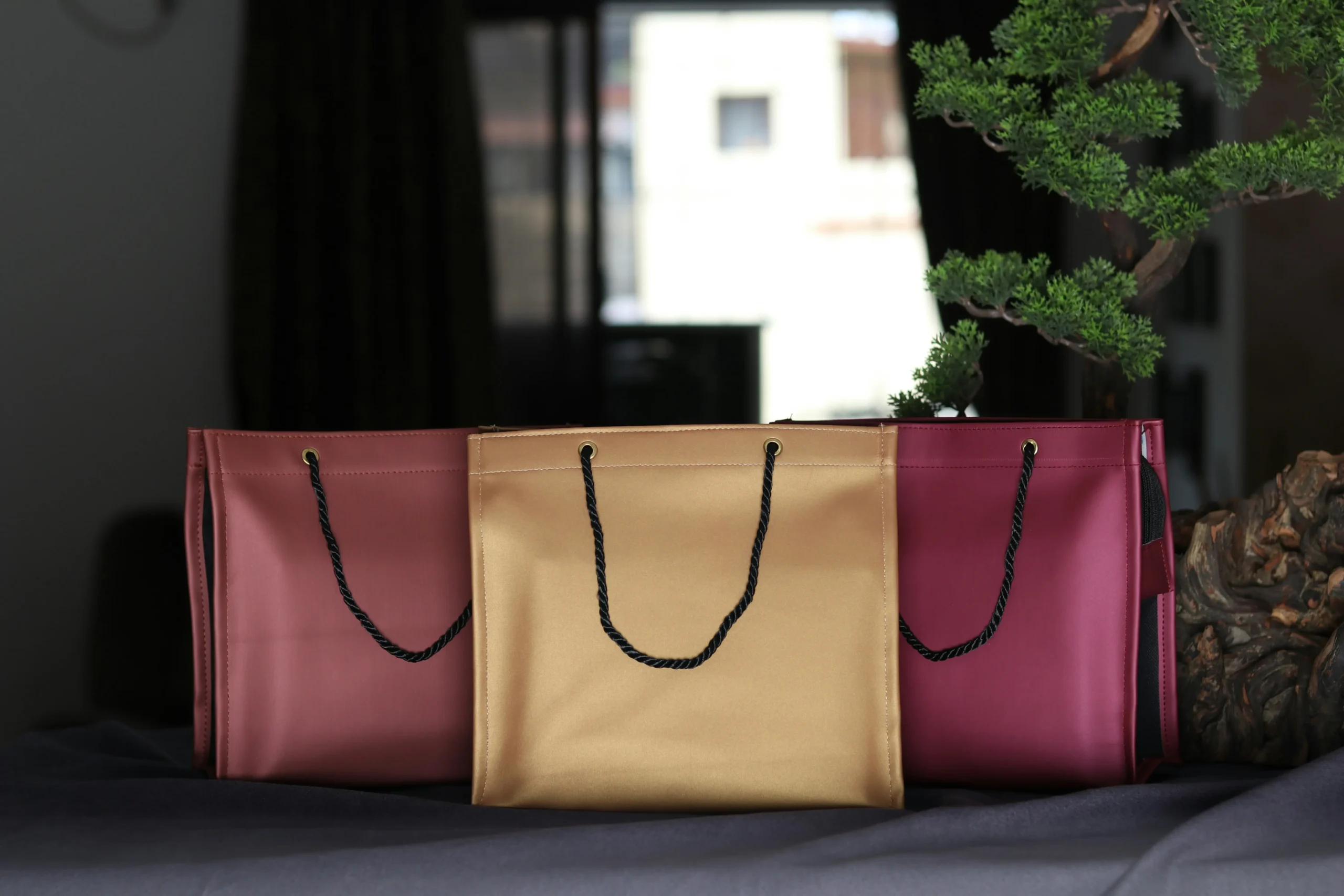
Material Selection Framework for Retail Brands
Oxford with PU backing is the highest-margin fit for brands demanding luxury feel with structural dependability.
The material-to-tier mismatch is the single most avoidable cost leak in custom tote programs. Luxury brands default to 16oz canvas because it “feels heavy,” but internal production data confirms 12oz canvas delivers 90% of the perceived quality at 20% lower unit cost and 30% less shipping weight. The real upgrade for the luxury tier is 600D oxford with a PU backing—it carries a 40–60% higher tear strength than standard canvas of comparable GSM, and at FOB $0.90–$1.50 per unit (1,000 pcs) it undercuts 16oz canvas by an average of 38%. The hand can be tuned with a matte PU finish to read as soft leather substitute, which is where the unboxing equity lives.
- Luxury tier (high-touch, low-frequency use): 600D oxford with PU backing is the material to beat. It preserves structure under load, won’t pill in a customer’s hand, and resists the “limp cheap bag” silhouette that kills premium perception. If sustainability is a board-level mandate, GOTS-certified organic canvas adds $0.50–$0.80/unit but enables shelf-ready eco-premium claims—calculate that against your avoided greenwashing risk.
- Lifestyle tier (frequent reuse, visible brand walking billboard): 12oz canvas is the rational ceiling. 16oz adds cost without proportional brand gain. The threat here is print degradation: a plastisol screenprint on 12oz canvas endures 20–30 machine washes before noticeable fading, while water-based inks start losing sharpness at 15–20 washes. If the bag is meant to circulate publicly for 18+ months, invest in proper curing, not extra fabric weight.
- Mass premium tier (medium volume, strict unit economics): 80g non-woven PP costs 60–80% less than canvas—FOB $0.30–$0.80 at 2,000 pcs—but the print cracking that sets in after 8–12 washes turns a $0.40 bag into a brand liability if customers keep reusing it. Reserve this material for giveaways with a defined short lifecycle or shift to woven PP for a structure that holds up to 25 lbs without delaminating.
- Wet/humid environments: Skip uncoated canvas—water retention induces uneven dye fading and accelerates seam rot. Oxford with PU backing or a laminated PP variant is the only spec that stays dimensionally stable.
- Project-based corporate gifting with hard deadlines: Factory-direct canvas sourcing bypasses the 25–40% markup embedded in US reseller models, but sample lead times vary. If the order window is under 4 weeks, confirm that the supplier holds greige stock and can execute digital heat transfer without screen setup delays.
- Brands running multi-year loyalty programs: Overweight 16oz canvas is a margin leak that doesn’t improve retention. Reallocate that $0.50–$0.80 per unit into upgraded print curing or recycled content certification—consumers remember a crisp logo, not a slightly thicker weave.
Seasonal planning changes the priority chain. In Q4 holiday retail or pop-up activations, speed-to-market and color accuracy dominate—600D oxford accepts heat transfer and screen print with less wicking than uncoated canvas, hitting tight turnover windows. Summer outdoor events reward oxford again because the PU layer resists moisture absorption that waterlogs canvas and distorts the bag shape after a few beach runs. When the use-case shifts to farmers’ market grocery hauls or gym backpacks, the load capacity threshold becomes non-negotiable: 12oz canvas handles ~25 lbs of sustained weight, oxford with PU can push past that without seam tearing, and 80g non-woven PP fails structurally beyond 10 lbs over repeated cycles. If the bag must fold flat for retail shelf storage, oxford’s thinner profile is an operational win that 16oz canvas cannot match.
| Brand Tier & Use Case | Optimal Material Choice | Key Performance Metrics | Aesthetic & Print Longevity | Cost & Sourcing Advantage |
|---|---|---|---|---|
| Luxury (Flagship Bags, High-End Retail, Gift with Purchase) | 16oz GOTS-Certified Organic Canvas or Oxford 600D with PU Backing | Load: ~35 lbs; Tear Strength: Oxford +40-60% vs standard canvas; Superior structure retention | Embroidery-ready; Plastisol print 20-30 washes; Rich, textured hand feel; Eco-premium shelf visibility | Canvas FOB $2.30-$3.00/unit (500 pcs); Oxford $0.90-$1.50/unit (1,000 pcs); Factory-direct eliminates 25-40% reseller markup |
| Premium Lifestyle (Mid-Tier Fashion, Specialty Retail, Branded Merchandise) | 12oz Conventional Canvas or Oxford 600D | Load: ~25 lbs (canvas), higher with Oxford; 90% perceived quality of 16oz at 20% lower cost; 30% lighter shipping weight | Screen print 15-25 washes; Water-based inks degrade gracefully; Oxford provides premium look at mid-tier cost | Canvas FOB $1.50-$2.00/unit (500 pcs); Oxford $0.90-$1.50/unit (1,000 pcs); Lower MOQ flexibility for sample runs |
| Mass Premium & Seasonal (High-Volume Giveaways, Event Swag, Short-Term Promotions) | 80g Non-Woven PP or Woven PP (if load needed) | Load: <10 lbs for lasting use; Woven PP holds shape better; Ultra-lightweight, foldable | Heat transfer/screen print; Visible degradation after 8-12 washes; Adequate for single- or few-use branding | FOB $0.30-$0.80/unit (2,000 pcs); 60-80% cheaper than canvas; Ideal for maximum brand impressions per dollar |
| Eco-Conscious & Purpose-Driven Brands (Sustainability-Centric Retail) | GRS-Certified rPET Non-Woven PP or GOTS Organic Canvas | Recyclable PP (#5) or biodegradable organic canvas; Meets ESG mandates; Same strength as conventional counterparts | Eco water-based inks; Slightly faster fade but aligns with natural aesthetic; GOTS certification boosts brand story | Organic canvas adds $0.50-$0.80/unit; rPET competitive with virgin PP; Factory-direct ensures authenticity of certifications |
Заключение
Material choice directly shapes how a customer experiences the brand after the purchase. Oxford with a PU backing holds up under loads that crack standard canvas seams, while 12oz canvas gives you 90% of the luxury feel at a tangible cost and freight advantage. Sourcing direct from the factory removes the 25–40% reseller markup that quietly eats into margins on every unit.
Review the factory’s test reports for tear strength and wash fastness before locking in a spec. Compare bulk canvas pricing directly against oxford samples to see where your per-unit landed cost actually falls.
Часто задаваемые вопросы
What is the real difference between woven PP and non-woven PP tote bags?
Woven PP is made by interlacing polypropylene tapes into a visible grid; non-woven PP bonds fibers directly into a fabric-like sheet. Woven handles heavy loads much better, while non-woven suits lightweight. Choose woven for moving bags or any job over 20 lbs.
How many times can I wash a screen-printed canvas tote before the print fades?
With properly cured plastisol ink on 12oz canvas, expect 15–20 cold wash cycles before noticeable fading. Hot water and strong detergents sharply cut that number. Confirm the factory’s curing spec and wash-test video before bulk production.
Is oxford fabric more expensive than canvas for custom bags?
Oxford is typically 30–40% cheaper than canvas at the same weight and order volume when sourced factory-direct. PU backing or special coatings can reduce the gap. Request a like-for-like weight and backing comparison quote.
Which material is best for a fully recyclable tote bag?
100% woven or non-woven PP without lamination is your best bet, because #5 plastic is accepted in most curbside programs. Any coating or mixed-material trim usually blocks that stream. Verify local recycling rules and skip laminated films entirely.
What is the typical MOQ for custom canvas tote bags at a factory?
Most factories quote 500–1,000 units as the MOQ for standard 12oz canvas totes with simple one-color screen printing. Adding embroidery or multi-color prints often pushes the minimum higher. Ask about stock-blank programs if you need under 300 units.



0 комментариев