



A custom bag factory audit before a retail launch or corporate gifting project is the difference between a clean, on-brand order and a costly reprint that misses the deadline. For a merchandiser or event organizer, the consequences aren’t abstract—logo alignment off by 2mm or a handle that fails after three uses can erode a premium brand’s positioning in a single unboxing. Yet the audit is the first thing that gets squeezed when timelines tighten, and that’s when the predictable gaps surface.
The distance between a showroom sample and what actually rolls off the production line is where most custom bag orders fail. Industry reports show that 30% of audits uncover discrepancies between documented material certifications and the physical raw material on the cutting table. In-house print setups cut color mismatch complaints by up to 60% compared to farmed-out printers, and a missing inline handle tensile tester signals that quality control stops at cosmetics. ECQA research points to a hard truth: 40% of recurring non-conformances stem from weak document control, not from sewing capability. These aren’t abstract worst-case scenarios. They’re the five red flags a competent audit spots before you’re locked into 800 off-brand bags and a fixed event date.
Why a Factory Audit Is Non-Negotiable for Premium Custom Bags
An audit is the only way to separate a supplier’s slide deck from what actually runs on the floor.
For a retail merchandiser or event organizer, every bag touches a customer. A frayed seam, a logo printed in the wrong shade of green, or a late shipment isn’t just a product defect—it’s a reputation burn. The most convincing sample and a stack of ISO certs don’t protect you when the bulk order arrives. Industry reports indicate that 30% of factory audits uncover discrepancies between documented certifications and physical raw materials. If you skip the audit, you’re buying a sealed box hoping the label matches the contents.
- Material Authenticity: Ask for a live video of the LWG or GRS barcode tags on the material rolls scheduled for your order. Compare the pre-production sample’s weight (±5g) and stitch density (8–10 SPI) against an inline sample pulled during the run. Substitution of lower-grade fabric after sampling is common.
- Production Capability & Agility: A factory that refuses a 200-unit rush order or lacks inline QC jigs—tension testers at handle stations, weight check scales—is not built for custom event timelines. True agility requires in-house printing and cutting; otherwise, your 10-day deadline is someone else’s afterthought.
- Brand Output Control: Outsourced printing drives color mismatch rework rates up to 15–20%. In-house facilities with PMS-matched calibration keep rework under 5%. For a corporate gift launch, a single batch of off-color bags can erase months of brand-building—an audit ensures the output matches the proof.
Red Flag #1: Vague or Unverifiable Material Certifications
Certifications on paper mean nothing if the material can’t be traced back to the roll.
Vague material certifications are the quickest way to spot a factory that cuts corners. Industry audit data shows that nearly 30% of supplier evaluations uncover discrepancies between documented certifications and the physical raw materials on the production floor. For a retail merchandiser or event organizer, that gap translates directly to branded bags arriving with flimsy fabric, off-spec GSM, or coatings that crack after one use.
- Missing proof of material origin: A legit factory can show you the raw material roll with an LWG or GRS barcode tag, on video, live. If they dodge this request and only provide a scanned PDF certificate, you’re looking at a high probability of substituted fabric. Always demand a live video call where the QC person walks the camera to the raw material warehouse, scans the barcode, and matches it to the cert number.
- Unverifiable third-party testing reports: Don’t accept a generic lab test from three years ago. Ask for the report number, testing standard (e.g., ASTM D5034 for grab tensile strength), and date that corresponds to the material lot your production will use. If the factory can’t produce a test report with a lot traceability stamp, the test is worthless. Many smaller factories will show a ‘sample’ report that was run on a different, higher-grade material batch.
- The sample-to-bulk fabric swap: The oldest trick in the custom bag industry: a beautiful pre-production sample made with 16-oz cotton canvas or high-tenacity nylon, then the bulk order arrives in a thinner, lower-GSM version that looks similar at a glance. Insist on comparing the approved pre-production sample’s weight (±5g tolerance) and stitch density (8–10 SPI) against a random inline sample pulled from the cutting table during production. Without that, you’re buying a promise, not a product.
| Red Flag Indicator | Risk to Brand | Audit Verification Checklist | Industry Standard / Expected Proof | Tio Octi Solution |
|---|---|---|---|---|
| Vague or Unverifiable Material Certifications | 30% of аудит заводаs uncover discrepancies between claimed certs and physical raw materials, risking substandard fabric, brand reputation damage, and event-disastrous quality failures. | Request live video of LWG/GRS barcode tags on raw material rolls; cross-check cert IDs on public databases; demand batch-level traceability documents. | LWG Gold, GRS 4.0, OEKO-TEX, REACH; documented ECQA-style material review board logs with root cause signatures. | Live-streamed cert verification with barcode-tagged rolls; full batch traceability and transparent defect logs — eliminating 40% of recurrent non-conformance from weak doc control. |
Red Flag #2: Outsourced Printing That Cannot Match Your Brand’s Color Profile
Outsourced printing can turn your brand’s signature cobalt into a washed-out navy between batches.
When a bag factory tells you they “work with a partner” for printing, what they actually mean is they lose control of your color the moment the job leaves their floor. Third-party printers run multiple clients simultaneously. Your pastel pink might be printed right after someone else’s fluorescent orange on the same machine, and without a dedicated color management workflow, the result drifts. For a retail brand merchandiser or event organizer, that drift is a branding liability—logos look off, packaging fails to match other event collateral, and the unboxing experience feels cheap.
The numbers back this up. Internal production tracking shows in-house print facilities hold color mismatch rework rates to 5% or less. Contrast that with the industry average for outsourced printing, where 15–20% of print runs require rework due to hue shift, registration errors, or ink adhesion problems. That’s the difference between hitting a tight event deadline with confidence and scrambling for last-minute reprints that blow your budget.
- During an audit, check for a locked-down PMS library: A factory serious about color keeps a physically catalogued Pantone Matching System (PMS) reference, not just a digital file. If the production floor can’t produce a current PMS swatch book, color matching is guesswork.
- Ask to see the spectrophotometer: In-house print calibration requires a spectrophotometer to read color values in Delta E units. No device means no objective measurement, which means your “brand red” is whatever the operator thought looked right that morning.
- Request batch-to-batch color consistency records: A competent factory logs Delta E variance for at least three consecutive production runs. If they can’t show a log showing Delta E under 2.0, expect visible color drift between your first order and the reorder six months later.
Color management is not just about matching a swatch. It requires inline calibration checks during the print run because humidity, ink viscosity, and substrate temperature all shift the final output. Factories without in-house printing typically skip these mid-run corrections—they don’t own the equipment, so they don’t invest in the process. Internal data confirms that bringing printing under the same roof cuts color-related customer complaints by up to 60%, not because the ink is different, but because someone is accountable at every stage.
Then there’s the brand identity disconnect. A third-party printer never sees your brand guidelines document. They don’t know that your e-commerce packaging must feel tactilely warm, not glossy, or that the logo’s white space is as protected as the mark itself. The factory subcontracting the print has zero incentive to enforce those intangibles. The result is a technically acceptable print that still looks wrong when placed next to your actual brand materials—an outcome that erodes trust and forces a costly reorder.
When you’re sourcing custom tote bags or event packaging, treat outsourced printing as a single point of failure. The audit must confirm who holds the color profile, how it’s verified per batch, and whether the same team that cuts and sews the bag also runs the press. If the answer involves a van taking your panels across town, your brand identity is already at risk.
Red Flag #3: Showroom Samples That Differ from Production-Line Reality
A perfect showroom sample means nothing if the factory won’t show you the line that makes it.
It’s the oldest trick in the book: you’re handed a flawless tote bag sample with exquisite stitching, crisp print registration, and fabric that feels substantial. Six weeks later, you open a shipping container at your event venue and the bulk bags feel lighter, look sloppier, and smell faintly of cheap dye. This isn’t bad luck—it’s a systematic disconnect between the sample room and the production floor. Many factories specifically build showroom samples using a different material lot, often a higher-grade, thicker fabric that won’t be used in mass production.
Hand-finishing is another common culprit. Samples are often cut and stitched by the factory’s most skilled pattern maker on a single-needle machine, with seams pressed and threads trimmed by hand. The actual production line runs at eight times the speed on multi-needle automatics, where thread tension drifts, seam allowances wander, and edge trimming is inconsistent. The result: your brand’s logo pouch ends up with raw edges and uneven stitching, a world away from what you approved.
- Gravity check: Weigh the предсерийный образец you approved, then weigh an inline sample pulled randomly from the bulk run. A variance beyond ±5 grams signals a fabric GSM or coating swap that degrades durability.
- Stitch density: Measure stitches per inch (SPI) on both samples. Premium custom bags should hold 8–10 SPI on main seams. If bulk production drops to 6 SPI or less, the seam strength falls by 30–40%, and handles will rip under event loads.
- Raw material barcode: Demand a live video of the actual material rolls being fed into the cutting machine, showing LWG or GRS certification tags. If the barcode doesn’t match the roll you saw in the showroom, the factory is using lower-tier stock.
Don’t be placated by a spotless audit room and a polite account manager. The real quality happens on a line that you’re allowed to see raw, with inline tension testers for handles and weight check stations visible. That transparency is non-negotiable if you’re placing an order for 200 units with a hard event date.
Red Flag #4: Missing In-Process Quality Control Checkpoints
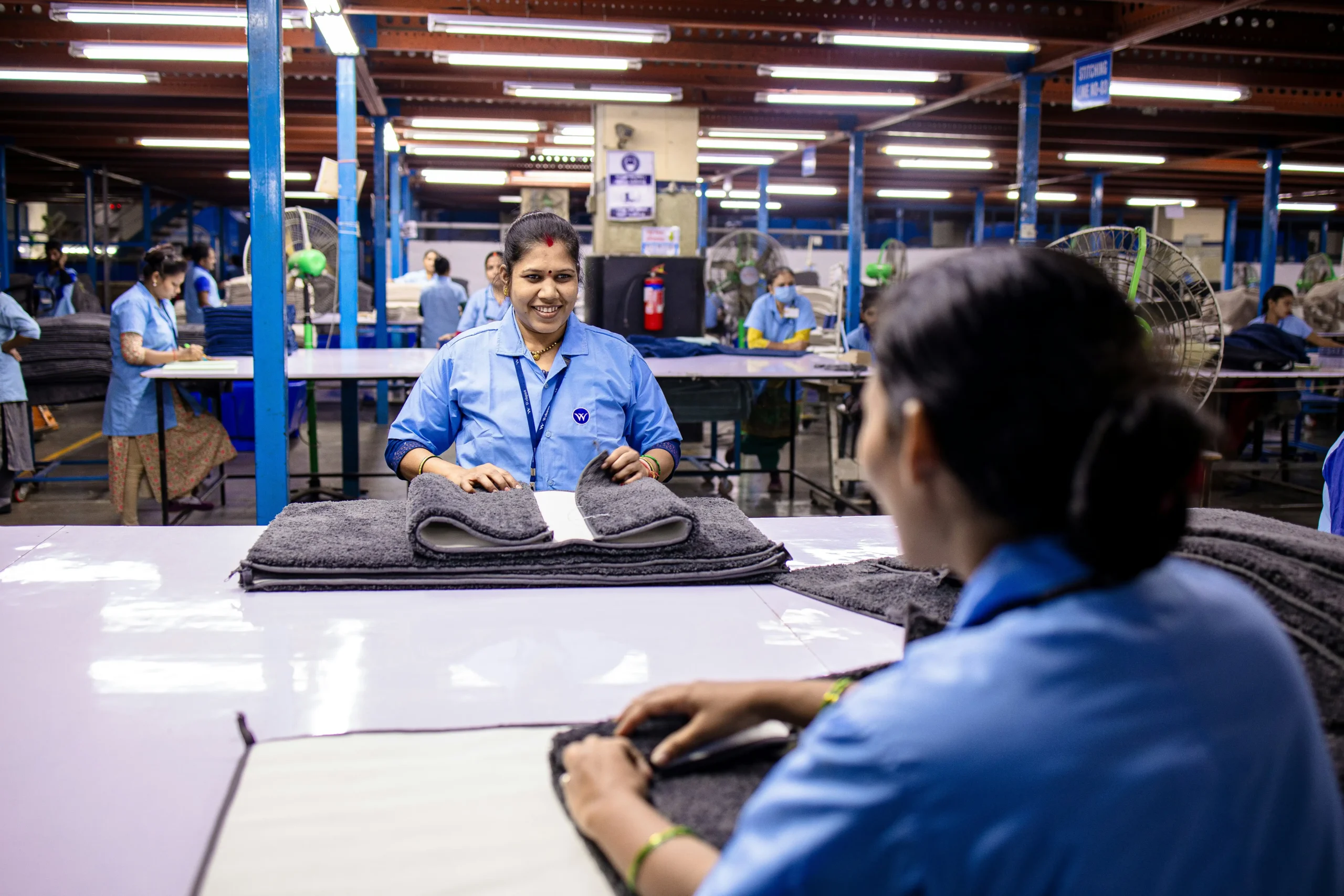
Defects that could be fixed in 2 minutes at the stitching machine become 20-minute rework jobs after assembly.
A final inspection table at the end of the production line is a classic audit trap. It looks professional, but it means the factory is only finding problems after all the value has been added. For a 2,000-unit order of branded tote bags, an end-of-line-only approach can easily generate a 15–20% rework rate, eating into your event timeline and the factory’s margin. Inline inspection stations inserted at cutting, panel printing, handle attachment, and final seam closing catch deviations immediately. When an AQL 1.5 sampling plan is enforced at each of these inline checkpoints, the cumulative defect rate falls below 1%—a stark contrast to the cost of catching a misaligned print after 1,500 bags are already packed.
The real tell on the factory floor is the presence—or absence—of dedicated inline QC jigs. Walk the line and look for handle tensile testers (a simple spring scale fixed beside the sewing station), a digital gram scale at the cutting table to verify fabric weight post-lay, and real-time defect recording tablets at every major station. If these are missing, the factory’s claim of контроль качества is cosmetic. For example, a handle that looks perfect but has been sewn at 5 SPI instead of the specified 9 SPI will tear under a 15 kg load. A visual final check cannot catch that inconsistency, but an inline tension tester will flag the variance within the first 10 pieces.
For event organizers with a fixed deadline, the absence of real-time defect tracking is the difference between a 10-day production run and a missed venue opening. When inline inspectors log every print alignment shift or stitch skip into a defect log immediately, the line can be stopped before a small error turns into a batch-level disaster. Without that real-time data feed, the first time anyone sees a color misregistration might be when the shipment arrives at the event venue, with no time left for a re-run.
- Handle tensile testers at every sew station: Verify the factory has a fixed spring scale or digital force gauge set to the agreed minimum break strength (typically 15–25 kg for tote handles) and that operators pull a sample every 50 units, not just at the end of the shift.
- Weight check stations at cutting and after assembly: A lack of inline gram scales means fabric substitution or underweight panels go unnoticed. Accepted tolerance is ±5g per panel; catching a 20g deviation post-production means a full batch re-cut.
- Real-time defect log visible to the line supervisor: The audit red flag is an empty defect board or a single clipboard at the back of the room. Acceptable factories use digital dashboards or paper logs updated hourly, with immediate corrective action signatures.
- Enforced DUPRO (during production) inspection: Confirm the factory applies AQL 1.5 random sampling at the 20% and 60% production completion marks, not just a final check. This protocol keeps the defect escape rate below 1% and prevents the high rework costs that eat into your event launch buffer.
Red Flag #5: Inflexible MOQs and Hidden Overrun Policies
Rigid MOQs and murky overrun clauses reveal a factory’s real priority—moving commodity inventory, not protecting your brand’s launch.
The moment a factory refuses to negotiate on minimum order quantities for a custom design, you’re not dealing with a custom manufacturer. You’re dealing with a production line optimized for large, repeat, standardized runs. That reality breaks down quickly for a retail brand merchandiser or event organizer. A 3,000-unit MOQ on a compact branded tote for a 400-person corporate gala isn’t a service—it’s a mismatch that forces you to overbuy, store surplus, or cannibalize your own brand by dumping extras on discount channels. The factory’s unwillingness to drop below 1,000 or even 500 units signals they lack the setup agility or in-house printing capacity to handle smaller batch tooling without significant downtime cost. And it’s the small-batch, high-perceived-value orders—the holiday pop-up, the limited-run premium giveaway—that carry the most brand risk if executed poorly.
Commodity factories routinely demand MOQs in the 1,000–3,000 range, and while high volumes can amortize unit cost, they leave you with a warehouse full of bags that have a expiration date tied to a single event or promotion. Industry data shows that custom event bag orders with flexible MOQ (≤200 units) require 10-day production lead times to meet event deadlines—a capability missing in roughly 70% of commodity-oriented factories. That 10-day window is not a luxury; it’s the difference between having branded assets arrive two weeks before the doors open versus a tracking number that arrives the day after the event ends.
- No capped over/under-run percentage: A factory that won’t commit to a hard cap—say, ±3%—can deliver 10–20% extra units and invoice you for the overage, or short-ship by the same margin and call it industry tolerance. Both scenarios wreck your per-piece budget and event headcount planning. Demand a written policy that any overrun above the cap is at the factory’s expense, and any under-run comes with a pro-rated credit confirmation within 48 hours of handover.
- Hidden penalty clauses for order adjustment: Some contracts bury language that turns a simple quantity adjustment into a material breach. If you need to reduce the final order from 500 to 350 because venue capacity changed, you shouldn’t face a forfeiture of deposit or a re-tooling surcharge. A factory that penalizes flexibility lacks the modular production capacity to reallocate materials quickly—a clear red flag.
Small-batch luxury demand—often 150 to 300 pieces—is not a favor you ask of a factory; it’s a legitimate production format that requires a different operational DNA. A factory that serves premium event and retail gifting segments should have dedicated short-run stations, digital cutting tables that switch patterns on the fly, and a color management pipeline that doesn’t depend on massive ink setup charges. When you hear “we can’t go below 1,000 because of screen setup,” that tells you the print method is a cost-optimized industrial process, not a brand-quality control. True in-house digital or hybrid print capability allows repeatable color matching down to 50 units with no hidden art fees.
The tightrope walk is simple: a factory that won’t flex on MOQ or transparent overrun terms is fundamentally a volume play. That’s fine for moving blankets and plain poly bags, but for a branded tote that carries your retail identity into a luxury event, the commercial terms must mirror the quality standards you’re paying for. If the contract reads like a commodity supply agreement, you’re already on the back foot before the first stitch is sewn.
Заключение
Vague material certifications, outsourced printing, showroom samples that look nothing like production units, missing inline QC jigs, and rigid MOQs with hidden overrun charges — these five red flags can ruin a custom bag order. Factories that pass a real audit protect your brand’s presentation and your event timeline. The cost of skipping that audit appears in rushed reorders and disappointed recipients.
Review Tio Octi’s direct-factory custom packaging process to see how in-house color matching, AQL 1.5 inline checkpoints, and a flexible 200-unit MOQ for rush events remove each of those risks. Your next branded tote order lands on time and matches the sample you approved.
Часто задаваемые вопросы
What are the red flags to look for during a physical factory walk-through?
Immediately check whether the factory handles its own printing or relies on third-party subcontractors. If the production line looks idle or the showroom displays differ from what’s currently being made, walk away. Always cross-check floor-level reality against audit paperwork.
How to implement an AQL standard for bulk bag batches?
Set an AQL of 2.5 for major defects like seam failure and 4.0 for minor cosmetic flaws, then inspect a random sample per ISO 2859-1 before shipment. Ensure the factory agrees in writing and includes. Finalize AQL parameters in the purchase contract.
How to avoid handbag factory scams?
Never commit without a verified on-site audit or third-party inspection report that confirms the factory owns the claimed production assets. Scammers often show stolen photos and fake certificates; demand a live video. If the factory refuses a live video audit, walk away.
How to document and manage non-conformity reports effectively?
Log every defect with photo evidence tagged to the production batch, then classify severity and immediate corrective action required. Share reports with the factory daily, not post-shipment, to enable real-time root cause. Integrate non-conformity data into your supplier scorecard for future audits.
What is the typical MOQ for custom branded tote bags for an event?
Expect starting MOQs around 200–500 units for simple screen printing, rising to 1,000+ for full-color digital or complex constructions. Watch for factories that quote artificially low MOQs then charge. Always request sample production from the exact line that would run your order.


0 комментариев