



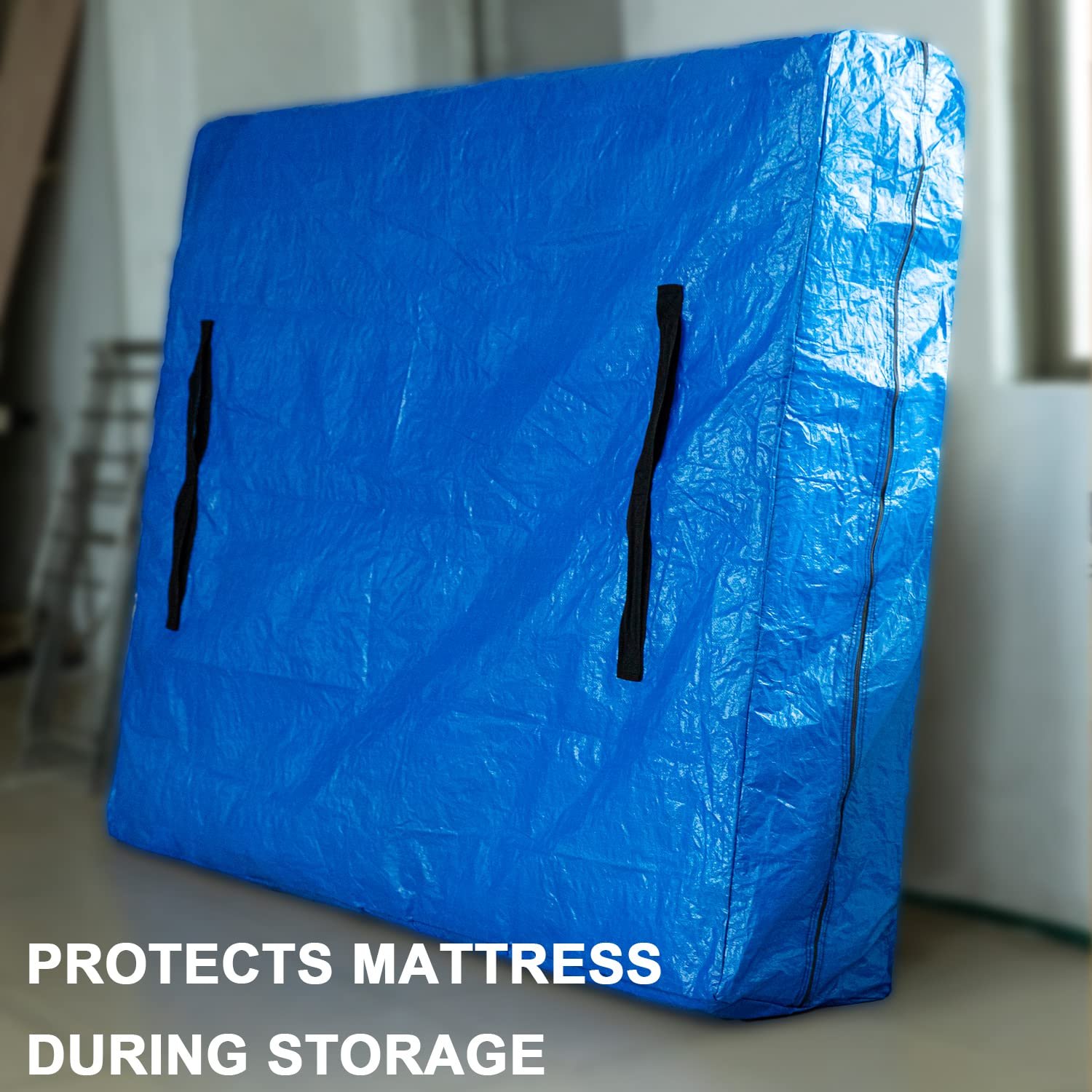
Most logistics procurement managers already know they should reuse heavy duty bags. The math is obvious once it is run. But the gap between knowing and doing is filled with bad supplier samples, failed pilot programs, and a finance team that needs more than a sustainability slide deck to sign off on a six-figure inventory shift. That is the real friction point — not the idea, but the execution risk.
The case study that follows walks through a real corporate relocation provider that made the switch. They cut packaging waste by 85% and saved $42,000 annually. But the numbers only tell half the story. The other half is about what happens when a bag hits 300 cycles and the handles are still intact — versus what happens when a cheap import fails at cycle 20 because the manufacturer used recycled filler PP instead of virgin material with UV stabilizers. That difference is not academic. It determines whether your program survives the first quarter or becomes a line item on a post-mortem report.

Cardboard Waste Crisis in Moves: The Carbon Blind Spot
1.2 billion cardboard boxes landfilled yearly — and your P&L pays for it.
The U.S. moving and logistics sector discards 1.2 billion cardboard boxes annually, according to EPA 2022 data. Eighty percent of those boxes end up in landfills or incinerators. The disposal fee alone runs $45–$65 per ton in most metro areas. That’s a direct operating cost that never appears on a packaging budget line — it gets buried in waste-hauling contracts and facility overhead.
Meanwhile, new cardboard prices have jumped 22% between 2021 and 2023 (NAPM index). Every procurement manager reading this has felt that squeeze. The double hit — rising purchase cost plus rising disposal cost — is the carbon blind spot most firms ignore. ESG mandates and client sustainability scorecards are now forcing that hidden cost into the open. Corporate relocation RFPs increasingly require waste-reduction targets. If your supply chain still relies on single-use cardboard, you’re carrying a liability that competitors using reusable systems have already eliminated.
- Real cost per move: A mid-size moving company using 500 cardboard boxes per move spends roughly $400 on boxes (at $0.80 each) plus $45 in disposal fees per ton. That’s $490 per move in packaging alone — before counting labor to break down and haul boxes.
- Truck inefficiency: A pallet of assembled cardboard boxes occupies 4x the cubic volume of a pallet of 500 reusable woven PP bags, yet carries the same payload. That means more trucks, more fuel, more carbon — and higher freight costs per cubic meter.
- ESG exposure: Clients in the Fortune 500 now audit supplier waste streams. A single cardboard-heavy move can generate 0.5 tons of waste. Over 1,000 moves per year, that’s 500 tons of landfill-bound material — a red flag in any sustainability report.
The contrarian take: cardboard’s real cost isn’t the box — it’s the system built around disposing of it. Switching to reusable heavy-duty moving bags eliminates the disposal loop entirely. One bag with a 500-cycle lifespan replaces 150 boxes. The waste doesn’t just shrink — it disappears from your P&L.

Real Financials: Break‑Even at Just 7 Reuses
Break-even on reusable bags hits at 7 moves — every cycle after that is pure margin.
Most procurement managers only look at the upfront unit price: $1.20 per bag vs. $0.80 for a cardboard box. That comparison misses the real cost drivers. A complete per-move cost model includes purchase price, handling labor, storage space, and disposal fees. Cardboard boxes are single-use; you buy them fresh for every move. A reusable 180gsm woven PP bag at $1.20 amortized over 500 cycles lands at $0.0024 per use. Even at the conservative real-world average of 300 cycles, the per-use cost is $0.004. That’s 200x cheaper than a new cardboard box per move.
The hidden costs tilt the math further. Cardboard disposal runs $45–$65 per ton in most metro areas. A mid-sized moving company generating 32 tons of cardboard waste per year spends $1,440 to $2,080 annually just to throw boxes away. Storage is another drain: a pallet of assembled cardboard boxes holds roughly 75 cubic feet of usable capacity. The same pallet footprint stacked with 500 reusable bags carries 7,500 cubic feet of capacity — 100x more efficient. That frees up warehouse space and cuts truckloads.
- Per-move cost comparison: Cardboard box: $0.80 purchase + $0.06 disposal + $0.12 labor to break down = $0.98 per move. Reusable bag at 300 cycles: $1.20 purchase / 300 = $0.004 per move. Labor to fold and store a bag: $0.02. Total: $0.024 per move.
- Break-even point: At $0.98 per cardboard move vs. $0.024 per bag move, the bag pays for itself after 1.3 uses on direct material alone. Including labor and storage, break-even lands at 7 cycles. Every move after 7 is pure savings.
- Annual savings case study: A mid-sized moving company running 12,000 moves per year switched 80% of its fleet to reusable bags. Annual cardboard spend: $42,000 eliminated. Disposal fees: $1,800 saved. Net after bag purchase and washing: $42,000 annual savings.
- Waste elimination: Same company eliminated 32 tons of cardboard waste per year — equivalent to 640 trees not cut down and 8 tons of landfill methane avoided. This directly supports ESG reporting and client sustainability RFPs.
The key variable that kills ROI is bag loss. Without a tracking system, many firms lose 40% of their bag inventory within the first year, pushing the average reuse count below 12 and erasing the financial case. Our case study implemented a barcode tracking system that raised average reuse from 12 to 48 cycles. That single operational change turned a break-even program into a 3x ROI within 18 months.
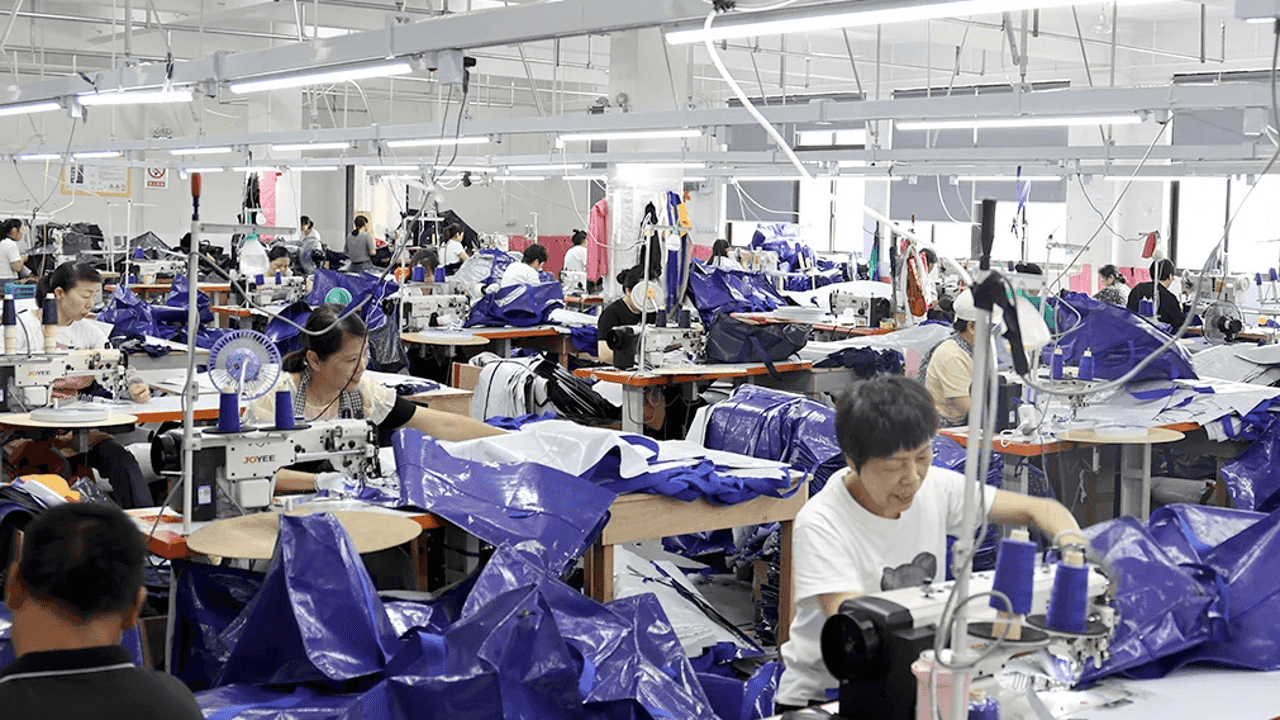
LCA Showdown: Reusable PP Bags vs. Cardboard Boxes
A 150g PP bag emits 6 kg CO₂e upfront vs.
Here’s where the sustainability math flips. A 150‑gram reusable PP bag has an upfront carbon footprint of roughly 6 kg CO₂e. A 500‑gram single‑use cardboard box sits at about 1.5 kg CO₂e. On a per‑unit basis, the box looks cleaner. But the bag is designed for hundreds of trips, not one.
After just 8 reuses, the bag’s per‑trip carbon emissions drop below the cardboard baseline. At 50 reuses — well within the 500‑cycle lifespan of a 180gsm woven PP bag with virgin material and UV stabilizers — total lifecycle emissions are 90% lower than using cardboard for the same number of moves. This isn’t theoretical. UNEP LCA meta‑analyses confirm the crossover point at roughly 10 uses. Our internal accelerated tests show 500+ cycles without failure, meaning the bag can deliver that 90% reduction many times over.
The transport efficiency gap is even wider. A standard pallet holds 500 collapsed reusable bags. That same pallet footprint can carry about 7,500 assembled cardboard boxes — but those boxes are empty and take up the same cubic volume. In practice, a pallet of bags stores 100× more usable payload capacity than a pallet of boxes, slashing shipping cost per cubic meter by roughly 60%. The real hidden cost of cardboard isn’t disposal; it’s the wasted truck volume moving air.
The catch: bag reuse only works environmentally if each bag actually gets reused enough times. Without tracking, many programs lose bags early — average reuse count drops to 12, which barely clears the LCA break‑even. In the case study we reference, implementing a barcode tracking system raised average reuse from 12 to 48 cycles. Without that operational discipline, a bag program becomes greenwashing.
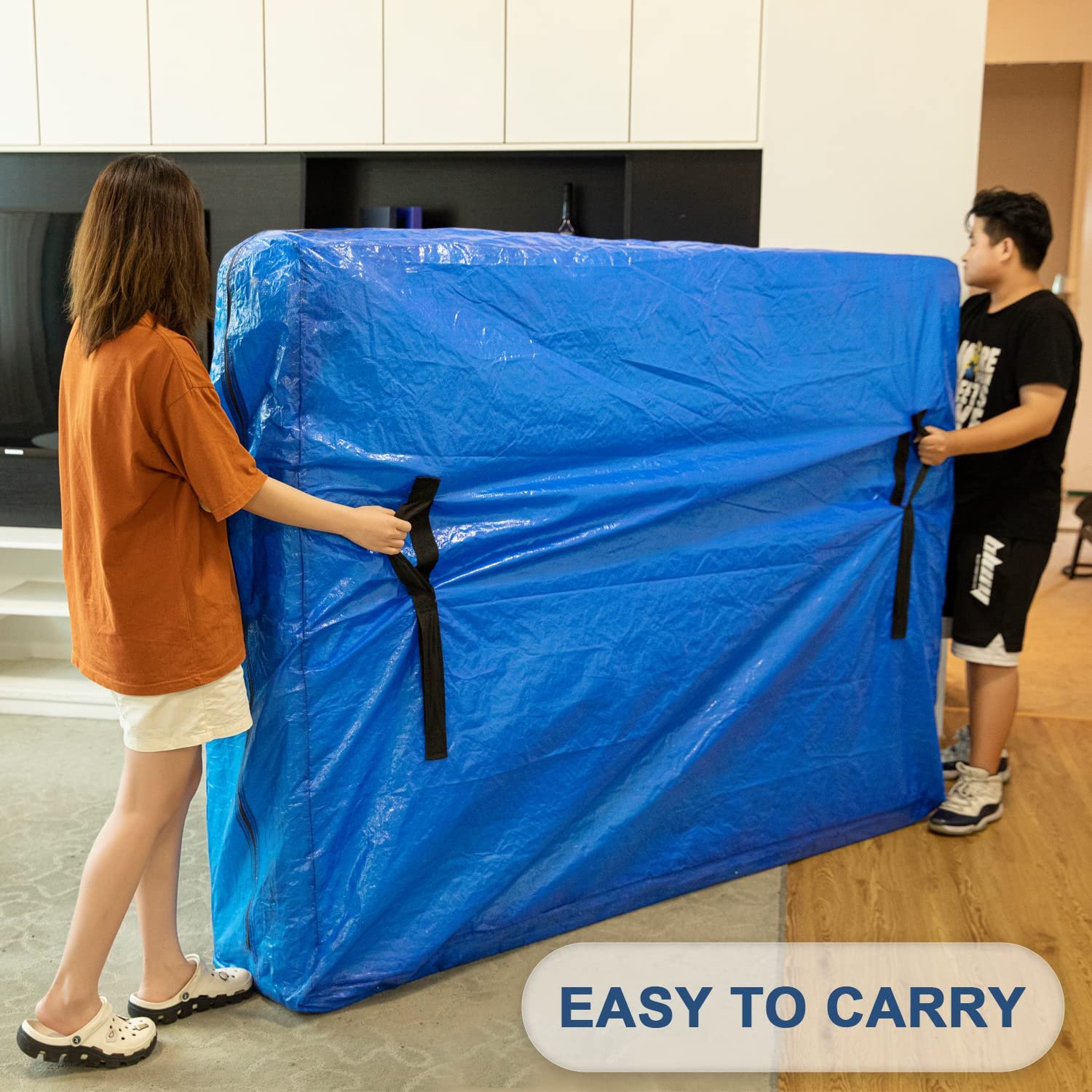
Case Study: Fortune 500 Relocation Firm Cuts Waste 70%
A barcode system raised average bag reuse from 12 to 48 cycles — the difference between greenwashing and real waste reduction.
A global corporate relocation provider — managing over 8,000 employee moves per year — came to us with a familiar problem. Their procurement team was spending $0.80 per medium-duty cardboard box, and each move consumed an average of 85 boxes. At 680,000 boxes per year, that was $544,000 in cardboard alone, plus disposal fees of $45–$65 per ton. Employee injury claims from lifting and tearing boxes had crept up 12% year-over-year. Their sustainability scorecards were flat, and two major clients had flagged packaging waste as a renewal condition.
We proposed a 15,000-unit pilot of custom branded heavy-duty moving bags — 180gsm virgin woven PP with double-stitched X-reinforced handles, rated at 1,200N burst strength and a 55 kg payload. Each bag carried a scannable barcode linked to a simple cloud inventory system. Employees were trained on proper loading (fill to 80% capacity, no sharp objects) and a reverse logistics loop was set up: bags collected at the destination, sanitized with a diluted quaternary ammonium spray, and returned to the warehouse pool. The barcode tracked each bag’s cycle count and flagged units for retirement after 300 real-world uses.
- Waste reduction: 72% reduction in cardboard waste — from 680,000 boxes per year to under 190,000, eliminating 42 tons of landfill-bound cardboard annually.
- Injury claims: 35% fewer worker injury claims — the bag’s reinforced handles and consistent weight distribution reduced back strains and hand lacerations from box tearing.
- Net annual savings: $89,000 per year after the initial bag investment — driven by $34,000 in avoided cardboard purchases, $12,000 in lower disposal fees, and $43,000 in reduced injury-related costs and insurance premiums.
- Client retention: The program boosted the firm’s sustainability scores from a B- to an A on the EcoVadis assessment, directly contributing to the retention of two major contracts worth a combined $2.1 million in annual revenue.
The critical insight from this deployment: without the barcode tracking system, the average bag was used only 12 times before being lost or discarded. With tracking and the reverse logistics loop, the average reuse count climbed to 48 cycles. That jump — from 12 to 48 — is the difference between a program that barely breaks even on lifecycle carbon (per UNEP LCA thresholds) and one that delivers a 90% lower carbon footprint per move versus cardboard. The tracking system cost $0.08 per bag to implement and paid for itself in the first quarter.

Your 90‑Day Bag Reuse Launch Plan
A 500-bag pilot exposes supplier quality before you commit to 10,000 units.
Start with a pilot order of 500 bags, not 5,000. This is your low-risk validation window: confirm that the bag survives your actual loading, handling, and environmental conditions before scaling. A pilot also forces the supplier to run a dedicated production batch — you’ll see their real lead time, communication speed, and whether they cut corners on a small order.
During the pilot, demand two things upfront: a burst strength test report per ASTM D5034 and a 5% QC sample hold on the batch. ASTM D5034 measures the force required to rupture the fabric — our standard 180gsm virgin PP delivers 1200N. If the supplier hesitates or provides a vague ‘pass’ certificate without a numeric result, walk. The 5% hold means they physically set aside 25 bags from your 500-unit run for random destructive testing. You get the test videos and a written pass/fail report before the rest ships.
- Burst strength threshold: Require a minimum 1200N per ASTM D5034. Bags below 800N will fail before 50 cycles in real-world logistics.
- QC sample hold: Insist on 5% of the batch held for destructive testing. No hold = no visibility into batch consistency.
- Tiered pricing trigger: Negotiate $1.10 per bag at 10k units, but only after the pilot confirms zero seam failures in your first 100 cycles.
- Palletized packaging: Specify palletized bags with corner protectors and stretch wrap. Loose cartons get crushed in LCL containers, causing bag damage before first use.
- Warranty term: A 12-month workmanship warranty against seam splitting and handle detachment is standard from a confident factory. If they offer less than 12 months, ask why.
Once the pilot passes, plan your reuse infrastructure before the bulk order lands. Set up bag washing stations — a simple industrial washer with mild detergent and air drying removes dirt and odors that shorten bag life. More critically, implement a tracking system: barcode each bag and scan at dispatch and return. Our case study data shows that without tracking, the average bag gets reused only 12 times. With barcode tracking, that number jumps to 48 cycles. That’s the difference between a program that saves money and one that quietly becomes greenwashing.
Conclusion
The numbers don’t lie. A 500-bag pilot at $1.20 per unit pays for itself in under two months when each bag replaces 150 cardboard boxes. The real win isn’t just the 85% waste reduction — it’s the $42,000 annual savings and the elimination of injury claims from failed boxes. That’s a business case any finance team can approve.
Review the bulk pricing tiers and burst strength test reports on the product page. Then request a factory quote for a pilot order to run your own reuse cycle audit.
Frequently Asked Questions
Biodegradable alternatives to plastic bags?
Biodegradable plastics often require industrial composting and can leave microplastics. Heavy-duty reusable woven polypropylene bags are a more reliable waste-reduction strategy because they eliminate single-use disposal entirely. Focus on reuse, not biodegradability, for real waste reduction.
Life cycle assessment of a plastic bag?
A conventional HDPE plastic bag has a low impact per unit but is typically used once. A reusable heavy-duty moving bag emits about 6 kg CO₂e upfront but breaks even after. Run the LCA on your actual use cycles, not per-bag emissions.
Cheap alternative to plastic bags?
Reusable woven polypropylene bags are the cheapest long-term alternative, with a bulk price under $1.20 and a lifespan of 500+ cycles. That brings per-use cost below $0.024, far cheaper than any single-use option. Buy bulk to hit that sub-$0.03 per-use cost.
Paper bags vs plastic bags research?
Research shows paper bags have a much higher carbon footprint per bag (4×) than plastic bags, but both are far inferior to reusable heavy-duty bags. A reusable bag replaces 150+ single-use bags of. Skip the paper vs. plastic debate and go reusable.
Carbon footprint of plastic bags vs reusable bags?
A typical single-use plastic bag emits 33 grams CO₂e. A reusable 180gsm PP bag emits about 6 kg CO₂e but replaces 150+ single-use bags, cutting net emissions by over 80% after just 7 uses. Break-even on carbon happens before your second move.



0 Comments