
For retailers, selecting the correct moving bag size isn’t just about capacity—it affects storage efficiency, shipping costs, and inventory protection. Choosing between a 75L, 93L, or 125L bag can be confusing, leading to operational mistakes and wasted resources.
This size guide explains the ideal applications for each size, from clothing to bulky bedding. We also explore critical factors like weight capacity and custom options, helping you match the right solution to your specific products for better operational flow.

Decoding Liters & Gallons: Visual Sizing Chart
To convert between liters and gallons, use the standard formula: 1 gallon is equal to approximately 3.785 liters. For a quick conversion, you can divide the number of liters by 3.785 to get gallons, or multiply gallons by 3.785 to find the equivalent in liters.
For retailers and logistics managers, accurately converting between liters and gallons is essential for inventory management, product specifications, and international shipping. Misunderstanding these volumes can lead to labeling errors and incorrect capacity assessments. This guide provides the formulas, charts, and practical examples to make these conversions simple and accurate.
The Core Conversion Formula
At the heart of any volume conversion is a simple mathematical relationship. Whether you’re calculating batch sizes for production or verifying container capacity, these formulas ensure precision.
- ✅ Gallons to Liters: Multiply the gallon value by 3.785.
- ✅ Liters to Gallons: Divide the liter value by 3.785.
- 💡 Key Ratio: 1 US liquid gallon is equivalent to 3.785 liters.
Quick Reference Conversion Chart
For quick, on-the-fly estimates without a calculator, this chart covers common volumes found in both consumer retail and bulk logistics. It’s designed for easy reference when checking product labels or planning shipments.
| Gallons to Liters | Liters to Gallons | ||
|---|---|---|---|
| Gallons | Liters (Approx.) | Liters | Gallons (Approx.) |
| 1 | 3.78 | 1 | 0.26 |
| 2 | 7.57 | 5 | 1.32 |
| 5 | 18.92 | 10 | 2.64 |
| 10 | 37.85 | 20 | 5.28 |
| 25 | 94.63 | 30 | 7.93 |
| 50 | 189.27 | 50 | 13.21 |
Practical Conversion Examples
Understanding the formulas is one thing; applying them is another. Here’s how these conversions work in everyday business scenarios.
- Batch Production: If a product recipe requires 2 gallons of a liquid ingredient, you need 7.57 liters (2 x 3.785).
- Equipment Capacity: A fuel tank specified at 56.775 liters holds exactly 15 gallons (56.775 ÷ 3.785), a key detail for logistics planning.
- Retail Product Sizing: A 5-liter bulk container of cleaning solution is equivalent to 1.32 gallons (5 ÷ 3.785), which is important for creating clear, compliant product labels for different markets.
Key Considerations for Retailers
When dealing with inventory and customers, especially across borders, a few extra details can prevent confusion and build trust.
- ⚠️ US vs. Imperial Gallon: The conversions here use the US liquid gallon. The imperial gallon (used in the UK, Canada, and some Caribbean nations) is larger, at about 4.546 liters. Always confirm which standard applies to your target market.
- 💡 Quick Estimation Tip: For fast mental math, remember that one gallon is slightly less than 4 liters. This helps in quickly assessing if a container size feels right without needing a precise calculation.
- 🚀 Clear Product Labeling: For products sold in standard metric sizes (e.g., 5L, 10L, 20L), providing the gallon equivalent on the label is crucial for customer clarity. This applies to liquids and solids alike, as many storage solutions, like our heavy-duty bags, list capacity in liters (e.g., 90L) to provide a universal measure of volume.

Standard 75L: Best for Clothes & Books
A 75-liter storage solution is optimal for organizing bulk clothing, textiles, and documents. For professional use, key features include durable, waterproof materials like Woven PP, reinforced handles capable of holding 20-25 kg, and structural designs that allow for easy stacking and content identification.
| Aspect | Details for Retailers and Logistics Teams |
|---|---|
| 💡 Essential Features |
|
| 🚀 TIIOCTI Product Match | In our experience, matching the bag style to the inventory is critical for efficiency. We recommend these solutions:
|
| ✅ Benefits for Bulk Operations |
|

Extra Large 93L: The All-Rounder for Bedding
The Extra Large 93L moving bag is a specialized storage solution designed for bulky bedding items like quilts, comforters, and pillows. Its large capacity and sturdy construction make it ideal for moving companies and home retailers who need to transport or store large textiles efficiently and securely.
Defining the 93L Capacity: What It Holds
A 93-liter capacity provides significant volume tailored for large, soft goods. This size prevents the damage that comes from over-compressing textiles into smaller containers. It’s the perfect solution for organizing and protecting valuable inventory.
- ✅ Bulky Single Items: Easily fits a king-size quilt, multiple comforters, or several large pillows in a single bag.
- ✅ Seasonal Collections: Offers ample space to store entire seasonal bedding collections, keeping them clean and ready for the next use.
- ✅ Consolidated Sets: Allows retailers or movers to consolidate several smaller bedding sets into one manageable unit, simplifying transport and storage.
Key Structural Features for Commercial Use
For commercial use, a bag must withstand repeated handling and heavy loads. Our design incorporates features that ensure reliability in demanding environments like warehouses and moving trucks.
- ✅ Moisture & Tear Protection: Constructed from heavy-duty Woven PP with a waterproof PE coating, the bag protects contents from moisture, dust, and tearing during transit.
- ✅ Engineered for Heavy Loads: The handles feature reinforced, double-stitched webbing, confidently supporting loads of 20–25 kg without risk of failure.
- ✅ Space-Efficient Stacking: Its sturdy rectangular frame helps the bag hold its shape, making it easy to stack neatly on warehouse shelves or pack tightly in a moving truck.
Applications in Retail and Logistics
The 93L bag is a practical tool for businesses managing large textiles. Its size and durability solve common logistical challenges for retailers and service providers.
- 🚀 Moving Companies: Provide a professional and secure way to handle clients’ large bedding collections, protecting items from damage during a move.
- 🚀 Home Goods Retailers: Efficiently manage and protect backstock inventory, especially bulky seasonal items like comforters and decorative pillows.
- 🚀 Storage & Relocation Services: Offer a robust, reusable container for customers’ belongings or for managing corporate employee relocations.
Build Your Custom Fleet of Heavy-Duty Moving Bags
From reinforced handles that hold 25kg to full-color logo printing, we engineer durable, reusable bags to your exact specifications. See your design come to life with a free, professional digital mockup in just 12 hours.


Jumbo 125L: When You Need to Move a Mountain
Jumbo 125L containers are a high-capacity storage solution, holding approximately 44 gallons. They serve B2B needs by bridging the gap between standard boxes and large industrial bins. This offers substantial capacity while keeping the container manageable for handling and transport in logistics, storage, and commercial operations.
Key Specifications of 125L Containers
When evaluating a 125L container, the technical details determine its suitability for your inventory, equipment, or bulk materials. In our experience manufacturing heavy-duty storage, material quality and construction are what separate a reliable asset from a logistical problem.
- Capacity: 125 liters, which is equivalent to about 44 gallons.
- Typical Load Capacity: Reinforced models can securely support loads up to 205 pounds.
- Material Options: Common materials include flexible LLDPE plastic, rigid polyethylene for heavy-duty use, or durable fabric with internal metal frames for structure.
- Common Features: Most designs include heavy-duty zippers, reinforced handles for safe lifting, and are often designed to be stackable, nestable, or foldable.
- Price Range: Varies from approximately $32 for basic models to $184 for high-performance, specialized containers.
Common B2B Applications
The versatility of the 125L size makes it a workhorse across multiple sectors. It’s large enough to consolidate smaller shipments but small enough to avoid requiring specialized handling equipment.
- 🚚 Moving & Logistics: Used for transporting goods in bulk, functioning as a reusable and more durable alternative to cardboard moving boxes.
- 🛠️ Tool & Equipment Organization: Often seen in the form of portable plastic tool boxes with wheels, allowing trade professionals to transport entire toolsets to job sites.
- ♻️ Industrial & Hygiene: Serves as nestable bins for commercial waste management or for organizing and moving materials within a warehouse.
- 🍎 Food & Agriculture: Heavy-duty, food-grade polyethylene containers are essential for storing and transporting bulk produce, ingredients, or grain.
The Strategic Advantage of the 125L Size
Choosing the right container size directly impacts operational efficiency. The 125L format hits a strategic sweet spot for many businesses, balancing volume with practicality.
- 🚀 Maximum Portability: This size is engineered to hold a significant volume but remains manageable for a two-person team to handle, avoiding the need for forklifts.
- 💡 Space Optimization: Stackable and nestable designs help maximize valuable floor space in a warehouse or cargo area in a vehicle.
- ✅ Versatility: It fills a critical gap between smaller bins that require too many units and massive industrial-scale containers that are too cumbersome for many tasks.
- ✅ Cost-Efficiency: Foldable variants offer excellent space-saving storage when not in use. This reduces overhead for businesses with fluctuating inventory or seasonal demands.

Weight Limits: Why Bigger Isn’t Always Better
Quick Answer: A product’s weight limit is a crucial engineering specification, not just a suggestion. Exceeding this limit, even in a physically large bag, compromises its structural integrity. This can lead to material failure, handle breakage, and damage to the contents, proving that true capacity relies on material strength and construction, not just volume.
Understanding Material Stress and Structural Integrity
A moving bag’s physical volume and its engineered load capacity are two entirely different metrics. While a large bag can hold more items, its ability to carry them safely depends on how it manages stress. Every bag has critical failure points that absorb the most pressure.
Key stress points include handle seams, bottom corners, and zipper tracks. In our experience, these are the first areas to fail when a bag is overloaded. To prevent this, we use materials like woven polypropylene (PP) specifically for its high tear resistance and tensile strength. Features like reinforced webbing and double-stitching are not just for show; they distribute the load evenly across the bag’s structure, preventing localized tears and ensuring the product meets its specified weight limit.
The Hidden Risks of Overloading
Ignoring a bag’s stated weight capacity introduces serious and costly risks. Pushing a bag beyond its engineered limits leads to component failure, often at the worst possible moment. These failures aren’t just an inconvenience; they can damage the bag’s contents and create safety hazards.
- ⚠️ Sudden Handle Failure: This is the most common result of overloading. Reinforced handles can only withstand so much force before the stitching gives way, causing you to drop everything.
- ⚠️ Seam Bursting: Over-stressed threads along the seams will snap under pressure. The entire side or bottom of a bag can split open, spilling its contents during transport.
- ⚠️ Zipper Damage: Excessive internal pressure forces zipper teeth out of alignment or causes them to break completely, making the bag impossible to close securely.
- ⚠️ Reduced Reusability: Consistently overloading a bag causes micro-tears and permanently stretches the fabric. This invisible damage dramatically shortens its functional lifespan.
How Professional Bags Are Engineered for Specific Loads
A professional-grade moving bag’s weight rating is the result of careful engineering, material selection, and rigorous testing. Manufacturers match the right materials and construction techniques to a specific load capacity, ensuring reliability for commercial use.
This process involves several critical steps to guarantee performance and safety.
- ✅ Material Matching: We select materials like heavy-duty woven PP to build bags engineered for specific loads, such as a reliable 20-25 kg capacity for professional movers and retailers.
- ✅ Reinforced Construction: Features like double-stitched webbing for handles are core engineering components. They are designed to manage torque and tension, providing the strength needed to meet a high weight rating.
- ✅ Validated Performance: Reputable manufacturers submit their products for third-party testing. Certifications from bodies like SGS or Intertek validate that a bag meets its stated performance claims for load, durability, and safety.
Choosing a bag with a clearly defined and tested weight capacity protects the value of the items being stored or moved. It’s an investment in reliability.

Custom Sizes: Tailoring Bags to Your Products
Custom-sized bags are tailored precisely to your products. This involves measuring your item’s width, depth, and height, then adding specific allowances for a proper fit and secure closure. Bag thickness, measured in Mil, is also customized based on the weight and sharpness of the contents.
How to Calculate the Right Bag Dimensions
Ensuring your bags fit perfectly prevents product damage and material waste. A precise measurement is the first step. Use this simple formula to determine the right dimensions for your items.
- Calculate Bag Width: Measure your product’s width (left to right) and add its depth (front to back). Then, add an extra 1/2″ to 1″ to ensure an easy fit.
- Calculate Bag Length: Measure your product’s height (bottom to top) and add half of the depth. Finally, add an extra 3″ to 5″ of material. This provides enough overhang for a secure closure, whether you’re using a zipper, tie, or seal.
Choosing the Correct Bag Thickness (Mil)
The thickness of the bag material, measured in Mil (one-thousandth of an inch), is critical for protecting the contents. Choosing the right Mil thickness prevents punctures and tears, especially for heavy or irregularly shaped items.
| Thickness | Best For |
|---|---|
| 5 Mil Thickness | ✅ Ideal for hefty items or products with sharp corners that could puncture thinner materials. This includes construction supplies, heavy hardware, or bulk textiles. |
| 6 Mil Thickness | 🚀 Recommended for the heaviest, bulkiest, and sharpest items requiring maximum protection. This thickness offers superior resistance to tears and punctures during rough handling. |
Key Considerations for Custom Orders
When you’re ready to place a custom order, a few practical details will help streamline the process. As a manufacturer, we manage these elements to ensure your project runs smoothly from design to delivery.
- 💡 Consultation Services: We offer expert consultation to help you finalize dimensions and material specifications before production begins. This service ensures your final product meets your exact needs.
- Minimum Order Quantities (MOQs): MOQs for custom bags typically start between 2,500 and 5,000 units, depending on the complexity and features. We also offer promotional MOQs as low as 500 pieces for certain projects.
- Affordable Pricing: Customization is more accessible than you might think. For custom printed options, pricing can begin as low as $0.10 per bag, making branded packaging a cost-effective solution.

Frequently Asked Questions
How big is a moving bag?
A standard moving bag is typically around 29″ L x 15″ W x 13″ H. This size provides a capacity of about 20 gallons and is built to carry a weight limit of 60-65 pounds.
What size moving bag for clothes?
Medium to large moving bags, with capacities up to 70 liters, work well for folded clothes, coats, and bedding. For hanging clothes, wardrobe boxes are a better solution. To maximize space, vacuum storage bags can reduce the volume of bulky clothing by as much as 80%.
How many gallons is an IKEA bag?
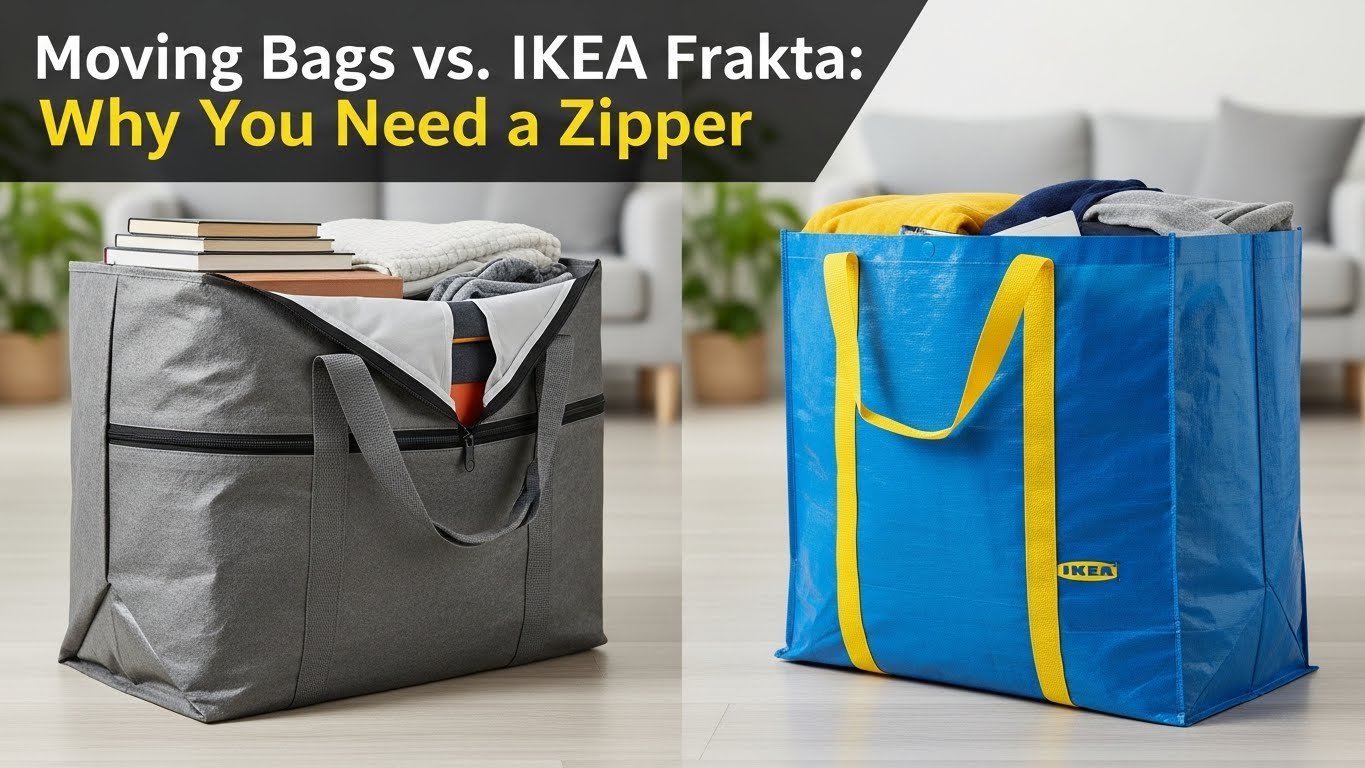
The popular large blue IKEA FRAKTA bag holds 19 gallons. The company offers other models as well, from the 13-gallon SPIKRAK to the 20-gallon FRAKTA storage bag made for carts.
What is the best size bag for comforters?
What is the weight limit for moving bags?
Most heavy-duty moving bags are designed with a weight limit between 60 and 65 pounds. This strength is achieved with durable woven polypropylene material and reinforced carry handles that prevent tearing under heavy loads.
Can you get custom size tote bags wholesale?
Yes, many suppliers provide custom size tote bags for wholesale orders. Minimum order quantities can be as low as 12 units. Bulk orders usually include significant discounts (up to 50-60%), and you can customize dimensions, handle sizes, materials, and printing.

Final Thoughts
Choosing the right moving bag involves more than just picking the largest size. It requires matching the volume—whether 75L for clothes or 125L for bulk items—to the specific contents while respecting engineered weight limits. Understanding that a bag’s true capacity comes from its material strength and construction prevents costly product damage and equipment failure. For unique inventory, custom sizing offers a tailored solution that optimizes protection and space.
This strategic approach to sizing directly improves operational efficiency. Selecting the correct bags reduces customer returns, streamlines warehouse logistics, and makes inventory planning more predictable. Equipping your team with properly specified storage solutions protects your assets and your bottom line. A reliable manufacturing partner can help you navigate these choices, ensuring you get a solution built for your specific needs.