



Ask any industrial distributor what kills margin on wholesale custom tote bags, and they’ll point to the gap between FOB price and actual landed cost. A quote that looks profitable at the factory gate can shrink by 5-8% once palletization, fumigation, and peak-season freight surcharges hit the invoice. Most distributors build their pricing off the FOB number alone — and spend the next six months wondering why gross margin per SKU keeps slipping.
The sharper play is factory-direct sourcing with real cost visibility. Moving from 500 to 1,000 units drops per-unit canvas cost from $2.70 to $1.75 on a standard 10oz bag. Stack that volume leverage against a 25% import duty from China versus 6.3% from Turkey, and the sourcing geography decision alone protects four to six points of gross margin that most distributors leave on the table. Combine standard and custom SKUs inside one shipment to hit higher volume tiers — a tactic fewer than one in five buyers actually negotiate — and the math shifts further in your favor before a single bag hits the warehouse.
Understanding Wholesale Custom Tote Bag Dynamics in 2026
Factory-direct removes 15-25% markup—but the real margin lives in material weight, print specs, and duty origin.
Most US-based tote bag suppliers don’t manufacture anything. They import from the same factories you can reach directly, then layer on a 15-25% markup to cover warehousing, financing, and sales overhead. When a 10 oz canvas bag costs $2.70 per unit at 500 pieces through a supplier, the factory-direct price on the same spec sits closer to $1.75 at 1,000 units. That’s a $0.95 per-unit margin recovery—$9,500 on a 10,000-bag year. The trade-off: you absorb QC, logistics, and cash flow. But if you already manage inventory turnover daily, that’s a fair swap for an instant 35% cost reduction on your top-selling SKU.
- Fabric Weight (oz/yd²): 10 oz canvas delivers load-bearing durability for retail packaging; 5-6 oz is acceptable for trade show swag but risks returns if sold as sacs réutilisables. Every ounce increase adds roughly $0.15-$0.25 per bag at volume.
- Order Quantity Tier: Moving from 500 to 1,000 units slashes per-unit canvas cost from $2.70 to $1.75—a 35% drop. The real savings compound when you combine multiple SKUs into one production run to hit higher volume tiers without overstocking a single design.
- Print Setup & Color Count: Screen setup fees range $30-$60 per color, amortized over the order. A 4-color design on a 500-bag run adds $0.24-$0.48 per bag in screen cost alone, plus $0.50-$1.50 per bag for ink and labor. That erodes margin fast if you don’t consolidate designs or run larger batches.
- Country of Origin & Duty: Cotton bags from Turkey fall under HTS 6305.33 with a 6.3-6.7% import duty. The same bag from China faces 25%+ duty. This differential can swing landed cost by $0.25-$0.50 per bag—erasing any advantage from a slightly lower FOB. Always calculate landed cost before comparing two quotes.
Printing cost is the quickest way to blow a budget if you treat it as an afterthought. Full-bleed, multi-color digital prints on heavy canvas require pre-treatment and slow the press, bumping labor. Single-color screen print on the same bag adds maybe $0.30 per unit; a four-color process digital can hit $2.50. Ask your factory for per-unit print quotes broken out by technique and color, not bundled. Insist on sample approvals from the production lot, not a digital mockup, to avoid costly re-runs that eat 5-8% in waste charges—charges that often hide in the freight line as ‘palletization and fumigation surcharges’ that add exactly 5-8% above FOB if not negotiated upfront.
MOQ Reality and Tactical Negotiation
Combining standard and custom SKUs in one shipment unlocks MOQ tiers that standalone custom runs cannot touch.
The MOQ number on a quote is an opening position, not a floor. Every major factory typically prices on production runs that pack multiple SKUs onto the same cutting table. The real determinant is total fabric consumed and total print screen setups, not how many different logos you print. For canvas tote bags, the industry standard entry point sits at 500 units per design with a single-color screen print. Move to RPET or laminated non-woven, and 1,000 units becomes common because the base material roll width and minimum order from the fabric mill drive the constraint.
- 10 oz cotton canvas (screen print): 500 units per design at $1.75–$2.70/unit FOB for 1,000 units. Scaling from 500 to 1,000 units alone drops unit cost from $2.70 to $1.75.
- RPET non-woven (custom): 1,000 units minimum per SKU. RPET base rolls often have a factory MOQ of 800–1,200 meters, which translates to ~1,000 bags. Combining a blank run with a custom print run can lower the apparent minimum.
- Heavy-duty moving bags (industrial PE/canvas): 1,000–5,000 units depending on lamination and handle reinforcement. Distributors targeting contractors often start at 2,000 to amortize custom label patches and reinforced seam testing.
- Multi-color or full-wrap digital print: MOQ jumps to 1,000–2,000 units because the print machine setup and color calibration waste eats a larger share of small runs. Bundling 3–4 designs that share the same base bag color can bring the effective MOQ per SKU down to 300.
- Aggregate base material runs: Ask the factory if they can run 400 custom bags alongside 400 blank bags of identical fabric weight and color. Most cut-and-sew lines don’t differentiate until the printing stage. This halves the risk of being stuck with overstocked custom inventory.
- Negotiate sample allocation against the order: A 2% free sample quota on a 1,000-unit order saves $500–$2,000 annually in marketing costs. Some factories will credit the cost of pre-production samples toward the bulk deposit, which avoids paying double for the same production setup.
- Amortize setup fees over a 12-month forecast: Screen setup costs $30–$60 per color. Instead of asking for a lower MOQ upfront, commit to three reorders of 500 units each. Many suppliers will spread the setup fee across all three runs or waive it on the first repeat, turning a $120 setup into $40 per shipment.
- Go blank first on specialty materials: RPET and laminated bags carry mill-level MOQs. Order 1,000 blanks, then screen print locally in 100-unit batches for different end-customers. You bypass the factory’s custom MOQ entirely and keep inventory flexible.
- Co-op marketing offset: Direct factory partnerships often include co-op marketing funds if negotiated during the PO. A 1% rebate on a $20,000 order gives you $200 back—enough to cover a second round of sample giveaways to your own clients.
A narrow focus on per-SKU MOQ is how distributors bleed margin. The single most overlooked tactic is SKU aggregation: ordering 300 units of a natural canvas tote with a 1-color logo and 200 units of the same bag blank, all on a single production order. The factory sees 500 total units, you hit the volume tier, and the blank units can be printed locally or sold as is. This alone can shrink per-unit cost by 20–25% versus running two separate small orders.
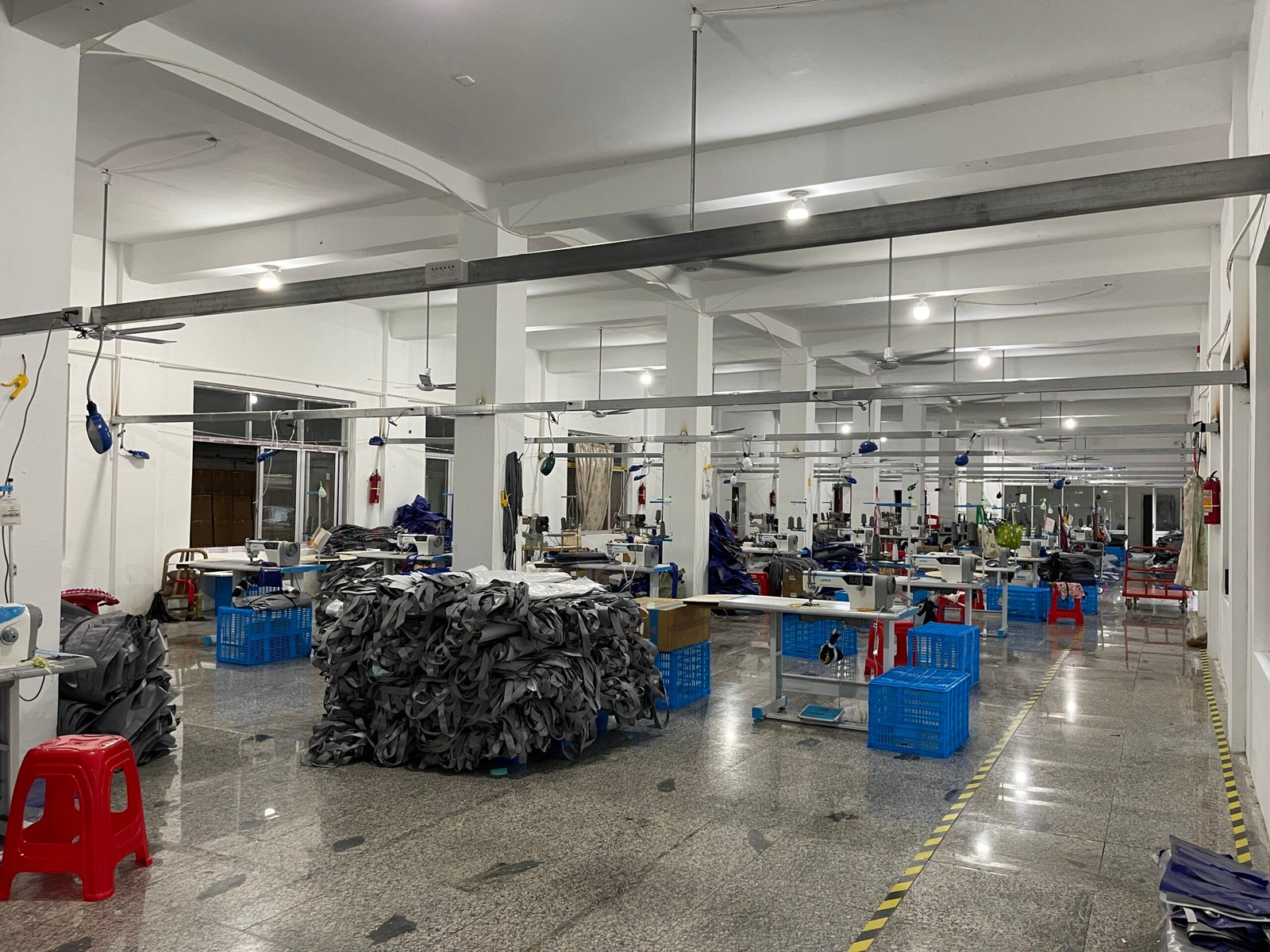
Shrewd industrial distributors also use MOQ as a filter for supplier seriousness. If a factory insists on 2,000 units for a 10 oz natural canvas bag with a single-color print while three competitors quote 500, you are likely dealing with a trading company that layers its own margin onto the real factory’s MOQ. Always request photo evidence of the production floor with your bag design in progress—an intermediate step that roots out brokers and ensures your MOQ negotiation is with the entity actually cutting the fabric.
FOB Price Construction and Hidden Costs
FOB is a starting point — landed cost is what hits your P&L.
A factory-quoted FOB unit price splits into three buckets: raw material, direct labor, and print application. Material eats 55-65% of the cost. On a 10 oz cotton canvas tote bag at 1,000 units, the fabric alone runs roughly $1.10-$1.50 per bag. The remaining third covers cut-and-sew labor, gusset construction, handle attachment, and the printing method you select.
- Material grade: 10 oz cotton canvas lands around $1.75-$2.70 FOB at 1,000 units. Drop to 6 oz and you shave $0.40-$0.60 per bag. RPET (recycled PET) runs 10-15% higher than equivalent-weight cotton due to yarn premiums.
- Print method: Screen printing adds $0.30-$0.80 per bag per color, with a $30-$60 setup fee per screen. That setup cost amortizes fast — at 1,000 units, it adds just $0.03-$0.06 per bag. Full-color digital print jumps to $1.50-$2.50 per bag, but eliminates screen fees entirely for small runs.
- Volume threshold: Scaling from 500 to 1,000 units drops per-unit canvas cost from $2.70 to $1.75. The factory switches from smaller fabric rolls to full-width production cutting, reducing material waste by 8-12%.
- Ocean freight (per bag): At 5,000 units on a consolidated container from Turkey to the US East Coast, freight runs $0.15-$0.30 per bag. Smaller shipments under 1,000 units can push that to $0.60-$0.90 per bag in LCL (less-than-container-load) pricing.
- Duties by origin: Cotton tote bags from Turkey (HTS 6305.33) carry a 6.3-6.7% duty. The same bag from China faces a 25% tariff under Section 301. On a $2.00 FOB bag, that’s the difference between $0.13 and $0.50 in duty alone. Country of origin is not a minor detail — it’s a margin decision.
- Palletization and fumigation: Wood pallets require ISPM 15 heat treatment or fumigation certificates. Miss this and your shipment sits at port accumulating demurrage at $75-$150 per day. Even when done correctly, palletization adds $0.08-$0.15 per bag and fumigation certificates add a fixed $150-$300 per container.
- Peak season surcharges: From August through October, ocean carriers impose peak season surcharges (PSS) of $300-$600 per container. General rate increases (GRI) hit without warning. These two variables alone can swing total landed cost by 5-8% compared to a March shipment of the same order.
Labor is the least flexible lever. In most producer countries, cut-and-sew wages are already priced near the floor. The real savings come from material procurement and volume-tier negotiations. A distributor who understands that material weight dictates 60% of FOB cost stops asking for a ‘cheaper bag’ and starts asking for the right fabric spec for the end-use application.
FOB pricing creates a dangerous blind spot. A $2.00 FOB bag looks profitable until you add international freight, customs duties, port handling, drayage, and warehouse receiving. The gap between FOB and delivered cost routinely runs 12-18%, but distributors who price off FOB alone set themselves up for a 5-8% margin erosion they never saw coming.
Warehousing is the final margin leak most distributors overlook. A pallet of tote bags arriving at your 3PL requires receiving labor, putaway, and pick-pack labor for outbound orders. If your warehouse charges $4.50 per inbound pallet and $0.35 per unit picked, a 5,000-bag order tacks on $1,750+ in handling before you sell a single unit. Build these costs into your SKU-level pricing or watch your gross margin shrink by 3-4 points.
The distributors who consistently land 40-50% gross margins on tote bags do one thing differently: they request a landed-cost breakdown from their supplier before signing a purchase order. They compare the factory’s FOB quote against two origin countries, they model freight at both LCL and FCL volumes, and they negotiate co-op marketing funds or free sample quotas to offset the soft costs that never appear on a commercial invoice.
| Facteur de coût | FOB Estimate (1,000 Units) | Hidden Cost / Surcharge | Impact sur les marges | Distributor Action |
|---|---|---|---|---|
| Base Canvas Material (10 oz Cotton, 1,000 Units) | $1.75–$2.70 / Unit | Volume threshold penalty: scaling from 500 to 1,000 units drops cost 35% ($2.70 → $1.75). Under-ordering can leave 15–25% margin on the table. | FOB price inflates margin risk if MOQ is missed | Aggregate standard + custom SKUs to hit 1,000-unit tier; avoid split runs. |
| Printing & Customization (1‑Color Screen Print) | $0.30–$2.50 / Unit | Screen setup fee $30–$60 per color (amortized over order). Design changes post‑approval add rework surcharges. | Unplanned print costs erode 2–5% gross margin | Finalize artwork before PO; negotiate free setup for repeat orders. |
| Ocean Freight (FCL, Turkey → US East Coast, 5,000 Units) | $0.15–$0.30 / Unit (added to FOB for landed cost) | Peak season surcharge (5–8% above FOB), plus palletization and fumigation ($0.05–$0.10/unit). Often excluded from initial quote. | Landed cost can swell 5–8% unexpectedly | Insist on all‑in FOB palletized quote; book off‑peak if possible. |
| Import Duties (HS 6305.33) | Turkey: 6.3–6.7%; China: 25%+ | Misclassification risks retroactive duties; antidumping scope on Chinese cotton bags. | Duty variance alone can swing final margin by 10–18% | Source cotton bags from Turkey; request factory pre‑classification support. |
| Warehousing & Last‑Mile Delivery | Adds 12–18% on top of landed cost | Often omitted from FOB‑only calculator; storage fees, port handling, and inland trucking accumulate. | True final margin is 5–8% thinner than FOB‑based estimates | Build full landed‑cost model (FOB + freight + duty + 15% logistics) before pricing resale. |
| Co‑op Marketing & Sample Support (Not a Cost, a Margin Leak Opportunity) | Not applicable | Lost savings: free sample quotas ($500–$2,000/yr) and co‑op funds are often unclaimed. | Equivalent to 0.5–2% net margin uplift if utilized | Negotiate annual sample allowance and market‑development funds in supplier contract. |

Margin Protection and Profit Maximization
Negotiating FOB while ignoring landed cost is how margins evaporate.
Pricing for resale starts with your true landed unit cost, not the FOB quote. Factory-direct sourcing already gives a 15–25% cost advantage over US-based middlemen. But if you price off a $2.20 FOB for a 10 oz canvas bag and later discover palletization, fumigation, and peak season surcharges add 8%, plus a 25% China duty rate, your real per-unit cost jumps to $3.42. The distributor who sets a 2.5x multiplier on that $2.20 is earning far less than they think. Always build your margin model on landed cost—specifically, the total divided by units delivered to your dock.
Volume tiering is the next lever. The price of 10 oz canvas drops from $2.70 at 500 units to $1.75 at 1,000 units. An underused tactic is combining multiple SKUs—standard blank bags with custom printed ones—in the same shipment to hit the higher volume tier while keeping MOQ per design low. This can cut unit cost by 30–40% versus small separate orders. Even if you resell blanks at a lower margin, the overall blended cost of goods drops enough to lift blended gross profit.
- Comparing FOB quotes without origin-adjusted duty: Turkey’s 6.3–6.7% duty versus China’s 25%+ means a $2.00 China FOB bag lands near $2.75, while a $2.20 Turkey FOB bag lands around $2.45. Chasing the lowest FOB without origin mapping destroys margin.
- Ignoring free sample and co-op marketing negotiations: Distributors who negotiate free sample quotas save $500–$2,000 annually in marketing support. That directly boosts net profit without touching per-unit prices. Not asking is the same as leaving a 1–3% margin bonus unclaimed.
- Ordering without a seasonal freight buffer: Ocean freight per bag at 5,000 units runs $0.15–$0.30 in normal lanes, but peak surcharges can lift that 50%+. Lock your landed cost in forward contracts or use buffer stock ordered during slack seasons to avoid invisible margin erosion.
- Skipping pre-production sample quality checks: Returns and chargebacks from inconsistent fabric weight or print registration eat into net margin faster than any per-unit cost variance. A $100 sample batch can prevent a $5,000 restocking write-off on a 2,000-unit order.
Screen setup fees are not sunk costs—they’re amortized over the run. At $30–$60 per color, they inflate unit cost on small orders but become negligible at volume. If a customer wants a low-run custom bag, price the setup into the quote as a separate line item so your margin on the bag itself stays clean. And when you sell to contractor or retailer accounts, use the ready argument that consistent supply and no stockouts justify a premium that protects their own businesses. That’s how you hold a 35–45% gross margin even when raw material prices fluctuate.
Conclusion
The margin in a tote bag deal doesn’t sit in the FOB quote — it sits in SKU bundling that cracks higher volume tiers, a landed cost model that catches the 5-8% hidden in palletization and peak surcharges, and free sample quotas that save $500 to $2,000 a year in sales support. Skip any one, and the per-unit advantage on paper evaporates on the warehouse floor.
Compare your current per-unit cost against factory-direct pricing by material and print method. The pricing tables break down MOQ tiers so you can model exactly where your margin improves.
Questions fréquemment posées
What is the typical MOQ for wholesale custom tote bags?
Typical MOQ for custom printed tote bags is 200–1,000 units per design. You can lower the per-design MOQ by ordering blank bags and printing locally, combining SKUs to reach production minimums. Always confirm MOQ per SKU before committing to artwork.
How much do custom tote bags cost in bulk?
For 1,000 units of 10oz canvas, expect $1.75–$2.70 FOB per bag, with printing and ocean freight adding $0.45–$2.65 depending on complexity and destination. Print complexity drives the biggest cost swing. Budget duty and drayage separately to protect your margin.
Can I order custom tote bags without a logo?
Yes, blank wholesale tote bags are widely available without a logo. Adding branding later through a local screenprinter avoids custom MOQ constraints and lets you order stock units as needed. Confirm fabric print compatibility with your local shop first.
What is the difference between FOB and landed cost?
FOB covers the bag cost at the factory gate; landed cost adds international freight, insurance, customs duties, and port handling. A $2.00 FOB bag can land at $2.50–$2.80, directly squeezing your margin. Always calculate landed cost before comparing supplier quotes.
How do I choose the right fabric for wholesale tote bags?
Match fabric weight to end use: 5-6 oz cotton for swag, 10-12 oz canvas for retail packaging, RPET for eco brands. Heavier fabric prevents seam tears but increases freight, so. Request a fabric swatch set to check hand feel and print adhesion.

0 commentaires