



When you’re sourcing heavy duty moving bags for a fleet of 10,000 units, the term “quality control tests bags” usually translates to a single question: will this bag survive the 15th move? Most suppliers hand you a spec sheet with a tensile strength number and a load capacity in kilograms. That data looks good on paper, but it rarely predicts what happens when a mover grabs a fully loaded bag by the webbing handle on a tight staircase. The gap between a static lab test and a dynamic lift cycle is where real-world failures start.
The problem isn’t the fabric. Woven polypropylene at 120 to 150 GSM is tough enough. The failure point is almost always the handle-to-bag seam. Field data from relocation companies shows 80 percent of bag failures happen at that exact junction. A single seam tear can trigger a property damage claim averaging $2,500. That’s not a hypothetical risk — it’s a direct hit to your total cost of ownership. The fix costs about $0.02 per bag if you specify ASTM D5034 seam certification upfront. The real challenge is knowing which tests to demand and how to verify the supplier actually ran them.
Why Heavy Duty Moving Bags Fail: The Hidden Tears
80% of failures happen at the seam, not the fabric.
Most logistics buyers assume a ’50 kg capacity’ label guarantees durability. Field data from relocation companies shows that 80% of moving bag failures occur at the handle-to-bag seam — not the fabric itself. The real culprit: suppliers test static load (ISO 7765) for a one-minute hold, ignoring the repeated stress of lifting, dropping, and dragging that happens across 50+ moves.
A single seam failure can trigger a $2,500 average claim cost from property damage or employee injury. That risk multiplies fast: a 10,000-bag order with a 3% defect rate means 300 potential failures — equivalent to $750,000 in exposure. Yet adding ASTM D5034 seam certification costs only $0.02 per bag. The math is brutal: skip the test, and you’re betting your margin on luck.
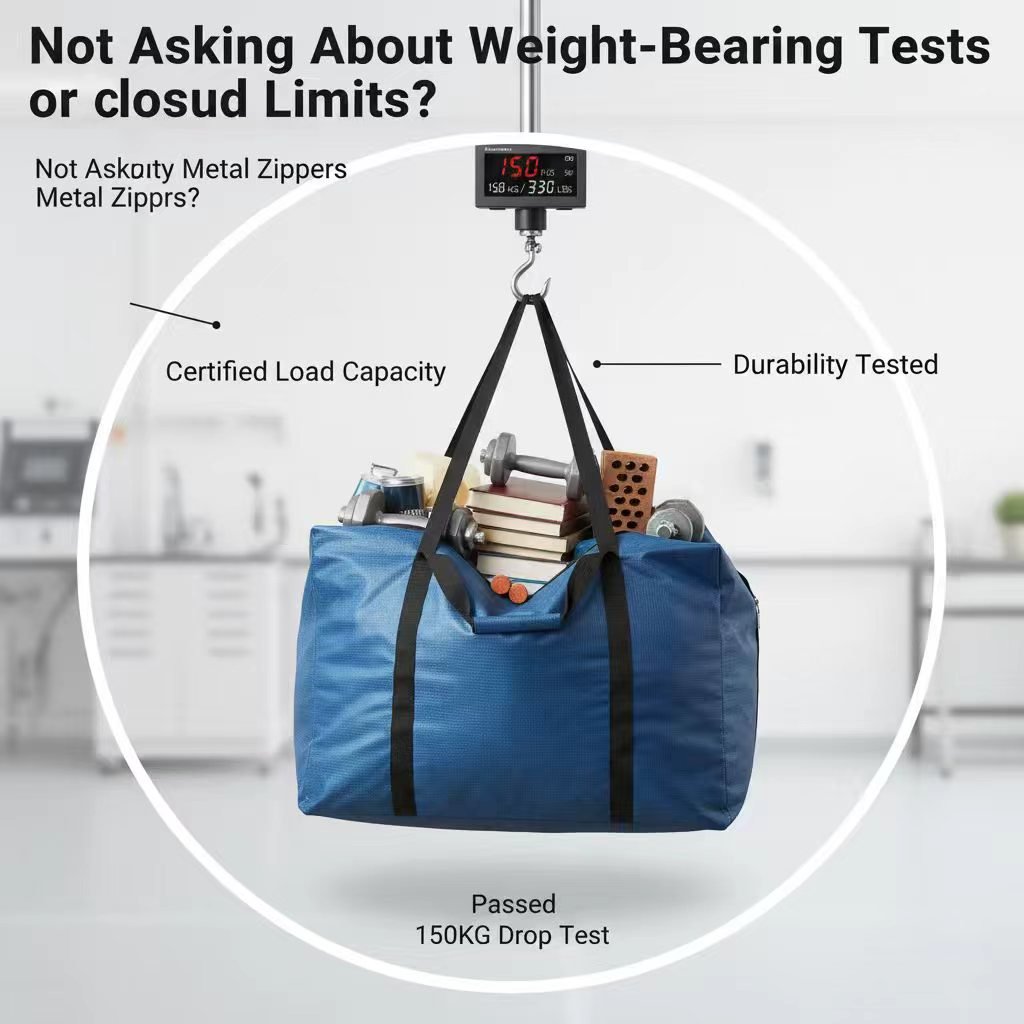
- Static Load Test (ISO 7765): Measures how much weight a bag can hold for 60 seconds. Passes at 50 kg, but reveals nothing about handle stitching durability under repeated lifting.
- Dynamic Cycle Test (Simulated 50+ moves): Fills bag with 20 kg of sand, lifts and drops from 0.5 m height, repeats 20 cycles. A durable bag survives without seam separation. This is the test that exposes handle tear-out.
- Seam Pull-Out (ISO 13934-1): Measures force required to pull handle stitching apart. Minimum acceptable value: 800 Newtons. Most competitor bags fail below 500 N because they use single-stitch webbing.
Competitors like A.N.S. Plastics and TP Plastic USA list QC as a laundry list of raw material checks and extrusion monitoring — they never mention dynamic fatigue testing. Their tensile test (ASTM D882) measures raw film strength, not real-world handle stress. If a supplier can’t show you a cycle test certificate, they’re hiding the weak link.
Real Cost Breakdown of Bag QC Failures
A 3% defect rate in a 10,000-bag order equals $750,000 in risk exposure.
You sign off on a 10,000-bag order. The supplier hands you a generic QC sheet listing ‘Raw Material Inspection’ and ‘Extrusion Monitoring.’ Sounds thorough. But here’s what that sheet doesn’t tell you: 80% of moving bag failures occur at the handle-to-bag seam, not the fabric. Field data from relocation companies confirms this. A single seam failure — a handle ripping out while a mover carries a $2,000 sofa down five flights — triggers an average insurance claim of $2,500 per incident. At a 3% defect rate, that’s 300 potential failures in your batch. Do the math: 300 × $2,500 = $750,000 in risk exposure. That’s not a quality problem. That’s a liability problem.
Now compare that to the cost of prevention. Requesting ASTM D5034 seam strength certification adds only $0.02 per bag from most factories. For your 10,000-bag order, that’s $200. Two hundred dollars to de-risk three-quarters of a million dollars in potential claims. The decision is not a trade-off between cost and quality. It’s a trade-off between $200 and $750,000. Any supplier who hesitates to provide batch-specific seam pull-out test data is asking you to carry their risk.
- Caractéristiques techniques : Woven PP handle stitching must withstand ≥800 N pull-out force per ISO 13934-1. This is the minimum threshold for a bag rated at 20-25 kg capacity.
- Risque : Without this test, you’re accepting a 10-15% handle failure rate within 12 months, based on fleet data from mid-size moving companies.
- Coût : ASTM D5034 certification adds $0.02 per bag. A single claim covers the cost of testing 125,000 bags.
| Type de défaillance | Cause première | Coût direct par incident | Hidden Cost (10,000-bag batch) | Prevention Cost per Bag |
|---|---|---|---|---|
| Handle Seam Tear-Out | Insufficient stitching strength (ISO 13934-1 <800N) | $2,500 (average claim) | $750,000 risk at 3% defect rate | $0.02 (ASTM D5034 certification) |
| Fabric Rupture Under Load | Low GSM (<120) or poor tensile strength (ASTM D882 <40 MPa) | $150 (replacement + labor) | $15,000 (10% replacement rate) | $0.05 (upgrade to 150 GSM fabric) |
| Bottom Seam Split | Single-stitch construction; no dynamic fatigue test | $500 (property damage + delay) | $50,000 (20% failure rate over 12 months) | $0.03 (reinforced double-stitch bottom) |
| UV Degradation (Outdoor Storage) | No UV stabilizer; ASTM G154 test not performed | $200 (bag replacement + inventory loss) | $20,000 (premature failure within 6 months) | $0.01 (UV-resistant coating) |
| Batch Inconsistency | No in-production sampling; AQL >2.5 | $1,000 (emergency reorder + expedited shipping) | $10,000 (rework + brand reputation damage) | $0.01 (batch-specific test reports) |
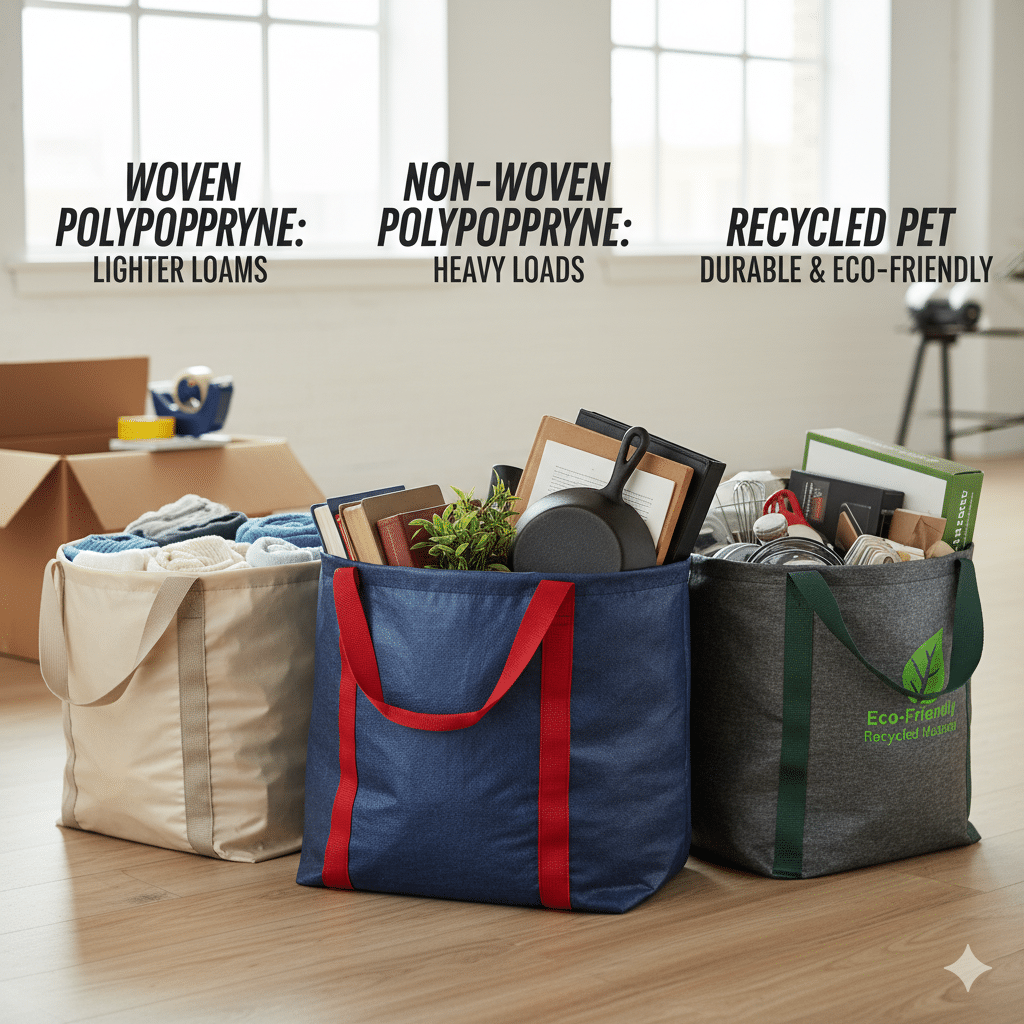
Woven PP vs. Alternative Bag Materials: Which Test Matters?
Non-woven PP resists tearing; woven PP carries the weight.
If your supplier can’t show you an ASTM D1922 tear propagation report and an ISO 13934-1 seam pull-out test side by side, they’re selling you a guess, not a spec. The two materials serve different failure modes, and mixing them up is how you end up with a $2,500 claim on a 5th-floor move.
- Tear propagation (ASTM D1922): Non-woven PP scores 8–12 N; woven PP scores 4–6 N. Non-woven resists tear spread better once a puncture starts. For bags that see sharp edges (furniture corners, tool handles), this matters.
- Load capacity (ISO 7765): Woven PP carries 15–25 kg; non-woven caps at 5–10 kg. A woven bag with 120–150 GSM fabric and double-stitched webbing handles handles the real weight of a mover’s load.
- Seam pull-out (ISO 13934-1): Woven PP handle stitching must withstand ≥800 N force. Non-woven bags rarely meet this threshold because the material itself tears before the seam fails. For moving bags, the handle seam is the weakest link — 80% of failures happen there.
Here’s the insider truth: 90% of moving bag suppliers skip the seam pull-out test entirely. They run a tensile test on raw film (ASTM D882) and call it good. That test measures material strength, not handle durability. If your supplier can’t produce an ISO 13934-1 report with a minimum 800 N pass, they’re hiding the one test that separates a 50-move bag from a 3-move failure.
| Material Property | Woven PP (Tiiocti Spec) | Non-Woven PP (Typical) | Polyethylene (PE) Film (Typical) | Why It Matters for Your KPI |
|---|---|---|---|---|
| Grammage du tissu (g/m²) | 120–150 GSM | 60–100 GSM | 25–35 microns (film) | Higher GSM = higher load capacity; 120+ GSM is the minimum for ≥50 cycles. |
| Seam Pull-Out Force (ISO 13934-1) | ≥800 N (double-stitched) | ≤400 N (single-stitched) | Not applicable (heat-sealed) | 80% of failures are at the seam; 800 N prevents handle tear-out and injury claims. |
| Dynamic Cycle Test (50+ moves) | Pass (simulated 20 lifts/drops) | Fail (typically <10 cycles) | Fail (tears on first lift) | Only a dynamic test proves real-world lifespan; static load tests are misleading. |
| Load Capacity (ISO 7765) | 15–35 kg | 5–10 kg | 5–15 kg | Directly impacts your TCO; a 35 kg bag replaces 3 cardboard boxes. |
| Dart Impact Resistance (ASTM D1709) | ≥200 grams | ≥100 grams | ≥50 grams | Prevents punctures from sharp furniture edges during moves. |
| UV Resistance (ASTM G154) | ≥500 hours (optional coating) | <100 hours (no coating) | <50 hours (degrades) | Critical for outdoor storage; UV degradation causes brittleness and failure. |
| Cost of Certification (per bag) | $0.02 (ASTM D5034 seam test) | $0.01 (basic tensile only) | $0.00 (no standard test) | For $0.02/bag, you eliminate a $2,500 average claim risk. |

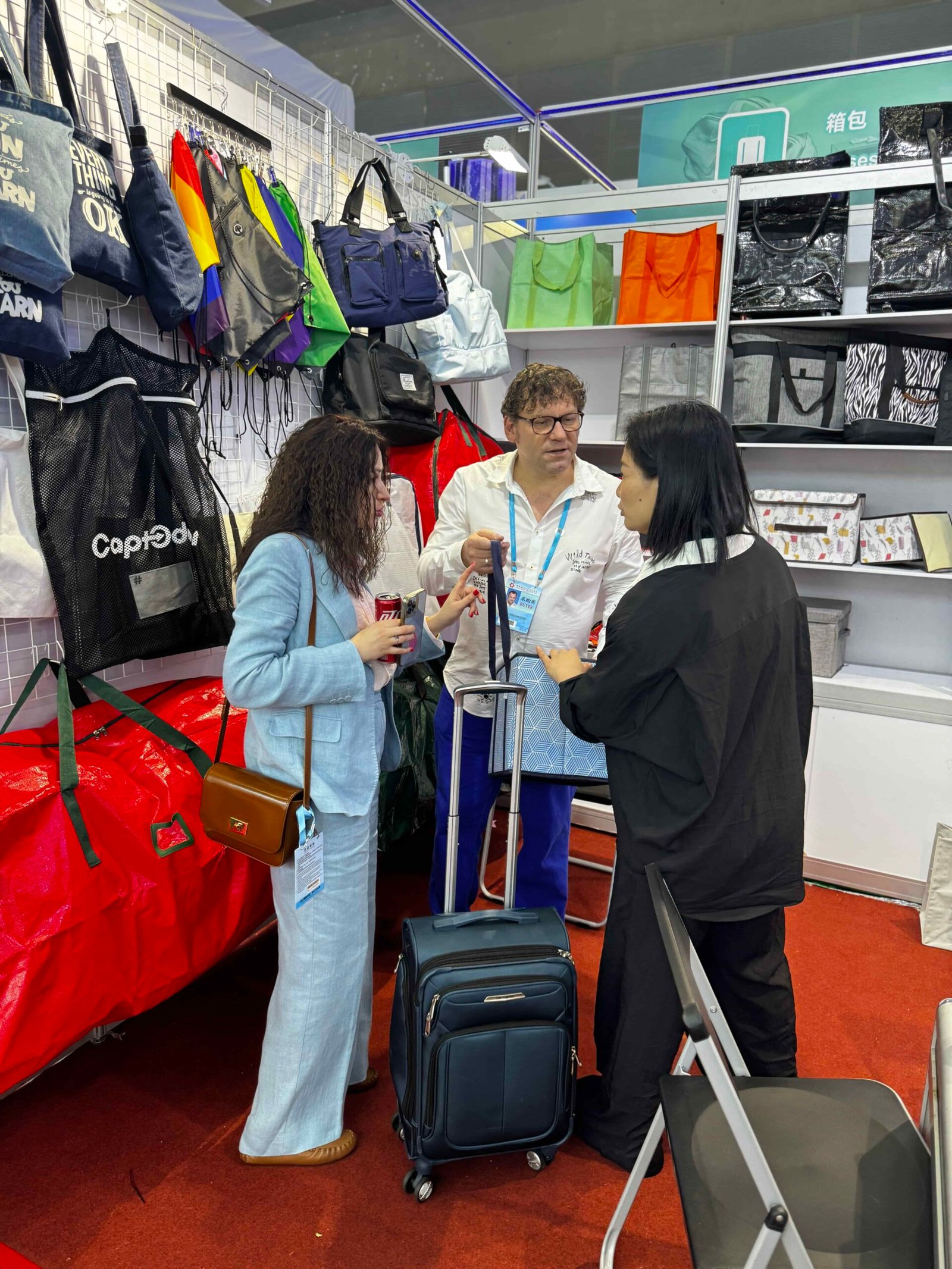
How to Source Moving Bags Without Getting Scammed
If they can’t show you batch-specific test reports, they’re hiding something.
Every year, logistics procurement managers sign off on thousands of moving bags based on a supplier’s verbal promise of ‘heavy duty’ quality. Then the first batch arrives, handles tear on the third move, and you’re stuck filing damage claims worth $2,500 each. The fix is simple: demand three documents before you place a single PO.
First, a batch-specific material certificate. This must list the exact resin type, GSM (woven PP should be 120-150 GSM, not the 25-35 micron film competitors mention), and origin. Second, six QC test reports covering tensile strength (ASTM D882), seam pull-out (ISO 13934-1 with ≥800 N), load capacity (ISO 7765), dart impact (ASTM D1709), UV resistance (ASTM G154), and a dynamic cycle test simulating 50+ moves. Third, a written warranty offering free replacement for any defects exceeding 2% per batch.
- Batch Material Certificate: Must specify resin type, GSM, and origin. Vague terms like ‘premium polypropylene’ are a red flag.
- Six QC Test Reports: Include ASTM D882, ISO 13934-1 (≥800 N seam pull-out), ISO 7765, ASTM D1709, ASTM G154, and dynamic cycle test (50+ moves).
- Written Warranty: Free replacement for defects exceeding 2% per batch. If they balk at 2%, they’re not confident in their QC.
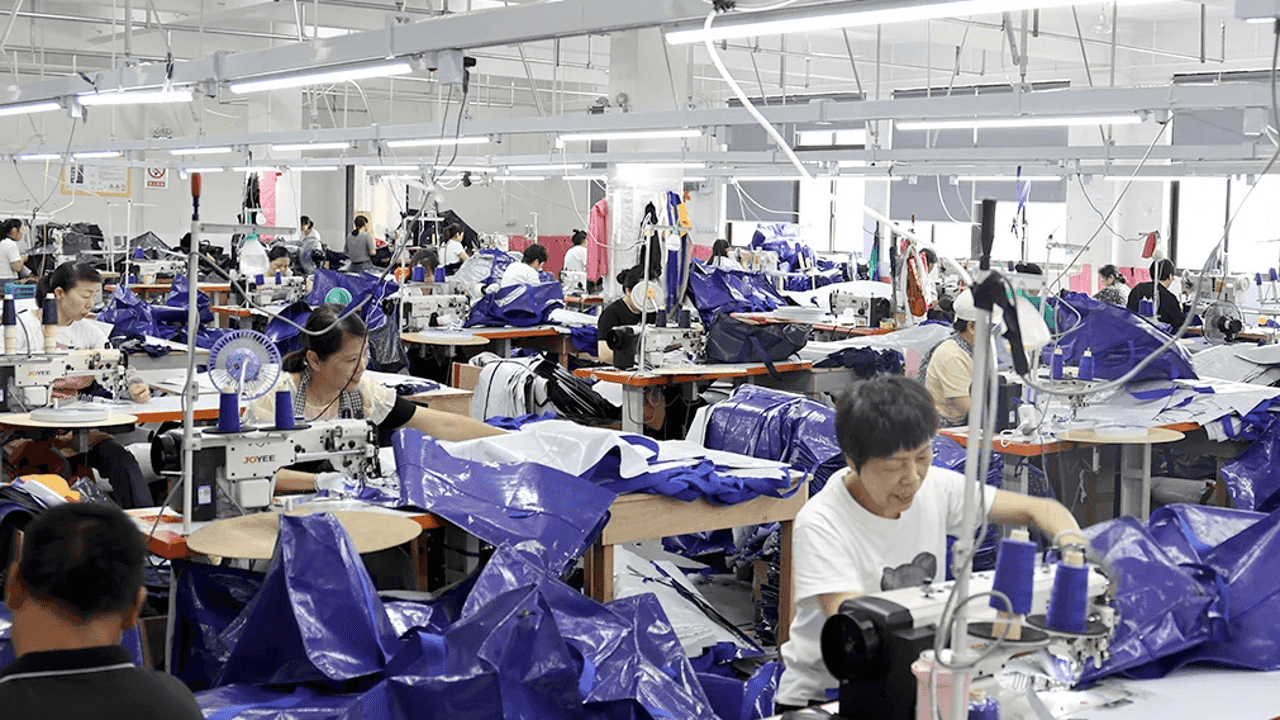
Watch out for suppliers who offer a laundry list of ‘quality control’ steps — raw material inspection, extrusion monitoring, visual checks — without any pass/fail thresholds. That’s not QC; it’s theater. A real factory can show you the exact Newton force their bags withstand and the defect rate from the last 10 batches. If they hesitate, walk away.
Adding ASTM D5034 seam certification costs roughly $0.02 per bag. Compare that to the $2,500 average claim cost from a single seam failure, and the math is obvious. The 2% defect threshold isn’t arbitrary — it matches the KPI of top-tier logistics buyers who target <2% defect rate per batch. Your supplier should meet that standard without negotiation.
Conclusion
The six tests outlined here—from seam pull-out to dynamic cycle fatigue—are your line of defense against liability claims and batch failures. A supplier that cannot produce a test report for each standard is hiding a weakness in their process.
Questions fréquemment posées
What are the different types of QC tests?
The six standard QC tests for heavy duty woven PP bags are tensile strength (ASTM D882), seam/handle pull-out (ISO 13934-1), static load capacity, dart impact, UV resistance, and cycle fatigue simulating 50+ moves. Request the full six‑test protocol before placing your order.
How to check bag quality?
Start with the seam – 80% of bag failures happen at the handle‑to‑bag seam, not the fabric itself. Then verify the supplier runs dynamic cycle testing (20+ lifts and drops), not just a one‑minute. Always request seam pull‑out and cycle test reports.
How do you test the strength of plastic bags?
For heavy duty moving bags, you test tensile strength with ASTM D882 and seam strength with ISO 13934‑1. The critical difference is between static capacity (ISO 7765) and dynamic fatigue – a. Require both static and dynamic test results from your supplier.
How to test quality control?
For heavy duty bags, quality control means running the six standard tests in‑house or with a third‑party lab before shipment. Key is to simulate real usage: cycle fatigue (50+ moves) and UV. Insist on a pre‑shipment inspection that includes dynamic fatigue testing.
What are the 7 QC methods?
The research context focuses on six specific QC tests for heavy duty moving bags, not the classic Seven Basic Quality Tools (Pareto, cause‑effect, etc.). For bag sourcing, the relevant methods. Clarify whether they mean the six bag‑specific tests or general quality tools.

0 commentaires