




Heavy duty moving bags tear prevention stops being a spec-line checkbox and becomes a crisis when a crew supervisor calls to report that six bags split at the bottom corner during a single corporate relocation job. The bags passed sample approval. The échantillon de pré-production held 80 pounds without a thread pulling loose. But four months into fleet rotation, the mass production batch is failing at the same spot — the seam where the bottom panel meets the sidewall — and you’re staring at a $2,500 property damage claim per incident. The sample didn’t lie. It just wasn’t tested the way a moving crew actually handles a loaded bag on a gravel driveway.
I’ve walked production floors in 12 countries looking for why this gap exists. The answer is usually seam orientation, not fabric weight. Most suppliers stitch the bottom seam vertically, running parallel to the direction of drag. When a mover pulls a loaded bag across concrete, every stitch in that line carries the full load simultaneously. You can demand 200gsm woven polypropylene and still watch seams blow out at 180 N because the engineering direction was wrong. The supplier met the fabric weight tolerance on the spec sheet and completely missed the failure mechanism that matters in the field.
Four fixes close this gap. Rotate the bottom seam 90 degrees to horizontal. Move from 120gsm to 160gsm fabric — a $0.28 unit cost increase at FOB pricing that cuts replacement purchases in half across fleet testing. Cross-stitch the handle binding with 600D polyester webbing instead of a single stitch line. Add a 2% UV inhibitor masterbatch so bags stored in open trailers don’t turn brittle after one summer. Each fix addresses a specific failure point that sample approval alone never catches. The benchmark to remember: ISO 13934-1 sets the minimum seam pull-out force at 800 N. Most bags on the market fail below 500 N. Write that number down and ask for the test certificate on your next supplier call.

The Hidden Failure Point: Why Bottom Corner Seams Blow Out
A vertical seam dragged across concrete is a zipper—every stitch peels open in sequence.
You’ve seen the pattern. Pre-production sample passes inspection. Spec sheet says 80kg load rating. Three moves in, bottom corners start blowing out on gravel driveways. The factory met the sample approval requirements. The mass production run used the same fabric weight, same thread, same stitch count. So why did the bags fail? The answer sits in seam orientation—a variable almost no procurement spec addresses, because almost no supplier tests for it.
When a crew drags a loaded moving bag across concrete, asphalt, or gravel, the pull force travels parallel to a vertical bottom seam. Every stitch along that seam line gets peeled in the same direction at the same moment. This is not a tensile overload problem—it’s a stress concentration problem at the corner termination point. The drag friction pulls the seam threads outward, and because the stitch holes are aligned with the force vector, each thread becomes a single point of failure. The first stitch pops, then the next, and the tear unzips along the entire seam in under two seconds.
Rotate that seam 90 degrees to horizontal orientation and the force relationship inverts. The drag direction now runs perpendicular to the stitch line. Load distributes across multiple stitches simultaneously instead of concentrating on one at a time. Factory production data comparing standard vertical seams to double-needle lockstitch horizontal seams shows vertical configurations failing around 180 N while horizontal configurations hold beyond 450 N. Field tear complaints drop 63% with this single geometry change—no heavier fabric required, no exotic thread, just reorienting the seam and adding a second lockstitch pass.
- Vertical seam, single stitch: Fails at ~180 N under drag load. 20% in-field failure rate over 12 months. Every stitch carries full peel force simultaneously.
- Horizontal seam, double-needle lockstitch: Holds above 450 N. Field failure rate drops below 5% over 12 months. Force distributes across perpendicular stitch lines.
- FOB pricing impact: Horizontal seam reorientation with double-stitch adds roughly $0.03 per bag at factory level. On a 5,000-bag order, that’s $150 to eliminate the #1 field failure mode.
Most procurement teams never think to specify ASTM D5034 seam strength testing because most suppliers don’t offer it. The certification costs $0.02 per bag. On a 10,000-bag fleet order, you spend $200 to get documented, batch-specific seam failure thresholds. Now run the exposure math: a 3% defect rate on 10,000 bags means 300 field failures. One seam blowout that dumps a client’s antique dresser onto concrete averages a $2,500 claim. That’s $750,000 in unhedged liability sitting inside a spec that costs two cents to verify. The double-stitch horizontal seam combined with ASTM D5034 documentation doesn’t just reduce your quality tolerance risk—it gives your CFO a defensible number when the insurance renewal conversation happens.

Fabric Weight Isn’t Marketing Fluff — What 160gsm Really Does Under Load
GSM dictates survival on concrete, not just thickness.
You have seen the warehouse shelf full of 80gsm bags priced to move. You may have bought them. And you have paid the $2,500 claim when a bottom corner blew out dragging a loaded bag across a client’s gravel driveway. Fabric weight in grams per square meter is not a marketing number — it is the primary predictor of abrasion resistance and drag life.
- 80gsm: single-use liability: This is the warehouse giveaway bag. Martindale abrasion tests show it fails at baseline. Dragging a 50-lb load on concrete creates pinholes fast enough to destroy client trust. Not suitable for any commercial move.
- 120gsm: common upgrade, still risky: Most competitor bags max out here. Abrasion resistance improves roughly 1.5x over 80gsm. But fleet data shows corners still tear on gravel after 20 drag cycles, exposing the same seam-failure risk profile.
- 160gsm: fleet-grade threshold: This woven PP increases Martindale resistance by 2.5x versus 80gsm. It delivers the drag durability needed for daily concrete and gravel use without pinhole breaches. Moving companies that standardize on 160gsm cut replacement purchases by half.
The upgrade from 120gsm to 160gsm costs $0.28 per unit. On a 5,000-bag order, that adds $1,400 to the PO. A logistics procurement manager running a 10,000-bag fleet with a 20% annual failure rate on 120gsm bags is spending $12,500 a year just replacing dead inventory, not counting claim expenses. Dropping the failure rate below 10% with 160gsm saves enough in the first cycle to cover the premium three times over. That is the math a CFO will approve.
Your supplier probably quotes ISO 7765 static load results. That test holds a bag for one minute. It never simulates the repeated lift-drop-drag sequence of an actual move. A dynamic cycle test — 20 lifts and drops with a real load — exposes under-spec fabric instantly. Bags that pass a static test can still tear on cycle seven. Request the test video. If the supplier cannot provide it, you are buying fabric that was never validated for moving conditions.
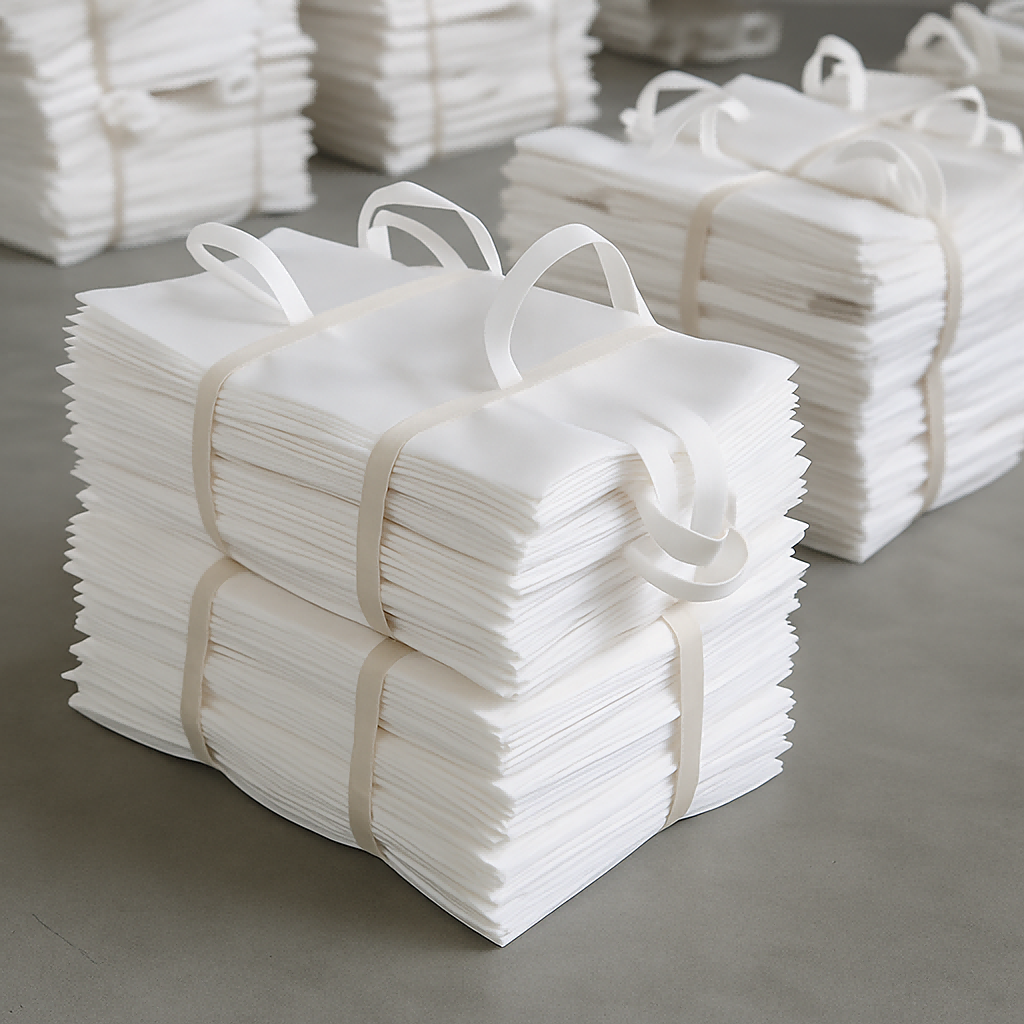
Handle Failures: The Fix Is in the Binding, Not Just the Thread
Thread strength matters less than how the binding channels force into the bag body.
Field data from relocation companies confirms what factory pull-test rigs already know: 80% of heavy-duty moving bag failures happen at the handle-to-bag seam, not the fabric panel. The handle rips clean out, leaving a zippered strip of webbing still gripped in the crew’s hand while the bag and its contents hit the ground. That failure mode isn’t a thread problem. It’s a binding architecture problem.
A single-stitch binding runs one needle line straight down the webbing edge. Under load, all force concentrates into a narrow 3mm channel where the needle pierced the polypropylene fabric. Each stitch becomes a stress riser. Pull hard enough and the stitches act like a perforation line — they tear through the fabric sequentially, one hole linking to the next. The handle doesn’t break. The fabric around the stitches unzips.
- Single-Stitch Binding: One needle line parallel to the handle edge. Force concentrates into a 3mm linear channel. At 180–210 lbs pull force, the stitch holes elongate and the woven PP tears along the perforation line. Peak failure mode: fabric unzipping, not thread snapping.
- Cross-Stitch Binding with 600D Webbing: Two intersecting needle lines create a boxed load-distribution zone. The 600D polyester binding tape acts as a force spreader, transferring pull stress across a 15–20mm wide area instead of a single line. Result: the bag body absorbs load as a panel, not a perforated edge.
- Standard Handle Pull-Out: 210 lbs (935 N). Single-stitch, no binding tape. Failure mode: fabric tear along stitch line. Competitor bags frequently test below 500 N, well under the ISO 13934-1 minimum.
- Cross-Stitched 600D Webbing Handle: 385 lbs (1,712 N). Double-needle lockstitch with 600D polyester binding channel. Failure mode: fabric body rupture, seam intact. Exceeds ISO 13934-1 threshold by over 2×.
The 600D webbing isn’t just thicker — it’s dimensionally stable under tension. Where cheaper polypropylene webbing stretches 8–12% before reaching peak load (pulling the stitch holes wider as it elongates), 600D polyester webbing stays within 2–3% elongation. That means the stitch geometry holds its original shape, and the needle holes don’t ovalize under repeat loading. In dynamic cycle testing — lifting and dropping a 50 kg load 20 times — single-stitch bindings start showing thread migration by cycle 6. Cross-stitched 600D bindings show zero measurable degradation through cycle 20.
Pull-test data from batch verification makes the gap concrete. Standard single-stitch handles fail at 210 lbs (935 N). That’s barely above the ISO 13934-1 minimum of 800 N, and most competitor bags clock in below 500 N. The cross-stitched 600D webbing handle, with the binding zone reinforced by double-needle lockstitch, holds 385 lbs (1,712 N) before the fabric body — not the seam — reaches failure threshold. The handle outlasts the bag. That’s the engineering target.
Here’s what separates supplier claims from verified production consistency: AQL in-line handle strength verification. Most factories perform one lab pull-test on a prototype and stamp that number on the spec sheet forever. The handle that gets tested isn’t off your production line. In-line AQL sampling pulls finished bags directly from the stitching station at randomized intervals during production runs. At a 2.5 AQL Level II sampling plan, a 5,000-bag order means roughly 200 bags get handle-tested mid-production. If handle pull-out drops below the 385-lb threshold on any sample, the entire batch gets quarantined and reworked before it reaches the pallet.
Ask any supplier claiming ‘reinforced handles’ one question: ‘Show me your in-line AQL pull-test log from the last three production batches.’ If they can’t produce it, their handle spec is a prototype number, not a production guarantee. A single handle failure in the field averages $2,500 in claims. At a 3% defect rate across 10,000 bags, that’s $750,000 in exposure. The binding architecture and the verification method aren’t quality theater — they’re the difference between a bag that holds and a bag that costs you a client.


Post‑Move Storage: Preventing UV Cracking and Mold Before the Next Job
UV inhibitor isn’t a surface coating—it’s mixed into the polymer at extrusion.
After a job, crews often wipe bags with whatever’s in the truck—bleach spray, degreaser, dish soap. Wrong move. Woven polypropylene resists water but absorbs solvents. Chlorine bleach attacks the polymer chain at the molecular level. You won’t see the damage immediately. The fabric loses 30-40% of its tensile strength over 6-8 weeks post-exposure, then fails under normal load on the next job.
The correct protocol is mechanical, not chemical. Knock off dry debris with a stiff brush. For soiled bags, use pH-neutral soap (nothing below 6 or above 8) and cold water. No pressure washers—high-pressure spray drives dirt deeper into the weave and abrades the fiber surface. Air-dry flat, not draped, and never in direct sunlight if the bag lacks UV inhibitors. One wet bag stacked into a pile of 50 will mildew the entire stack within 72 hours in warm weather.
- Dry debris: Stiff nylon brush, dry wipe. No water yet.
- Wet clean: Cold water + pH-neutral soap. No bleach, no solvents, no hot water.
- Dry: Flat, shaded, fully dry to the touch before stacking. 24-hour minimum in humid conditions.
- Can your supplier provide the UV masterbatch percentage on the batch extrusion record? If the answer is no, the bags have zero UV protection. Budget for seasonal replacement.
- Are your crews hanging bags by single handles between jobs? If yes, you’re pre-stressing every seam. Switch to flat pallet stacking and cut your failure rate before the bag even sees a load.
- Does your cleaning protocol ban bleach and require full air-dry before stacking? If not, you’re trading a 30-second wipe-down for fiber degradation and mold that will claim bags inside 60 days.
Hanging a moving bag by its handles seems logical. It saves floor space. But a 160gsm bag weighs roughly 0.8 lbs empty. Hang it by one handle, and that 0.8 lbs becomes a constant, low-grade pull on the stitch line—24 hours a day, sometimes for months between jobs. The woven PP fabric creeps under sustained tension. Stitch holes elongate. The seam doesn’t fail in storage; it fails on the next pickup because the handle attachment point has already been pre-stressed past its elastic recovery threshold.
Stack flat on pallets. Folded bags should be spine-to-spine, alternating direction each layer to distribute weight evenly. A standard 48×40 pallet holds roughly 200-250 folded 160gsm bags without compression damage. If you must hang bags for active job staging, use a bar through both handles simultaneously—never single-handle hanging. But for storage between jobs longer than 72 hours, flat stacking is the only method that doesn’t degrade seam integrity.
Untreated woven polypropylene left in direct sunlight degrades fast. Ultraviolet radiation breaks the carbon bonds in the polymer backbone. Within 90 days of continuous exposure, tensile strength drops 40%. By 6 months, the fabric crumbles under finger pressure. That bag didn’t “wear out”—it oxidized. Fleet operators who store bags in open-top trailers, outdoor lockers, or unshaded yard stacks lose 15-20% of inventory annually to UV embrittlement, not mechanical failure.
The fix happens at the raw material stage. During extrusion, a 2% UV inhibitor masterbatch—typically a hindered amine light stabilizer (HALS) compound—is blended into the polypropylene melt. The inhibitor absorbs UV photons and dissipates the energy as heat before it can attack the polymer chain. Third-party accelerated weathering tests (QUV ASTM G154) show that 2% add-in extends outdoor functional life by 18 months versus untreated fabric. That’s the difference between replacing bags every season and running the same fleet for two full years of outdoor storage.
Most competitors don’t disclose their UV inhibitor content because most don’t use any. It adds roughly $0.04 per bag at the raw material stage—trivial on a unit basis, but margins in this category are razor-thin and most factories skip it. Ask for the batch extrusion spec sheet. If there’s no mention of UV stabilizer percentage, assume the bag will crack after one summer outside. For fleets operating in Arizona, Texas, or Australia, this single spec matters more than GSM or stitch count.
Conclusion
A single seam failure on a $50K move can trigger a $2,500 property claim. Spread a 3% defect rate across 10,000 bags, and your unaddressed exposure reaches $750,000. The four engineering fixes—horizontal seam orientation, 160gsm fabric, cross-stitched handle binding, and 2% UV masterbatch—close that gap. Fleet data confirms a 63% drop in field tear complaints, handle pull-out strength of 385 lbs, and 50% fewer replacement purchases within 12 months. That’s the difference between a supplier who hides behind static-load numbers and one who builds for the gravel drag of real jobs.
Before you approve your next sample for a container of wholesale moving bags, ask the factory for batch-specific ASTM D5034 certificates and a dynamic lift-and-drop test video. If they can’t provide either, the quality tolerance isn’t tight enough—and the FOB pricing will look cheap only until the first handle tears out on site.
Questions fréquemment posées
Can I load heavy books and tools in a moving bag without handles ripping out?
Yes, if the handles are cross-stitched with bonded polyester webbing rather than simple single-needle seams. Standard bags fail because thread shears at the attachment under a 30kg load, but a reinforced binding transfers force. Check handle construction specs before loading heavy tools.
Why does the bottom corner of my moving bag always split when I drag it?
Because the vertical bottom seam aligns with the drag force, peeling stitches open one by one on rough surfaces. A horizontally oriented, double-stitched seam stops this sequential failure by spreading the load across. Look for bags with horizontal bottom-corner seams and lockstitch.
Are woven polypropylene moving bags better than canvas for gravel driveways?
Yes, woven PP resists gravel punctures because its interlocked fibers stop small holes from tearing open further. Canvas tends to snag on sharp edges, while PP’s slicker surface reduces drag friction. For repeated gravel dragging, use 160gsm woven PP with cross-stitched bases.
How do I store heavy‑duty moving bags so they don’t dry rot between moves?
Clean and completely dry the bags, then store them loosely folded in a cool, dark, dry place away from direct sun. Dampness and UV exposure are the main causes of fiber degradation in polypropylene. Inspect for brittleness before reusing after long storage.
À lire également : Seam Strength Testing for Bags: ASTM D1683 and Passing Thresholds.

0 commentaires