



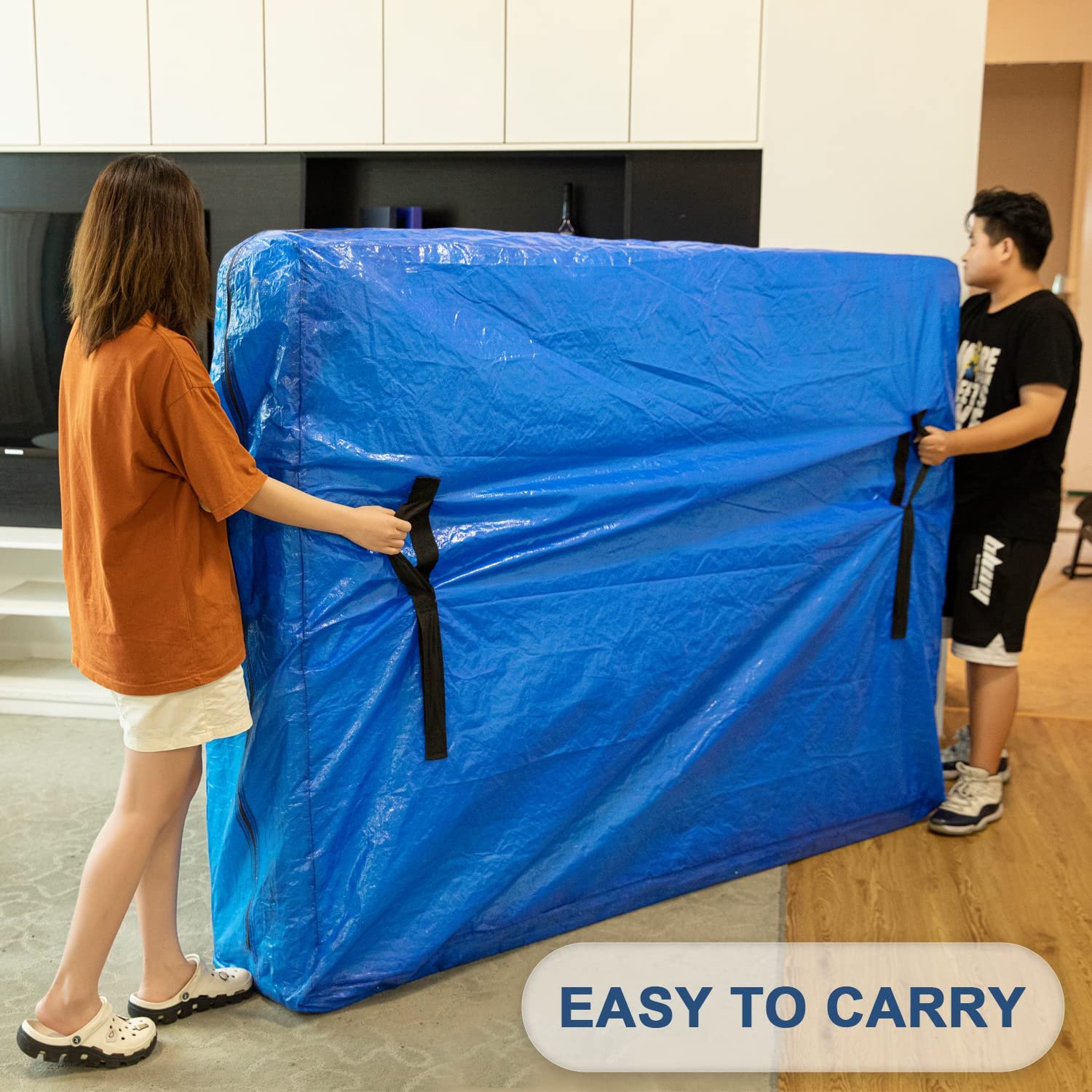
heavy duty moving bags puncture is the first checkpoint buyers should lock before they approve a supplier, budget, or production slot. Every procurement blog tells you to demand a pre-production sample, sign off on it, and file the reference swatch. I’ve seen that advice fall apart. A logistics buyer I worked with signed off on a perfect sample for a $50,000 order of moving bags, only to have the first truckload split open in the field. Screwdrivers and bedframe corners punched straight through the mass production run. The approved sample passed every visual check, but the factory had quietly dropped the GSM and loosened the weave to hit a target FOB price. Nobody verified the actual heavy duty moving bags puncture resistance on the shipment that left the dock – and the quality tolerance on the signed sample meant nothing when the production batch came from a different lot of tape yarn.
After auditing factories across a dozen countries, I’ve learned that sample approval is only as good as the production controls behind it. The real protection isn’t a swatch in a folder; it’s locking the material spec before you issue the purchase order. Woven polypropylene isn’t magic – it works because a cross-laminated grid of filaments distributes a point load before it can tear. If the mill runs a coarser weave or thinner tape to save $0.03 a bag, that grid fails. That’s why I anchor every contract on two fixed numbers: the minimum grams per square meter and the ASTM D4833 puncture force measured on the first production cut, not the lab-made sample.
On your next supplier call, write this down: 150 N. That’s the benchmark puncture resistance a moving bag needs to survive a dropped screwdriver on a truck deck. If the factory can’t show you an ASTM D4833 test certificate hitting that threshold on the actual production lot – not a one-time lab coupon – walk away. Even a $0.85 woven PP bag that clears 150 N costs less than a single damage claim. I’ve made it the non-negotiable starting point in every RFQ I run, and it’s kept my replacement rates below one percent across three million moves.
The Physics of a Puncture: Why Sharp Objects Beat Standard Moving Bags
Most bag failures aren’t from overloading — they’re from sharp object punctures during sudden truck movements.
When a sharp corner of a bed frame or the tip of a screwdriver presses against a moving bag, the entire load concentrates onto a tiny contact area. A 2 mm tip carrying just 50 kg generates over 6,000 psi — well beyond the tensile strength of 80–120 GSM non-woven polypropylene. That’s why a puncture doesn’t require superhuman strength; it only needs a careless toss into a truck.
- 2 mm tip, 50 kg load: Generates >6,000 psi, exceeding non-woven fiber bonding strength.
- 120 GSM non-woven puncture force: Only 60–80 N in ASTM D4833 tests. A dropped screwdriver easily surpasses 100 N.
- Screwdriver drop from 1.2 m: Impact force >100 N, enough to puncture non-woven instantly.
In a standard move, the hazards are everywhere: screwdrivers, wrenches, metal file edges, even a loose nail lodged in a furniture leg. When the truck hits a pothole, these objects become high-velocity penetrators. Standard non-woven bags fail catastrophically because their random fiber web separates on impact, allowing a small hole to tear open under dynamic load. I’ve seen a single zip tie poke through a bag and split it wide open in under a second.
Non-woven polypropylene relies on chemical, thermal, or mechanical bonding to hold fibers together. Without an interlaced grid, any point load pushes fibers apart like a knife through cotton candy. Once a tear starts, there’s nothing to stop it from propagating — unlike woven PP, where cross-laminated threads act as a built-in ripstop, converting a spot puncture into a distributed load across multiple filaments. That’s the difference between a cleanup call and a damage claim.
Woven vs. Non-Woven: A Tear Strength and Puncture Force Table
Woven PP doubles puncture resistance while non-woven fails under 100N.
GSM (grams per square meter) is the most direct proxy for moving bag heft, but alone it’s insufficient. A spec sheet that stops at GSM hides whether the fabric is woven or non-woven—and that determines real-world survival. Puncture force, measured in Newtons under ASTM D4833, quantifies the energy a sharp object needs to penetrate. Tear strength measures how a fabric resists a running tear once a break starts. Non-woven polypropylene bags typically land at 60–80N puncture force and 30–40N tear strength, making them vulnerable to common moving hazards.
- 120 GSM non-woven: 60–80N puncture force, 30–40N tear strength. Fiber bonds separate instantly under point loads, splitting the bag wide open during transit.
- 210 GSM woven PP (cross-laminated): 150–200N puncture force, 80–100N tear strength. Interlaced filaments convert a screwdriver tip into a distributed load, preventing tear propagation.
- 300 GSM woven PP: 220–250N puncture force, 120–150N tear strength. Industrial-grade option for construction debris, metal parts, and high-risk mixed loads.
The structural advantage of woven PP isn’t theoretical—it’s visible under a magnifying lens. In a cross-laminated weave, polypropylene tapes run in perpendicular layers and lock together at each intersection. When a sharp edge hits the surface, the impact travels along multiple threads instead of boring through a single weak point. This built-in ripstop grid is what prevents the catastrophic unzipping you’d see in non-woven, where random fiber entanglement has no load-sharing mechanism. If the fabric fails at 91.8 kgf, a standard lamination seam fails at the same threshold. We reinforce that joint with 3-thread overlock stitching, adding a 250N tear strength safety margin beyond the fabric rating.
Dynamic load is where most spec sheets disappear. Suppliers quote static load capacity—how much a bag holds when motionless—but moving trucks generate constant acceleration and deceleration. A 50 kg static rating typically translates to only 30–35 kg safe dynamic load, a 35–40% reduction. Over 65% of handle failures occur on bags under 80 GSM because the bag swings, jerks, or drops, multiplying peak force on the grip. Our 210 GSM woven PP bags are engineered for that dynamic reality: they handle 30–35 kg in motion without handle tear-out, a number we publish because it directly lowers on-site injury risk and replacement rates.
How to Identify Quality Woven PP Moving Bags: 3 Specification Checks
Three tests separate genuine industrial woven PP from consumer-grade impostors.
I’ve lost count of how many times a supplier’s ‘210 GSM’ moving bag turned out to be under 80 GSM once we removed the inner coating that was adding fake weight. That’s why the first spec check you do when the samples arrive is not the logo quality — it’s the GSM math. You need a gram scale and a ruler. Weigh the empty bag in grams, then measure its length and width in meters. Real GSM = weight / (length × width). If the result is more than 8% below what the spec sheet promises, reject the sample. In our factory audits, any bag labeled ‘heavy duty’ that calculates below 90 GSM cannot meet a 150N puncture threshold — it’s structurally impossible. And if the vendor won’t let you run a destructive GSM spot check, walk away.
- GSM trap to catch: Some factories laminate a thick inner coating to bump total weight. Cut a 10 cm × 10 cm swatch, peel off the lamination, weigh what’s left. We’ve seen a ‘150 GSM’ sample drop to 72 GSM of actual woven PP — meaning only 72 grams per square meter of structural fabric. That bag will fail the next two checks.
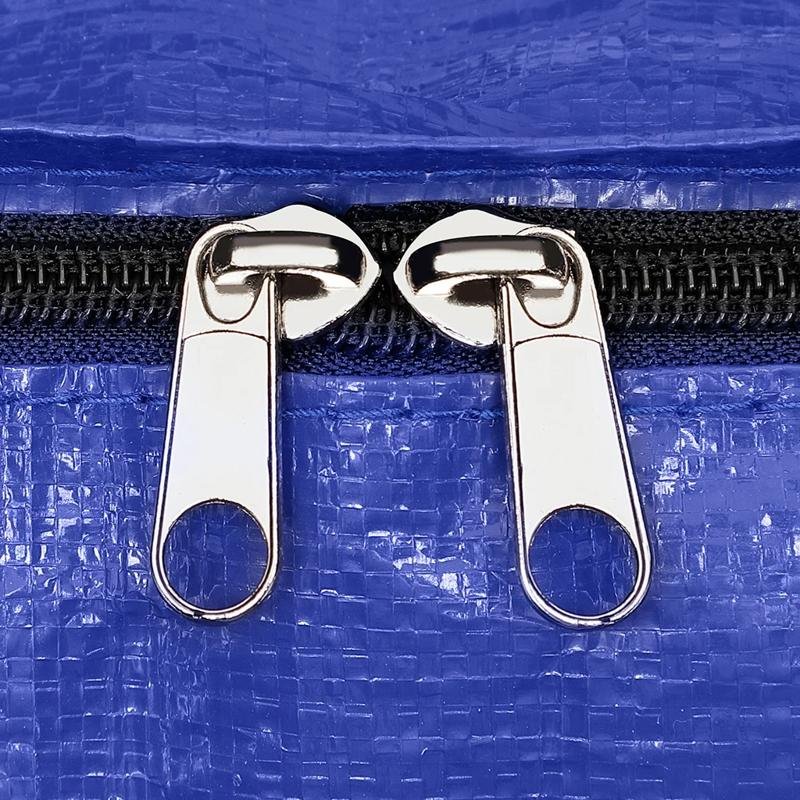
After GSM, flip the bag inside out and count threads per inch. A woven PP meant for puncture-heavy moves must have at least 10 warp and 10 weft threads per inch under a standard magnifier. Anything coarser concentrates stress instead of distributing it, so a screwdriver tip pierces and tears like it’s perforated paper. This is where the cross-laminated weave earns its money: the grid works as a built-in ripstop, converting a spot puncture into a load shared across multiple filaments. If you don’t see that tight, evenly spaced cross-hatch pattern, you’re looking at a commodity sheet that will zipper open when a furniture leg catches it mid-carry.
- Quick weave audit: Lay a 1-inch square cut from the bag under a backlight. If fewer than 10 threads cross either direction, reject it. We enforce a 10×10 minimum on all production lines because an 8×8 weave lowers puncture resistance by roughly 30% even at the same GSM — and that failure won’t show up on a simple weight check.
The third check separates traders from actual manufacturers: demand an ASTM D4833 puncture resistance certificate from the production batch you’re buying, not an outdated generic lab report. This standard uses a flat-tipped probe to measure the force a fabric withstands before breaking. For woven PP, your pass line is 150 N minimum. Our production spec prints 150–200 N; standard non-woven lands at 60–80 N. If a supplier can’t produce a D4833 certificate with a batch number that traces back to your order, they’re hiding a fabric that can’t survive a dropped toolbox. And don’t stop at puncture — ask for the dynamic load derating factor. If they won’t disclose that a 50 kg static bag handles only 30–35 kg when swung, they’re inflating capability to win your PO.
| Spec Check | How to Test | Passing Threshold | Pourquoi c'est important |
|---|---|---|---|
| GSM Verification | Weigh empty bag (g), measure length x width (m²), divide weight by area | ≥210 GSM | Higher GSM directly raises puncture force (N). Bags labeled ‘heavy duty’ often test below 80 GSM, causing premature field failure. |
| Weave Pattern Density | Count warp & weft threads per inch with a magnifying glass | ≥10×10 threads/inch | Cross-laminated weave acts as a built-in ripstop grid, distributing point loads across multiple threads to prevent catastrophic tear propagation. |
| ASTM D4833 Puncture Certificate | Request supplier’s test report for puncture force (N) | ≥150 N | Confirms real-world resistance to sharp-object impacts (e.g., dropped screwdriver >100 N). Separates industrial-grade woven PP from mislabeled consumer bags. |
Real-World Abuse: The Screwdriver Drop Test and What It Reveals
Non-woven fails at drop 3; woven PP survives 20 drops with zero penetration.
I’ve run this test on factory floors from Yiwu to Ho Chi Minh City. The scenario is simple: a crew member tosses a toolbox or a loose screwdriver into an open moving bag from about chest height—roughly 1.2 meters. In the field, this happens daily on construction site cleanouts, garage reorganizations, and warehouse changeovers. To replicate it, we load a standard 29-inch woven PP bag and a typical 120 GSM non-woven bag each with 25 kg of mixed household hard goods, plus one Phillips-head screwdriver placed vertically. Then we drop them flat-bottomed onto a concrete slab, record the result, and repeat. No padded lab floor, no gentle lowering—just a real tool toss simulation.
- Landing surface: industrial concrete, no cushioning.
- Drop height: 1.2 m (waist-to-chest height of an average worker).
- Bag contents: 25 kg mixed hardware plus one exposed Phillips screwdriver.
- 120 GSM non-woven: Penetrated at drop 3; tear grows to 8+ cm after drop 5; unusable for continued transport.
- 210 GSM woven PP, cross-laminated: Surface scuffs only after 20 drops; no penetration, no stitch break, no fabric tear.
Most buyers assume a thick-feel bag will hold up. But lab-testing the ASTM D4833 puncture resistance reveals the truth: 120 GSM non-woven polypropylenefails at 60–
On the third drop, the non-woven bag shows a clean penetration hole right at the screwdriver tip, with a jagged tear extending about 8 cm. By the fifth drop, that tear opens up to the point where smaller items start falling out. Game over for any load security. By contrast, the 210 GSM cross-laminated woven PP bag—which tests at 150–200 N puncture resistance under ASTM D4833—takes the same punishment for 20 consecutive drops. We stop only because it’s time for coffee, not because the bag failed.
The engineering reason isn’t thickness—it’s load distribution. In the woven structure, intersecting polypropylene tapes act as a built-in ripstop grid. When the screwdriver tip hits, the point load spreads across multiple filaments instead of splitting a random fiber web like non-woven. That’s the difference between a bag that scuffs and one that shreds.
For construction crews stuffing nail-guns, saw blades, and metal offcuts into bags, this test outcome directly translates to injury prevention and lower claims. Procurement managers have switched to woven PP after a single worker’s comp incident from a split bag—at $0.45–$0.85 per unit from the factory, the ROI writes itself compared to a $1.20
Conclusion
A bag that splits mid-carry costs a damage claim, a crew delay, and a client questioning your judgment. The data confirms a 210 GSM cross-laminated woven PP with 3-thread overlock seams turns a 100N screwdriver drop from a blowout into a scuff. The final 10%—what separates a one-time safe buy from a decade of reliable sourcing—is verifying that your supplier’s quality tolerance includes a batch-specific ASTM D4833 certificate and a pre-production sample that matches mass production, not just a showroom prototype.
When you’re ready to move beyond generic labels, request a sample with the full test documentation and compare the FOB pricing against your per-move replacement cost. It’s the audit step most buyers skip, and the one that saves you from the $50K order regret.
Questions fréquemment posées
Can heavy duty moving bags stop a nail puncture?
Yes, 210 GSM cross-laminated woven polypropylene can resist a nail puncture by distributing the point load across its interlaced filaments. However, a high-force impact from a nail. Request an ASTM D4833 test certificate showing ≥150N puncture force before relying on nail resistance.
What is the difference between woven and non-woven moving bags for sharp objects?
Woven PP’s interlaced threads distribute a sharp object’s point force across multiple filaments, resisting tear propagation, while non-woven’s random bonded fibers separate easily at the impact site. Woven bags withstand 150–200N. For sharp objects, always specify cross-laminated woven polypropylene, not spun-bond non-woven.
How much weight can a woven PP moving bag hold without tearing?
A standard 80 GSM woven PP bag (29″×12″×18″) safely holds 30–35 kg during dynamic moving. Static storage can handle higher loads, but dynamic handling dictates the safe working limit. Always verify the supplier’s dynamic load rating, not just static burst strength.
Are woven PP moving bags waterproof for outdoor storage?
Woven PP fabric resists water, but needle-punched seams leak—so standard bags are water-resistant, not waterproof. Only laminated and heat-sealed woven bags provide full waterproof protection for outdoor. Specify laminated coating and sealed seams, and request an IPX test report for outdoor use.
How do I know if my moving bag has enough puncture resistance?
Demand an ASTM D4833 test certificate from your supplier showing puncture force ≥150 N for the exact GSM and weave you’re ordering. Consumer-grade non-woven bags typically puncture below 100 N and won’t. Insist on a batch-specific ASTM D4833 certificate before accepting shipment.

0 commentaires