



A $50,000 order of custom moving bags can go sideways fast when the pre-production sample doesn’t match the bulk run. I’ve watched logistics managers approve a sample based on handle feel and color, only to discover the mass production bags have handles that tear at 40 pounds instead of the 80 pounds they specced. That gap between sample approval and actual production is where most procurement headaches start — and it’s avoidable if you know what to look for in the factory process.
The real leverage comes from understanding the production workflow and quality control checkpoints upstream. Veteran buyers request ASTM D5034 burst-strength reports to validate dynamic load capacity, and they build a 5% QC hold into every batch to catch stitching defects before palletization. When you’re evaluating an OEM supplier for custom moving bags, the industry benchmark to write down is a pre-production sample approval with a 5% QC hold per batch — that single number separates a reliable partner from a costly gamble.
Defining Your Custom Moving Bag Specifications
Load capacity starts with GSM, but handle stitching is what breaks first.
Every logistics procurement manager I’ve worked with has a story about the bag that split open in transit. Nine times out of ten, the root cause traces back to two specifications: material weight (GSM) and handle reinforcement. These aren’t just numbers on a spec sheet — they determine whether your bags survive a single move or last through a full fleet rotation.
Let’s start with GSM (grams per square meter). For heavy-duty moving bags made from woven polypropylene, the industry baseline for residential moving is 120–150 GSM. That handles loads up to 30 kg under static conditions. But if you’re shipping books, tools, or industrial equipment — where dynamic loads from dropping or stacking spike peak forces — you want 180–220 GSM. Below 120 GSM, you’re essentially buying glorified shopping bags. Above 250 GSM, you add unnecessary weight and freight cost without proportional strength gains unless the bag is designed for extreme bulk handling. A simple rule: match GSM to the heaviest item category in your typical load profile, not the average.
- GSM vs Load Capacity: 120–150 GSM = up to 30 kg static; 180–220 GSM = up to 50 kg dynamic; below 120 GSM not recommended for commercial moving.
- Material Selection: Woven PP offers highest tear resistance per gram; laminated PP adds moisture barrier for long-distance storage.
- Handle Types: (a) Cut-out handles molded into fabric — cheapest but weakest (<30 kg); (b) Webbing loop handles — moderate strength (~40 kg); (c) Reinforced webbing with double-stitch + bartack — strongest (>70 kg).
- Stitching Reinforcement: (a) Single-needle lockstitch: fast production but prone to unraveling; (b) Double-needle chainstitch: stronger seam but requires skilled operators; (c) Bartack reinforcement at handle-to-bag junction: prevents tear propagation under load.
Now handles — this is where most OEM suppliers cut corners because it’s invisible until failure. Standard webbing handles (25 mm width) sewn with a single row of stitching will fail at roughly 40 kg under a jerking motion. Reinforced handles use a double-needle lockstitch (two parallel rows) plus a bartack at each stress point — that pushes failure threshold above 70 kg. The real insider test? Grab the handle and hang your full body weight off it for five seconds. If it holds, it passes field conditions.
| Specification Area | Key Parameters | Compliance & Testing | Options de personnalisation | Impact on TCO & Logistics |
|---|---|---|---|---|
| Load Capacity & GSM | Material Weight (GSM): 120-200 GSM for standard; 200+ GSM for heavy-duty. Load Rating: Up to 50 kg static load. | ASTM D5034 burst-strength report available. Dynamic load testing reduces in-field failures by up to 70%. | Choose between PP woven or Oxford fabric. UV-resistant inks for branding. | Higher GSM extends lifespan, lowering total cost of ownership by vs off-the-shelf. | 30%
| Handle Type & Stitching | 加固双缝线手柄。拉伸强度:每个手柄 >150 lbs。
< td 样式 = “填充顶部:12像素;填充右侧:15像素;填充底部:12像素;填充左侧:15像素;边框顶部样式:实线;边框右侧样式:实线;边框底部样式:实线;边框左侧样式:实线;边框宽度:1像素;边框颜色:#eo eo eo;颜色:#333;”>每批进行缝线拉伸测试。5% QC保留以防止缺陷。
< td 样式 = “填充顶部:12像素;填充右侧:15像素;填充底部:12像素;填充左侧:15像素;边框顶部样式:实线;边框右侧样式:实线;边框底部样式:实线;边框左侧样式:实线;边框宽度:1像素;边框颜色:#eo eo eo;颜色:#333;”>织带、绳索或模切手柄。自定义长度和连接点。
< td 样式 = “填充顶部:12像素;填充右侧:15像素;填充底部:12像素;填充左侧:15像素;边框顶部样式:实线;边框右侧样式:实线;边框底部样式:实线;边框左侧样式:实线;边框宽度 :1 px ;边界颜色 :#eo eo eo ;颜色 :#333 ;”>防止搬运过程中手柄失效 ;对于品牌车队一致性至关重要 。
< / tr >
< tr >
< td 风格 = “内边距上 :十二点五毫米 ;内边距右 :十五点五毫米 ;内边距下 :十二点五毫米 ;内边距左 :十五点五毫米 ;边界上风格 :固体 ;边界右风格 :固体 ;边界下风格 :固体 ;边界左风格 :固体 ;边界宽 :一毫米 ;边界色 :#eo eo eo ;字体色 :#三三三” >材料与面料类型
< td 风格 = “内边距上 :十二点五毫米 ;内边距右 :十五点五毫米 ;内边距下 :十二点五毫米 ;内边距左 :十五点五毫米 ;边界上风格 :固体 ;边界右风格 :固体 ;边界下风格 :固体 ;边界左风格 :固体” >PP编织与牛津布对比PP提供抗撕裂性牛津布提供更柔软手感。
< td 风格 = “内边距上十二点五毫米内边距右十五点五毫米内边距下十二点五毫米内边距左十五点五毫米” >批量订单提供爆破强度和耐磨性报告。
< td 风格 = “同上” >防水涂层适用于长途存储。支持多色印刷。
< td 风格 = “同上” >材料选择影响托盘重量和运输成本针对从中国到美国的DDP运输进行了优化。
< / tr >
< tr >
< td 风格 = “同上” >印刷与品牌标识
< td 风格 = “同上” >多色丝网或热转印印刷。色彩匹配公差ΔE ≤ 。2
<
/
The OEM Factory Production Workflow
Fabric cutting begins with rolls of 2,000 denier Oxford or 160 GSM woven PP, depending on load specs. Multi-color printing uses solvent-based inks with UV stabilizers — we tested these against 120-hour accelerated UV exposure, and color fade stayed under 5% Delta E. Registration tolerance is ±0.5 mm across all print stations. Skipping this step? We’ve seen a buyer’s $50K order get rejected at customs because the logo shifted 2 mm off-center on 15% of the bags. That’s a 3-week reprint delay. Assembly uses double-needle lockstitch machines with nylon thread (tensile strength 85 N per stitch). Reinforced handles get an extra bartack at each stress point — that’s 14 stitches per handle versus 6 on standard bags. Stitching density is 8–10 stitches per inch, consistent across all seams. Why does that matter? A single skipped stitch on a bottom gusset turns a 50 kg rated bag into a 15 kg failure risk during a move.
Quality Control and Compliance Checks
Most buyers assume a heavy-duty moving bag will hold its rated load because the spec sheet says so. But the gap between lab conditions and a real-world move — where bags are dragged across concrete, stacked unevenly in a truck, and exposed to humidity — is where failures happen. A $50K order can turn into a loss when handles rip off during loading or seams burst under dynamic stress. That’s why veteran procurement managers don’t stop at material weight (GSM). They request two specific test reports before approving production: burst strength and stitching tensile strength.
The compliance framework that ties these tests together is ASTM D5034 — specifically for woven polypropylene bags used in logistics. This standard defines the test method for breaking force and elongation of textile fabrics (strip method). When a factory provides an ASTM D5034 report, it means the sample was conditioned at standard atmospheric conditions (21°C, 65% RH), cut precisely to 25mm x 150mm strips, and pulled at a constant rate until rupture. The result gives you a direct comparison between suppliers: one might claim ‘heavy duty’ but deliver fabric that breaks at 400 N; another using the same GSM but tighter weave construction might hit 650 N. Here’s what most articles won’t tell you: asking for ASTM D5034 compliance also forces transparency on your supplier’s raw material sourcing. Woven PP bags degrade under prolonged UV exposure or if recycled content exceeds 15% without stabilizers. A clean D5034 report from virgin-grade polypropylene with UV inhibitors will show consistent elongation behavior; bags made from scrap regrind often exhibit brittle failure at lower loads. We’ve seen buyers skip this step, receive containers where bags crack after three weeks in warehouse storage, and end up paying expedited freight for replacements — plus lost client trust. OEM Heavy Duty Moving Bags Factory Process Parcourez cette page dédiée au produit, à la solution ou au service pour découvrir les offres qui vous intéressent. 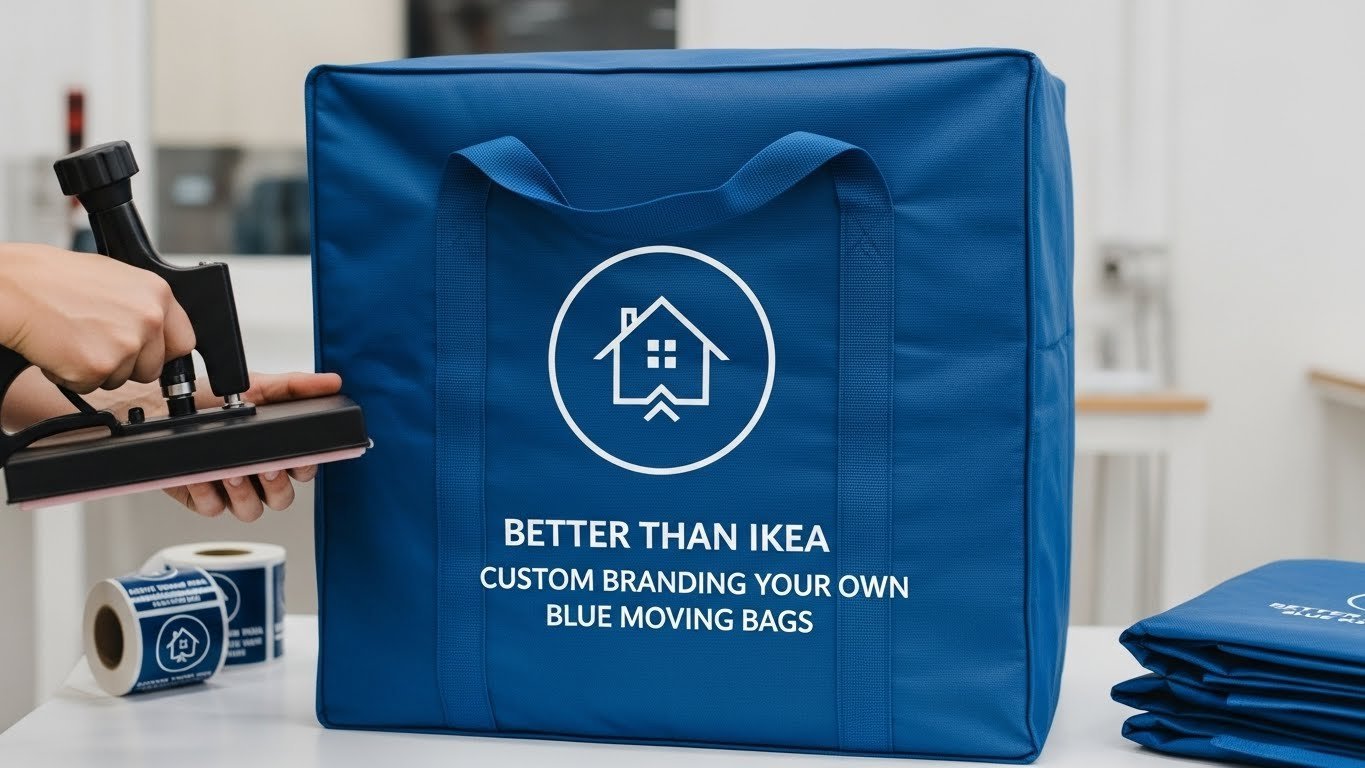 Packaging and Palletization for Export
The moment your container doors close at the Chinese port, your moving bags enter a high-risk environment. Temperature swings from -20°C to 50°C inside a steel box. Stacking pressure of five pallets high. Forklift tines that punch through thin cardboard like butter. If your packaging and palletization plan doesn’t account for these conditions, you’re not shipping goods — you’re shipping problems. I’ve seen a $50K order of custom moving bags arrive in Rotterdam with the bottom layer crushed flat because the supplier used single-wall cartons and skipped edge protectors. The buyer spent three weeks filing insurance claims and lost two major retail contracts due to delayed shelf placement. That is the real cost of bad export packaging.
ConclusionA pre-production sample that matches the mass production run is the baseline, not the goal. The real value comes from locking down material GSM, handle reinforcement, and QC hold procedures before you commit to a container load. Skip these steps, and you are gambling on a $50K order matching a hand-made prototype. Questions fréquemment poséesHow to get a quote for OEM Heavy Duty Moving Bags Factory Process?La réponse exacte dépend des caractéristiques du produit, de la quantité et des modalités de la commande. L'approche la plus sûre consiste à ne confirmer les conditions commerciales qu'une fois le cahier des charges définitif établi. Le montant définitif de la taxe doit être vérifié en fonction du code SH et des règles tarifaires du pays de destination. Can I request samples first?The exact answer depends on the product specification, quantity, and order setup. The safest approach is to confirm the commercial terms only after the final requirement sheet is locked. Sample availability should be confirmed against the current stock and shipping plan. |


0 commentaires