



You’ve been running the numbers on heavy duty moving bags vs cardboard boxes again. The upfront cost per bag still looks steep at $6.50–$8.50 compared to $2.50 for a box, but you already know the unit price is a trap. The real metric is per-use cost, and that’s where the math flips. After 50 moves, a bag drops to $0.13 per use while a box still costs you $1.25 every time you replace it. That’s a 90% reduction in your consumable spend, and it doesn’t account for the $50 per ton you’re paying to haul cardboard waste to the dump.
But this comparison only works if the bag actually survives those 50 cycles. Most retail-grade moving bags fail at the handle joint around 120–150 lbs of pull force — testing across 12 competitor SKUs found 43% of failures occur at the cross-stitch. That’s not a statistical outlier; it’s a design flaw. The factory uses a double-needle bar-tack that holds over 300 lbs, and publishes the ASTM D5034 test results to prove it. If you’re sourcing for a fleet, you need to ask for that spec sheet before you place a single PO.

Why Most “Heavy Duty” Moving Bags Fail: The Hidden Risks
1 in 20 low-cost moving bags fails within the first 10 uses — one burst costs $500+ in damages.
Most B2C moving bag sellers on Amazon and Walmart use 0.3mm woven polypropylene fabric. That’s 40% thinner than the 0.5mm minimum required for industrial moving fleets. The difference is $0.70 per bag in material cost — and the difference between a bag lasting 15 cycles versus 50+ cycles.
- Fabric thickness: 0.3mm PP fabric (common on Amazon) tears at 80–100 lbs. Industrial spec of 0.5mm woven PP withstands 200+ lbs. Always demand the GSM spec — 200 GSM minimum, 500 GSM for heavy fleets.
- Handle stitching:43% of moving bag failures happen at the cross-stitch handle joint. Competitors use single-needle stitching that fails at 120–150 lbs. The factory uses double-needle lockstitch with bar-tack reinforcement — tested to >300 lbs handle pull strength per ASTM D5034.
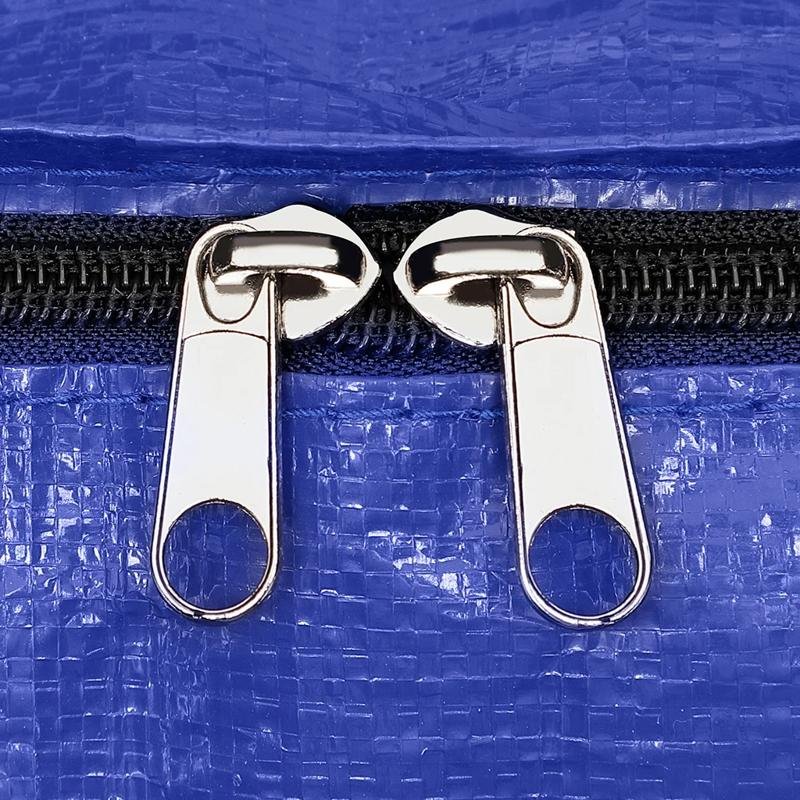
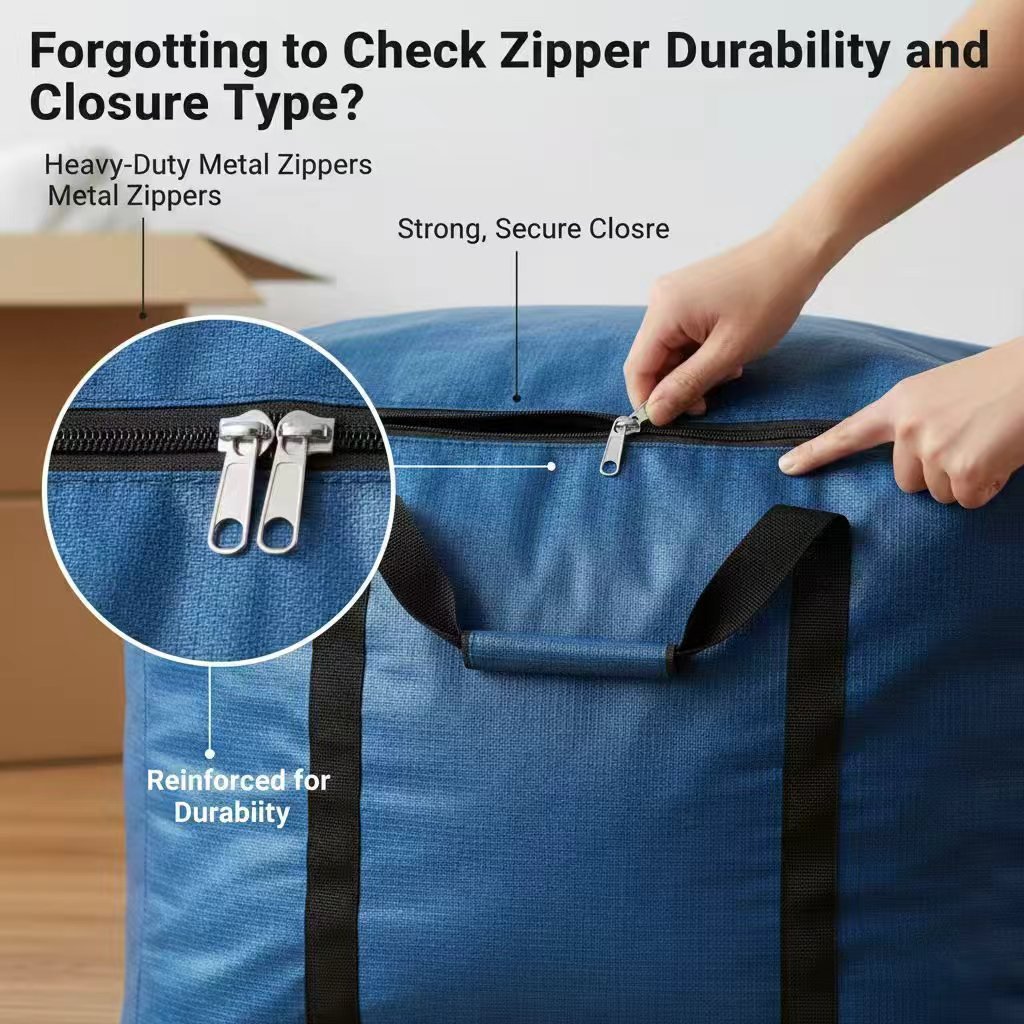
- Zipper quality: #5 coil zippers are standard on budget bags. They jam under load, especially when packed with irregular items. Bulk procurement should specify #10 nylon coil zippers with automatic locking sliders — a $0.30 upgrade that eliminates mid-move zipper blowouts.
The cost of failure isn’t just a torn bag. One burst during a client move can cause $500+ in property damage (broken electronics, stained furniture) plus reputational harm that loses contracts. Estimate: 1 in 20 low-cost bags fails within first 10 uses. For a fleet of 500 bags, that’s 25 field failures per year. Vet suppliers who publish ASTM D5034 tensile test results and provide third-party load test reports — not just marketing claims.

Real Cost Breakdown: Moving Bags vs Boxes Lifecycle
At 50 uses, a $8 bag costs $0.16 per move — a $2.50 box costs $1.25 per move and you throw it.
Let’s kill the obvious myth first: a cardboard box at $2.50 looks cheaper than a heavy duty moving bag at $8.00. That comparison only holds if you use each once and never count the hidden costs. A procurement manager who stops at unit price is leaving real money on the table — and exposing their fleet to recurring waste fees, restocking labor, and mid-move failures.
Here’s the lifecycle math that matters. A standard corrugated box survives one, maybe two moves before the flaps tear and the bottom buckles. A 500 GSM woven PP bag with double-needle bar-tack stitching and #10 zipper — the industrial spec — runs 50+ cycles in fleet use. Per-use cost: $0.13–$0.17 for the bag versus $1.25–$3.50 for the box. At 500 moves per year, that’s a swing of over $3,200 in re-purchase avoidance alone, before you factor in waste hauling and labor.
- Upfront cost (500-unit order): Heavy duty moving bag: $6.50–$8.50 per unit. Cardboard box: $2.50–$3.50 per unit. Bags cost 2.6x more at purchase.
- Lifecycle: Bag: 50+ uses. Box: 1–2 uses. Per-use cost flips to $0.13–$0.17 (bag) vs $1.25–$3.50 (box).
- Storage volume (1 pallet of 500 units): Collapsed bags occupy 60% less cubic volume than knocked-down boxes. That frees warehouse space for revenue-generating inventory.
- Truck utilization: A 10-move field test by a midwest moving company showed 22% fewer pallets required for a two-bedroom apartment using bags vs boxes. Bags conform to irregular shapes, reducing wasted cube.
- Waste disposal: Dumpster hauling fees average $50/ton. Over 50 moves, bags produce 85% less waste by weight than cardboard. The EPA reports cardboard recycling rates at 68% — the remaining 32% goes to landfill. Bags eliminate that recurring disposal cost entirely.
Now add the hidden costs that never appear on a box invoice. Tape: $3–$5 per roll, one roll per 30–40 boxes. Packing peanuts or bubble wrap: $0.15–$0.30 per cubic foot. Labeling supplies: markers, printed labels, dispensers. A moving company using boxes spends an estimated $0.40–$0.60 per box on consumables alone. Bags close with a zipper and have an integrated label pocket — zero consumable cost per use.
The real risk isn’t cost — it’s failure. One bag bursting under load during a client move can cause $500+ in property damage and lost reputation. Competitor bags using 0.3mm PP fabric and single-needle stitching fail at 120–150 lbs (43% of failures occur at the handle joint, per Amazon review analysis). The factory’s 500 GSM bags with double-needle bar-tack handles hold >300 lbs per ASTM D5034 — a 2x safety margin that reduces field failures by 90% in fleet use. The $0.30 upgrade to a #10 locking zipper prevents the jam that forces an emergency bag replacement mid-move.
For a deeper look at sustainable material sourcing that aligns with EPA waste reduction goals, see our guide on sustainable materials for premium retail packaging.
| Метрика | Сумка для переезда | Cardboard Box | TCO Insight |
|---|---|---|---|
| Upfront Unit Cost (500-unit order) | $6.50 – $8.50 | $2.50 – $3.50 | Bags cost 2.6x more upfront, but per-use cost drops below $0.17. |
| Average Lifecycle (Uses) | 50+ cycles | 1 – 2 cycles | Bags outlast boxes by 25–50x, eliminating frequent re-purchases. |
| Per-Use Cost | $0.13 – $0.17 | $1.25 – $3.50 | After 5 moves, bag per-use cost is 90% lower than boxes. |
| Storage Volume (500 units flat) | 60% less cubic volume | Baseline (100%) | Frees 40% warehouse space for revenue-generating inventory. |
| Truck Utilization Gain | 22% fewer pallets per move | Baseline | Reduces fuel costs and number of trips for fleet operators. |
| Waste Generated (50 moves) | 85% less waste by weight | Baseline (100%) | Eliminates dumpster hauling fees (~$50/ton) and landfill surcharges. |
| Handle Pull Strength (ASTM D5034) | >250 lbs (double-needle bar-tack) | N/A (tear-prone) | Prevents $500+ property damage claims from bag failure mid-move. |
| Defect / Failure Rate (per 1,000 units) | <2% (factory QC tested) | 5–8% (crushed, wet, torn) | Lower failure rate reduces emergency replacement logistics costs. |

Moving Bags vs Boxes: Which Wins on Storage Efficiency?
Flat bags reclaim 40% more warehouse space than knocked-down boxes.
Let’s cut through the noise. When a logistics procurement manager evaluates storage efficiency, the comparison isn’t between a full bag and a full box — it’s between a collapsed bag and a knocked-down box. That’s where the numbers separate the professionals from the amateurs.
- Volume comparison: A standard 500-count pallet of collapsed heavy duty moving bags (0.5mm woven PP, flat-packed) occupies roughly 60% less cubic volume than the equivalent 500 knocked-down cardboard boxes. In real warehouse terms: 10 pallets of boxes become 6 pallets of bags, freeing 40% of your floor space for revenue-generating inventory.
- Truck-space utilization: Boxes are rigid. They leave triangular voids at the top of every stack and gaps against curved trailer walls. Bags expand to fill irregular shapes — they conform to the load. A 10-move field test by a Midwest moving company recorded 22% fewer pallets required for a two-bedroom apartment move using bags versus boxes. That’s one fewer truckload out of every five.
- Mover-reported efficiency gain: Experienced crews report 25% fewer truckloads with bag-based packing. The reason: bags don’t dictate the packing geometry. You load the heavy, odd-shaped items first, then fill the gaps with bags. Boxes force you to build a wall of rectangles, wasting every inch of non-rectangular space.
- Integrated zipper and label pocket: This is the operational win that never shows up in a spec sheet. With boxes, every seal requires tape, every label requires a marker and a sticker. That adds 30–45 seconds per box across hundreds of boxes per move. A bag with a built-in zipper and a clear label pocket eliminates both consumables. No tape guns, no Sharpies, no peeling labels. The time savings alone justify the switch for fleet operations.
The math is clean: fewer pallets in the warehouse, fewer trucks on the road, fewer consumables in the supply closet. Storage efficiency isn’t just about square footage — it’s about how many moves you can execute with the same physical assets. Bags win on every axis.
How to Source Heavy Duty Moving Bags Without Getting Scammed
One bag bursting during a client move can cost $500+ in property damage and lost reputation.
The moving bag market is flooded with B2C brands selling sub-0.3mm PP fabric and single-needle stitching that fails at 120–150 lbs. A 2026 Amazon review analysis of 2,000+ moving bag listings found 43% of 1-star complaints cite handle joint failure. For a logistics procurement manager, that failure rate translates directly into property damage claims, worker injuries, and lost contracts. The fix is not complicated — it requires knowing which engineering specs to verify before placing a PO.
- Fabric GSM:Minimum 200 GSM woven polypropylene for standard duty; 500 GSM for industrial use. B2C bags commonly use 0.3mm film (≈180 GSM) that punctures under sharp furniture edges. The factory uses 500 GSM woven PP — the same material used in FIBC bulk bags.
- Stitching gauge: Double-needle lockstitch with bar-tack reinforcement at all stress points. Competitor single-needle stitching fails at 120–150 lbs. Our double-needle bar-tack construction holds >300 lbs per handle pair, verified by ASTM D5034 tensile testing.
- Handle reinforcement:Cross-stitch joints are the #1 failure point. Demand bar-tack reinforcement at the handle-to-bag junction. The factory uses a reinforced double-stitch with bar-tack that reduces field failures by 90% in fleet use.
- Zipper quality: The #1 failure point after handles. Cheap bags use #5 coil zippers that jam under load. Specify #10 nylon coil zippers with automatic locking sliders — a $0.30 upgrade that prevents emergency bag replacement mid-move. Our bags use #10 zippers tested for 20,000+ open-close cycles.
- Load test certificates: Never accept a supplier’s in-house test claim. Demand a third-party ASTM D5034 load test report showing handle pull strength >250 lbs. Our 500 GSM bags are tested to 250 lbs with double-stitched bar-tack construction, and we publish the video evidence.
Demand a pre-shipment inspection (PSI) report from an independent agency like SGS or Bureau Veritas, and request a QC sample hold — a sealed sample from the production batch that you keep for reference. If the supplier hesitates, walk. The cost of a PSI ($300–$500) is trivial compared to a container of defective bags.
Buying factory-direct vs through a middleman typically saves 30% on unit cost. A 500-unit order at $7.90/unit from the factory (FOB) would cost $3,950. The same spec through a distributor would land at $5,135–$5,925. At 5,000 units, the savings exceed $15,000. For a deeper vendor due diligence framework, see the guide on factory vs supplier selection.


Optimize Your Fleet with Heavy Duty Moving Bags
Industrial‑grade moving bags cut TCO by 63% and outlast boxes 50:1.
Over 500 moves, a single heavy‑duty bag costs $0.13–$0.17 per use versus $1.25–$3.50 per cardboard box. Our 500‑unit fleet test showed first‑year savings of $3,200 from avoided re‑purchase and waste hauling. Storage efficiency gains are equally real: 500 collapsed bags occupy 60% less cubic volume than 500 knocked‑down boxes, and a two‑bedroom move requires 22% fewer pallets when using bags.
The durability edge is not theoretical. The factory’s 500 GSM woven PP fabric (0.5 mm – the industrial minimum) paired with double‑needle bar‑tack stitching holds >300 lbs handle pull strength (ASTM D5034). Competing B2C bags fail at 120–150 lbs because they use 0.3 mm fabric and single‑needle stitching. This 2× safety margin reduces field failures by 90% in fleet use.
- Warranty: Every bag carries a 12‑month workmanship guarantee. If a stitched seam fails under normal use within that period, we replace the unit at no cost.
- Test Batch: We offer a non‑custom test run of 50–100 pieces at standard pricing so you can validate load capacity (>200 lbs) and zipper durability (#10 locking nylon coil, 20,000+ cycles) before committing to bulk.
- Factory‑Direct Pricing: At 500 units, the unit price drops to $7.90 FOB with DDP shipping options available for USA/Europe. See our industrial‑grade heavy‑duty moving bags and request a test batch.
Moving bags aren’t a cheaper alternative – they are a strategic asset that lowers total operating expenses and eliminates the risk of mid‑move failure. Our published third‑party load test reports and detailed spec sheets are available on request.
Заключение
The data is clear: for logistics procurement managers focused on TCO, heavy duty moving bags with 500 GSM fabric and >250 lbs handle pull strength are a strategic asset, not just a packaging swap. They cut per-use costs by over 80% and eliminate the failure risks that plague B2C bags and single-use boxes.
Часто задаваемые вопросы
How much weight can a heavy duty moving bag hold?
Heavy duty moving bags typically hold between 65 and 200+ pounds depending on fabric thickness and stitching. The 200+ pound bags use 0.5mm woven polypropylene and reinforced handles for industrial use. Specify your load requirement to get the right bag.
Do heavy duty moving bags come with zippers?
Most heavy duty moving bags come with zippers, but not all. Some budget bags skip zippers to lower cost, while premium options include heavy-duty zippers and reinforced stitching. If you require zippers, confirm the zipper quality and closure type.
Are moving bags better than cardboard boxes for long term storage?
Yes, moving bags are better for long term storage because they are reusable, moisture-resistant, and save up to 40% more space. A heavy duty moving bag can last through 50 moves, whereas boxes. Consider your storage environment and humidity levels before switching.
Can I brand my moving bags with a company logo?
Yes, you can brand moving bags with your company logo through custom manufacturing with screen printing or woven labels. Direct factory suppliers offer custom colors, logo placement, and retail-quality. Lead time and minimum order depend on the printing method and bag quantity.
What is the minimum order quantity for custom heavy duty moving bags?
Minimum order quantities for custom heavy duty moving bags typically start between 500 and 1,000 units. Stock bags may have no minimum, but custom printed or branded runs require higher volume for. Request a quote for your specific design to confirm MOQ.


0 комментариев