




Three factory quotes land in your inbox for the same bag specification. One quotes 2.10 dollars per unit, another 2.45 dollars, and the third 1.85 dollars. The temptation is to pick the cheapest and move on. That decision costs importers more in defective product, delayed delivery, and hidden surcharges than any per-unit savings. Comparing bag factory quotes requires normalizing what each quote includes, excludes, and hides in fine print.
Capacity is part of comparing factories; see how to verify a factory can hit your deadline.
Payment terms are part of the total value — compare 30/70 vs 50/50 deposit structures.
Для bag importers evaluating Chinese factories, the quote comparison process determines whether your landed cost matches the promised FOB price or balloons by 20 percent in unexpected charges. This guide walks through the seven dimensions every quote must cover before you choose a supplier.
The factory that quotes 15 percent below the others is either cutting material specs, skipping QC steps, or burying surcharges in fine print. Compare all-in costs, not headline unit prices.

Why Raw Unit Price Misleads Bag Buyers
A bag factory quote is not a single number. It is a bundle of material specifications, production methods, quality control steps, packaging choices, and commercial terms. When three factories quote different prices for “the same bag,” they are rarely quoting the same product. Factory A may quote using 90 GSM woven PP while Factory B specifies 120 GSM. Factory C’s low price may exclude printing setup costs that add 0.15 dollars per unit on a 5,000-bag order.
The first step in meaningful quote comparison is sending identical specifications to all factories. Use a structured RFQ (Request for Quote) that specifies material GSM, dimensions, color, print method, stitching density, hardware, packaging, and certification requirements. Our bag factory RFQ template with 14 screening questions gives you the baseline for apples-to-apples comparison.
Without a locked spec sheet, factories fill the ambiguity in their favor. They quote lighter material, simpler construction, or lower-cost printing methods, then present a competitive price. The quote looks attractive until the sample arrives and the bag weighs 30 percent less than expected.
The Seven Dimensions of Quote Comparison
Every bag factory quote must be evaluated across seven dimensions before the unit price matters. Create a spreadsheet with these columns and score each factory on each dimension.
| Dimension | What to Compare | Red Flag |
|---|---|---|
| Material spec | GSM, fabric type, denier | Quote omits GSM or says “standard” |
| Unit price | FOB price per bag at stated MOQ | Price only valid at 3x your MOQ |
| Setup and tooling | Screen charge, plate fee, sample fee | Excluded from quote, billed later |
| QC and testing | AQL level, inspection inclusion | No AQL specified, QC is extra |
| Упаковка | Carton count, poly bag inclusion | Packaging billed separately |
| Время выполнения | Production days from deposit | Unrealistic timeline under 15 days |
| Payment terms | Deposit ratio, balance timing | Demands 100 percent upfront |
Material Specification: The Hidden Cost Driver
The single largest cost variable in a bag quote is material weight. A 90 GSM woven PP fabric costs 25 to 30 percent less than 120 GSM fabric of the same width. A factory quoting a lower unit price may simply be using lighter material. The bag looks identical in photos but fails after 30 uses instead of 200.
To compare material specs, request the exact GSM (grams per square meter) for the main fabric, the denier for any webbing or straps, and the thread specification. If a factory refuses to state GSM in writing, eliminate them from consideration. The GSM number is not proprietary information; it is a basic material spec that any legitimate factory can provide.
Для heavy-duty moving bags, 120 GSM woven PP is the minimum acceptable spec for industrial use. Retail totes can use 90 to 100 GSM. If one factory quotes 1.85 dollars with 90 GSM and another quotes 2.10 dollars with 120 GSM, the second quote is cheaper per use cycle despite the higher unit price.
Setup Costs and Tooling Fees
Screen printing setup, heat transfer plate creation, and custom mold fees are one-time costs that factories may or may not include in the unit price. Factory A’s quote of 1.85 dollars per bag may exclude a 150-dollar screen charge that adds 0.03 dollars per unit on a 5,000-bag order. Factory B’s 2.10-dollar quote may include setup in the unit price, making the all-in cost 2.10 dollars versus Factory A’s actual 1.88 dollars.
Request a line-item breakdown that separates one-time setup costs from per-unit production costs. This lets you calculate the true per-unit cost including setup amortization. For reorders, ask whether setup fees apply again or are waived for repeat orders. Factories that waive setup on reorders effectively discount their per-unit cost for long-term partnerships.
Quality Control: Inclusion or Exclusion
Some factories include AQL (Acceptable Quality Limit) inspection in their quote, others charge 3 to 8 percent extra for QC. A factory that quotes 1.85 dollars without QC and then charges 8 percent for inspection delivers a true cost of 2.00 dollars. The factory that quoted 2.10 dollars with QC included is only 5 percent more expensive, not 14 percent.
Specify the AQL level in your RFQ. AQL 2.5 for major defects is the industry standard for textile products, following the AQL sampling tables used by third-party inspection agencies. If a factory quotes without mentioning AQL, they are likely shipping uninspected product. The heavy-duty bags versus cardboard cost analysis shows that defect rates of 5 percent or higher erase any per-unit savings from a cheaper factory. Factor in the cost of returns, repacking, and customer credits when comparing a factory that includes QC versus one that does not.
Need a factory that quotes transparently?
TIIOCTI provides line-item quotes with GSM, AQL, setup, and packaging broken out. No hidden surcharges. BSCI audited.
Packaging and Shipping Terms
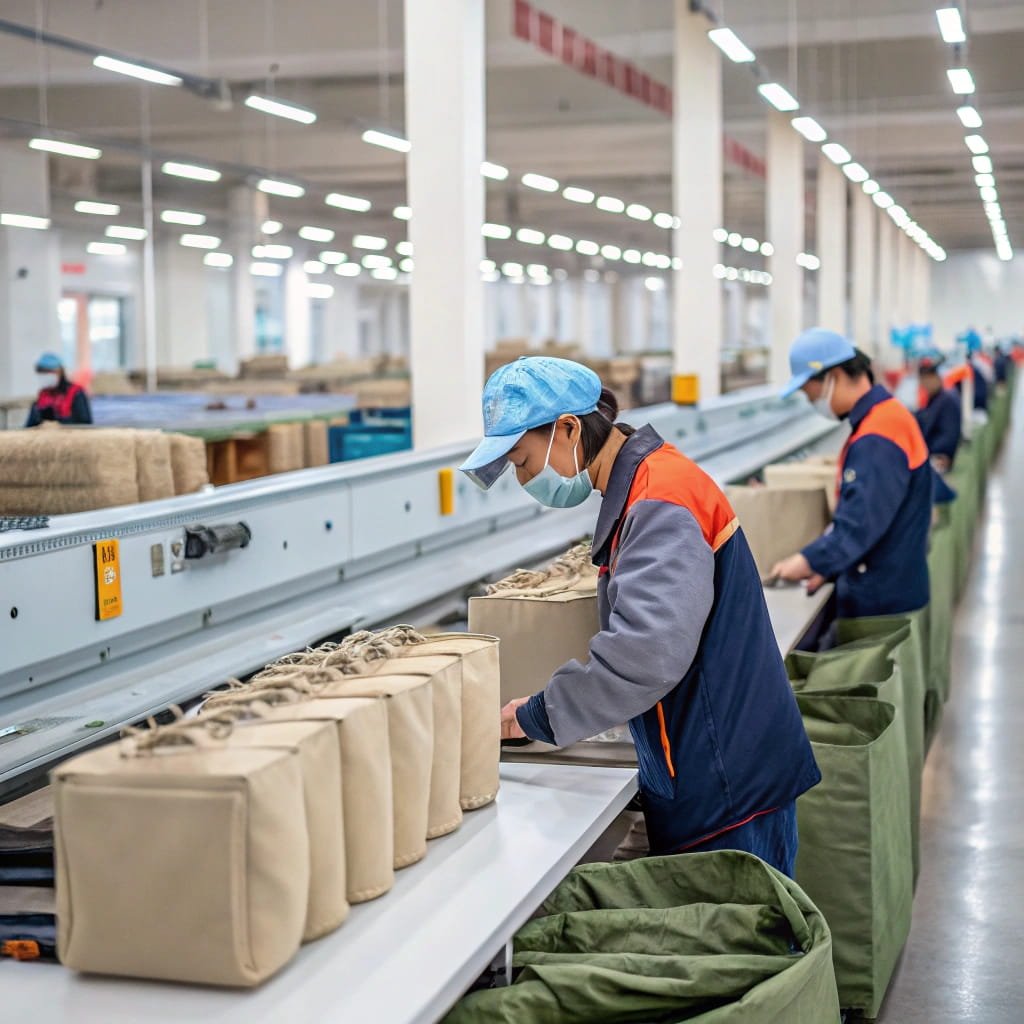
The FOB price may or may not include export packaging. Poly bags inside cartons, carton materials, pallet strapping, and container loading labor can add 0.05 to 0.15 dollars per unit. A factory that quotes a lower FOB price but charges packaging separately can end up more expensive than a factory with a slightly higher all-in price.
Specify packaging requirements in your RFQ: cartons per unit count, inner poly bag inclusion, pallet or floor loading, and shipping mark requirements. Request the per-carton CBM and weight to calculate your freight cost from FOB port to your destination, since the ICC Incoterms 2020 rules define exactly what the FOB price includes and excludes. Two factories at the same FOB price can deliver different landed costs if their carton dimensions produce different container utilization.
Payment Terms and Deposit Structures
The deposit ratio affects your cash flow and risk exposure. Standard terms for bag orders run 30 percent deposit with 70 percent balance against bill of lading. A factory demanding 50 percent or 100 percent upfront increases your financial risk without reducing the unit price. A factory offering 30/70 terms at a marginally higher unit price may be the better choice when you factor in the cost of capital and risk premium.
For first orders with a new factory, negotiate a smaller trial order at a slightly higher unit price to test quality before committing to full-volume production. A 500-bag trial at 2.50 dollars per unit costs 1,250 dollars. A 5,000-bag production run at 2.10 dollars that arrives defective costs 10,500 dollars plus return freight. The trial is cheaper insurance.
Building a Quote Comparison Spreadsheet
Create a spreadsheet with one row per factory and columns for each of the seven dimensions. Add a final column for “all-in per-unit cost” that sums the unit price, amortized setup, QC surcharge, packaging, and any other charges. This number, not the headline unit price, is what you compare.
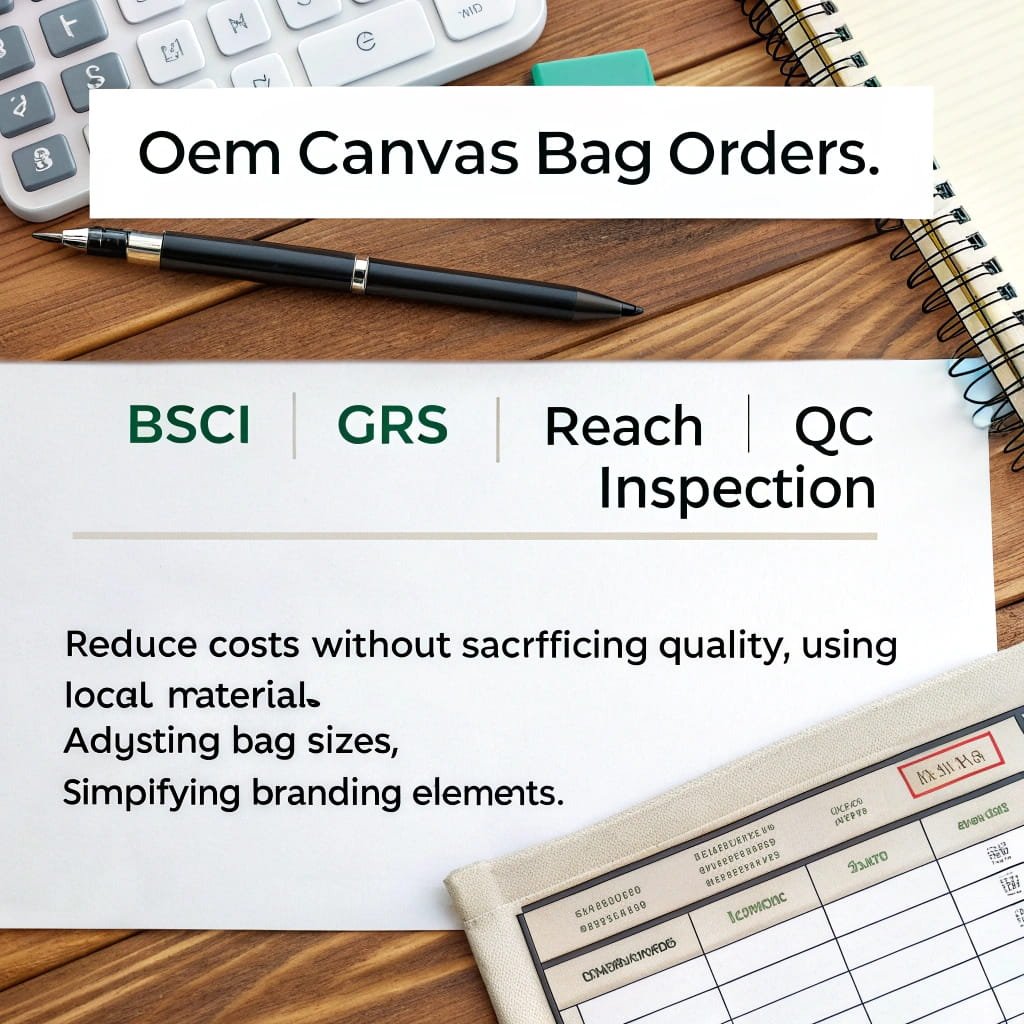
Include a “risk adjustment” column that adds 3 to 5 percent for factories without BSCI certification, 5 to 8 percent for factories without documented AQL inspection, and 2 to 3 percent for factories with lead times under 15 days (indicating possible quality shortcuts). These adjustments reflect the real cost of choosing an unverified supplier.
The spreadsheet makes the comparison mechanical rather than emotional. When three factories are scored on the same dimensions, the cheapest quote often reveals itself as the most expensive all-in option. The factory with the highest unit price frequently offers the lowest total cost when setup, QC, and packaging are included.
Заключение
Comparing three bag factory quotes is not about finding the lowest number. It is about normalizing what each quote includes and identifying the factory that delivers the lowest all-in cost per unit that meets your quality threshold. Build the comparison spreadsheet, score all seven dimensions, and let the math decide.
- Normalize specs first: Lock material GSM, dimensions, and print method before requesting quotes.
- Separate setup from unit price: Amortize one-time charges across the order quantity.
- Include QC costs: A factory without AQL inspection adds 3 to 8 percent in hidden defect costs.
- Factor packaging and freight: Different carton dimensions change landed cost even at the same FOB price.
- Add risk adjustment: Uncertified factories and unrealistic lead times carry real cost risk.
The factory that wins your order should win on all-in per-unit cost, not headline price. When the comparison spreadsheet reveals the cheapest quote as the most expensive option, you have done the analysis correctly.
Часто задаваемые вопросы
What is the most common hidden cost in bag factory quotes?
Setup and tooling fees are the most commonly excluded costs. Screen printing charges, heat transfer plate fees, and sample costs may not appear in the unit price but are billed separately. Always request a line-item breakdown separating one-time setup from per-unit production costs.
Why do bag factories quote different GSM materials at different prices?
GSM (grams per square meter) is the fabric weight and the largest cost driver. A 90 GSM woven PP costs 25 to 30 percent less than 120 GSM. Factories quoting lower prices may simply be using lighter material. Always specify the GSM in your RFQ to ensure apples-to-apples comparison.
Should I choose the factory with the lowest unit price?
Not necessarily. The lowest unit price often excludes setup costs, QC inspection, or packaging. Calculate the all-in per-unit cost by adding amortized setup, QC surcharges, packaging, and any other charges to the quoted unit price. Compare all-in costs, not headline numbers.
What AQL level should I specify for bag orders?
AQL 2.5 for major defects is the industry standard for textile products including bags. This means a maximum of 2.5 percent defective units is acceptable in a batch. Specify this in your RFQ and confirm the factory includes inspection at this level in their quote.
What payment terms are standard for bag factory orders?
Standard terms are 30 percent deposit with 70 percent balance against the bill of lading. Factories demanding 50 percent or 100 percent upfront increase your financial risk. For first orders, negotiate a smaller trial batch to verify quality before committing to full production volume.
After selecting a supplier, freight mode is the next cost decision. Our air vs sea freight guide breaks down 2026 rates by weight tier.
A complete tech pack makes quote comparison fair. See our bag tech pack guide for the specifications every quote should reference.
Once quotes are comparable, the payment terms for China bag orders decide which supplier structure actually protects your money.



0 комментариев