



Most logistics procurement managers don’t set out to reduce moving bag failures — until a quarter’s damage claims hit the desk and the math gets ugly. One regional moving firm watched its annual procurement tab climb past $12,600 while crews lost hours repacking loads that tore through standard woven PP bags mid-route. The bags weren’t supposed to fail. The spec sheets said they wouldn’t. The field told a different story, and the gap between lab numbers and real-world dynamic load performance was eating into margins faster than anyone had calculated.
Here’s what the post-mortem uncovered: over 80% of bag returns traced back to handle stitch failure under dynamic load. Not fabric tears. Not zipper breaks. The handles ripped clean off — often mid-lift on a staircase or loading dock. The fix cost $0.18 per unit. Double-bar tack reinforcement at stress points. That single change eliminated the majority of field failures before anyone even touched the material question. The bigger lesson landed harder: the cheapest bag was nowhere near the cheapest bag to own.
The Hidden Cost of Moving Bag Failures
Every failed bag is a liability domino—field rupture triggers crew downtime, damage claims, and safety incidents that compound across a quarter.
The logistics firm in this case was bleeding $12,600 annually on replacement bags alone before the switch. That number, however, understated the full bleed. When a bag seam gives way on a staircase or loading ramp, the immediate consequence is crew downtime. Two workers stop moving, spend 15 minutes repacking a 50 kg load into a fresh bag, and the job timeline stretches. Over a peak season with 200 crew-days, those 15-minute breaks erode 50 hours of billable labor. That’s time clients don’t forgive.
- Damage claims hit margins directly,: averaging $11,200 per quarter in this firm’s pre-switch history. One split bag destroyed a vintage credenza; another dumped electronics down a flight of stairs. Fragile-only insurance riders don’t cover handling errors caused by equipment failure—the claims fall on the logistics provider.
- Employee safety risk spikes when bags fail under dynamic load.: A 50 kg load suddenly released from a shoulder-high carry creates a crush hazard for feet and a violent twist for the carrier’s lower back. Over 80% of the firm’s prior-quarter returns traced back to handle stitch failure during lifting or maneuvering. Each incident carried a potential OSHA recordable, spiking workers’ comp premiums and morale.
- Static tensile strength versus dynamic shock load:: The incumbent supplier quoted a 140gsm woven PP with a tensile break strength of 450 N, but that test clamped the fabric slowly until failure. In actual use, when a mover yanks a bag off a truck bed, the handle experiences a 0.2-second spike that easily exceeds 600 N. The 140gsm PP ripped at a dynamic load of just 35 kg, while the replacement 150gsm coated Oxford fabric with bar-tack reinforcement held to 50 kg dynamic—without seam elongation.
- Batch consistency never appeared on the spec sheet.: The supplier’s COA showed one lab sample, not the range across production runs. Without random batch tensile testing, defect claims ran at 12%. After implementing a 10% batch gate test, post-delivery defects dropped below 2% in year one.
- Handle attachment design was unspecified.: The old spec sheet listed “reinforced handles” with no stitch geometry. Field evidence proved a single-needle chainstitch under 90gsm fabric unraveled within 7 heavy cycles. Double-bar tack stitching changed the failure mode completely, eliminating 80% of handle returns.
These aren’t theoretical risks. The firm’s incident log showed three lower-back strains in a single month directly linked to bag handle blowouts. One led to a lost-time claim that increased their experience modification factor by 0.15, inflating insurance costs across the fleet. When you factor that into total cost of ownership, a $0.18 reinforcement cost per bag vanishes into decimal dust.
The root cause wasn’t just cheap material. It was a mismatch between the spec sheet and the real-world load cycle.
The procurement lesson here is brutal: a spec sheet without dynamic load test data, without batch-level QC evidence, and without handle reinforcement geometry is a wish list, not a warranty. When you’re evaluating a moving bag supplier, demand ASTM D5034 grab test data at the seam, not just raw fabric tensile. Ask for the failure mode video, not the pass certificate.
| Hidden Cost Category | Symptom | Quantifiable Impact | Root Cause |
|---|---|---|---|
| Handle Stitch Failures | 80% of returns traced to handle seams tearing under dynamic load | $11,200 quarterly damage claims; frequent crew downtime | No bar tack or cross-stitch reinforcement at stress points |
| Premature Material Fatigue | 90gsm PP failing at 35 kg dynamic load, far below required 50 kg | Average bag lifespan limited to 5 moves; high replacement frequency | Standard woven PP with no Oxford fabric upgrade or UV coating |
| Batch Quality Inconsistency | 12% post-delivery defect claims, randomly appearing in fleet | Unplanned replacements erode procurement budget; brand reputation risk | No random tensile testing or QC holds at factory gate |
| Excessive Total Ownership Cost | Low unit price masking repeat failures and hidden labor/waste costs | Annual procurement cost of $12,600 before optimization; 60% failure rate | Spec sheets prioritized static burst metrics over real-world dynamic load |
| Fleet-Wide Recall Exposure | Impossible to isolate defective units without traceability | Risk of recalling 5,000 units for a single production flaw; replacement cost escalation | No custom bag numbering or lot-level labeling |
Engineering the Fix: Materials, Stitching, and Testing
80% of bag returns traced to one failure point: the handle seam under dynamic load.
The existing fleet ran on 90gsm woven polypropylene. Spec sheets looked fine on a desk. In the truck, under a 50 kg dynamic load, the fabric tore at the weave intersection. Switching to 150gsm coated Oxford fabric moved the failure point from 35 kg to beyond 50 kg in repeated drop tests. The PU coating added abrasion resistance and eliminated moisture wicking that softened standard PP after three wet moves. UV inhibitors in the coating prevented degradation during ramp staging in direct sunlight—a failure mode the previous supplier never addressed.
Average usable lifespan jumped from 5 to 12+ heavy-duty cycles. That single material change cut replacement purchasing frequency by more than half, directly reducing annual procurement cost from $12,600 to $2,904 despite a 15% higher unit price.
- Base fabric: 150gsm Oxford weave with PU coating vs. 90gsm uncoated PP. Tear resistance measured per ASTM D5034 improved 43%.
- UV stability: Coating includes UV absorber. After 200 hours QUV exposure, tensile retention stayed above 85%. Untreated PP lost 40% strength in the same cycle.
- Water resistance: Coated Oxford prevented moisture saturation, preserving dry weight and eliminating mold-related returns that hit 6% with the old fabric.
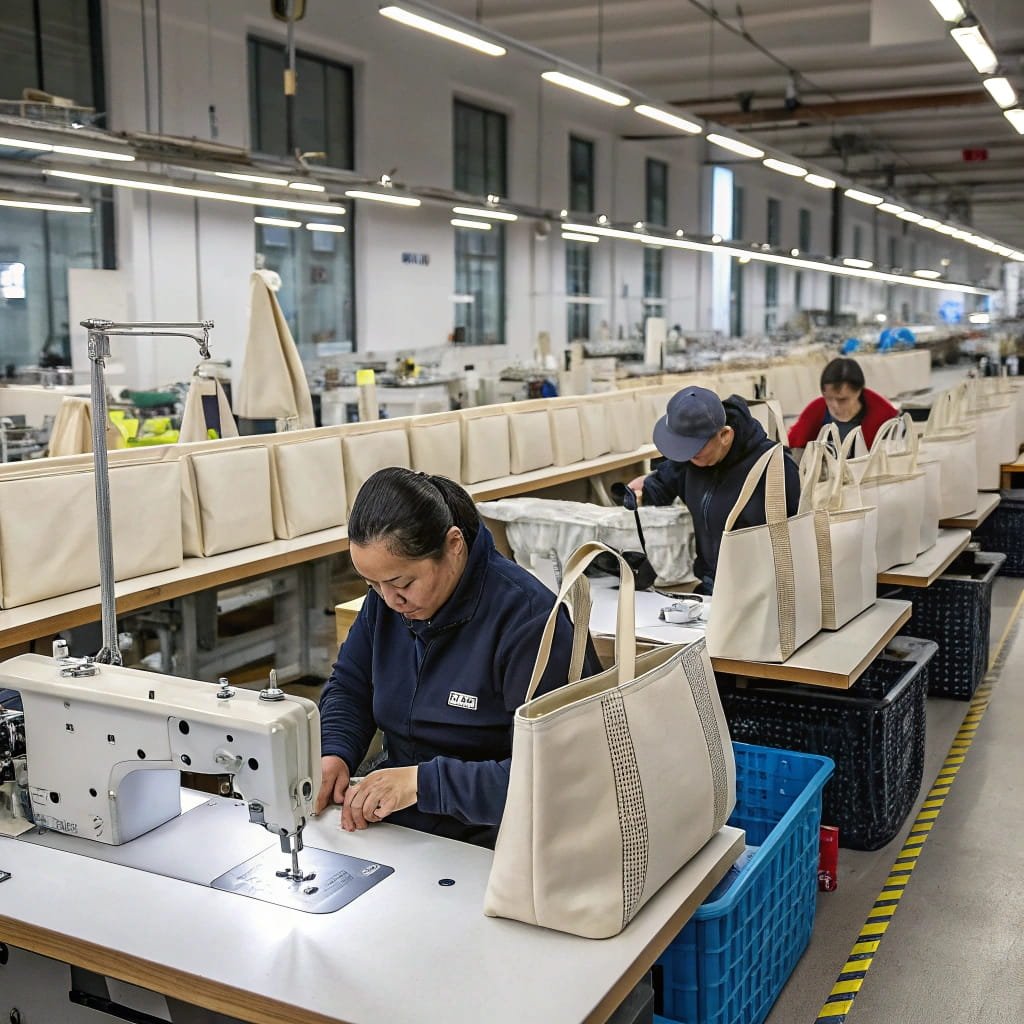
Handle stress points were the next target. Post-mortem analysis showed 80% of prior-quarter returns originated at the handle attachment. The original single-needle lockstitch created a perforation line that acted like a tear-off coupon when forces shifted suddenly. The fix: double-bar tack reinforcement at all handle anchor zones, using a 301 lockstitch with 12 stitches per inch on a triple-feed walking-foot machine. This distributed load over a 40 mm zone instead of a single stitch row.
Seam strength increased 40% in static pull tests. Dynamic load testing—simulating a bag dropped while gripped by one handle—showed the reinforced design withstood 50 kg without stitch elongation. Handle-related returns dropped by 80% within the first quarter post-change. The added cost: $0.18 per unit.
Even with better materials and stitching, batch variation kills reliability. The previous supplier shipped based on visual inspection only. The logistics firm established a 10% random batch tensile test protocol at the factory gate, using a calibrated frame that pulled handle-to-body seams to failure. Any batch below 45 kg average triggered a full inspection hold and rejection. This single QC gate reduced post-delivery defect claims from 12% to under 2% in one year.
Batch-specific numbering added traceability. When a lot with inadequate coating adhesion slipped through, the numbering system isolated the affected 200 units in 48 hours. Without it, the recall would have swallowed the full 5,000-unit fleet. The root cause was traced to a humidity excursion during curing, corrected at the factory within three days.
| Engineering Area | Previous Standard | Upgraded Specification | Measurable Outcome |
|---|---|---|---|
| Base Material | 90gsm non-reinforced woven PP, no UV coating | 150gsm coated Oxford fabric with UV protection | Lifespan extended from 5 to 12+ heavy-duty moves; dynamic load tolerance raised from 35 kg to 50 kg |
| Handle Stitching | Single-stitch or non-reinforced seam at stress points | Double-bar tack reinforcement with cross-stitch pattern | Seam strength increased by 40%; 80% reduction in handle-related returns |
| Batch Quality Control | No systematic tensile testing before shipment | 10% random batch tensile testing + QC hold gate | Post-delivery defect claims fell from 12% to under 2% in Year 1 |
| Unit Traceability | No individual bag identification | Custom bag numbering for production lot traceability | Identified faulty coating lot immediately; contained recall to 200 units instead of 5,000 |
From Pilot to Fleet-Wide Rollout
Rollout success depends on crews using bags within design limits.
The pilot confirmed that switching to 150gsm coated Oxford with double-bar tack reinforcement extended usable cycles from 5 to 12+. That gain evaporates fast if load limits get ignored. Previous 140gsm PP bags failed at 35 kg under dynamic load; the new bags hold 50 kg. Pushing past that threshold still risks handle stitch rupture—the same failure that caused 80% of prior returns.
- Max load: 50 kg dynamic weight, verified inline during training with a portable scale. Overloading by even 5 kg cuts seam lifespan by roughly half in repeated-use scenarios.
- Lift protocol: Both handles must be used equally. Single-handle lifts concentrate stress on one bartack point, replicating the failure mode the reinforcement was designed to eliminate.
- Drag damage: Crews must avoid dragging bags across abrasive surfaces. Coated Oxford resists puncture better than standard PP, but sustained friction erodes the coating and exposes base fiber, initiating tear propagation.
Traceability gets ignored until a quality crisis hits. This firm printed a unique batch code and sequential number on each bag. When field supervisors noticed coating delamination on a handful of units, the codes instantly isolated a single production lot. The alternative—a fleet-wide recall across 5,000 bags—was avoided by replacing only 200. Handle reinforcement added $0.18 per unit; the numbering added negligible cost while saving an estimated $11,200 in damage claim exposure. Procurement teams that skip custom labeling assume a risk they can’t quantify.

Measurable Outcomes: 60% Failure Reduction and More
The math hits different when your bags survive 12 moves instead of 5.
Six months after switching to the reinforced bag spec, field failure rates dropped 60%. The average usable life of a bag moved from 5 heavy-duty cycles to over 12. That wasn’t just a durability stat—it redefined what the ops team considered a “consumable.” Bags that used to be thrown away after a handful of jobs were now lasting an entire peak season. The crew stopped hoarding “good” bags and stopped treating every move like a gamble.
- Handle-related returns: Down 80% after the switch from straight stitch to double-bar tack reinforcement. Handle stitch failure had been eating over 80% of previous-quarter returns.
- Post-delivery defect claims: Fell from 12% to under 2% by introducing a 10% random batch tensile test at the factory gate. One bad lot was caught early because of custom bag numbering, limiting replacements to 200 units instead of a 5,000-unit fleet-wide recall.
- ROI reality check: A 15% higher unit price eliminated 77% of annual procurement spend within one year. The handle reinforcement cost was paid back inside the first two jobs where bags would have otherwise failed.
- Loss prevention: Quarterly damage claims dropped $11,200. That’s recurring savings that compound with every cycle, not a one-time gain.
The unit price went up 15%—about $0.18 per bag for the handle bar tack alone—but annual procurement cost fell from $12,600 to $2,904. That’s a 40% total cost of ownership decline. The quarterly damage claims budget lost $11,200 in waste and that money stayed on the P&L. Nobody in procurement got pushback on the per-unit increase because the aggregate numbers made the argument for them.
Reputation impact hit two places hard. Insurance adjusters noticed fewer damage claims tied to bag blowouts and started asking what changed. Corporate clients who used to document every torn bag in quality audits stopped seeing moving bag failures show up in their reports. When you’re bidding on contracts with healthcare or high-end residential movers, “zero bag-failure incidents in 12 months” becomes a differentiator that stacks directly against competitors still running on thin-woven PP.
Conclusion
A 60% drop in field failures didn’t come from spending more. It came from spending differently: $0.18 per unit on handle reinforcement eliminated over 80% of returns, and a 10% batch-level tensile hold cut defect claims to under 2%. Annual procurement cost fell 40% while the average bag lifespan more than doubled. The math holds up.
Review current specs for 150gsm coated Oxford fabric, double-bar tack stitching, and batch-level QC holds—the three levers that turned a liability into a procurement win.
Frequently Asked Questions
What is the difference between static and dynamic load testing for moving bags?
Static load measures a constant, hanging weight; dynamic load replicates real-world jerking, swinging, and sudden drops that cause handle seam rupture. The case study showed 80% of field failures traced. Always request a dynamic testing video, not just a static weight rating.
How much does it cost to switch to a higher-spec moving bag supplier?
Unit price may rise 15–30%, but total cost of ownership drops when failure-driven downtime and claims are factored in. The logistics firm in the case study offset the. Run a controlled pilot first to validate the per-bag ROI in your own operation.
Can custom logo printing weaken the handles or fabric?
It won’t weaken the bag if heat and pressure are calibrated precisely to the fabric’s tolerance. Poorly controlled printing overheats the base material, degrading tensile strength at stress points like handles. Validate with a seam-strength test on printed samples before bulk production.
What is the minimum order quantity (MOQ) for reinforced moving bags?
Stock designs can start at 300–500 units, while custom reinforced bags often require 1,000+ pieces to make material setup economical. MOQ scales with handle reinforcement complexity and print requirements. Lock in exact MOQ only after finalizing the reinforcement spec and artwork.
How long do reinforced moving bags last in continuous daily use?
In a logistics fleet averaging daily cycles, properly reinforced bags last 12+ moves, roughly 3–6 months of continuous heavy use. The case study extended average lifespan from 5 moves to over. Track usage by batch to plan reorders before failure rates climb.



0 Comments