



When you import custom packaging bags direct from a Chinese factory, the unit cost drops 30–50% compared to buying from a domestic middleman. That margin gap decides whether you win a retail chain contract or watch a competitor undercut you by twelve cents per unit. Most distributors figure this out after their third or fourth container. The ones who scale fastest figure it out before their first.
What separates a reliable supply line from a margin-eroding headache comes down to a handful of contract clauses most first-time buyers never ask for. A 3% defect allowance with free replacements. ASTM D5034 burst strength test reports on file. A 5% safety stock buffer on your top three SKUs so peak-season reorders don’t stall. Pallet wrap with corner protectors—because a crushed corner on 2,000 units wipes out the savings from a cheaper freight quote. The six steps that follow map out exactly where these levers sit in the sourcing process, so you negotiate from a position of hard data, not hope.
Understanding the Import Opportunity for Custom Packaging
Factory-direct sourcing can slash your unit cost by 30–50%.
Let’s skip the obvious. You already know China dominates packaging exports with a 28% global share. The real question is whether the math works for your SKU mix once you factor in freight, duties, and the risk of a 40-foot container full of bags that can’t hold a 50-pound load. If you’re stocking heavy-duty moving bags or premium retail totes for resale, the margin between a profitable line and a warehouse write-off usually comes down to three things: the factory’s raw material sourcing, the contractual defect allowance, and whether you negotiated like a distributor or a tourist.
- Unit Cost Compression: A 1,000-unit order for a standard laminated tote might land at $1.80 per bag. Push that to 10,000+ units and you’re staring at $0.90–$1.25. That 30–50% drop isn’t a theoretical range — it’s what happens when a factory can run a continuous production line for three days instead of stopping every four hours to change thread colors. The math gets even better if you standardize across two or three high-turn SKUs.
- Defect Allowance as Profit Protection: A 3% defect allowance with free replacement is non-negotiable. Without it, a single container with 5,000 defective bags — wrong stitch tension, handles tearing at 30 lbs instead of 60 — wipes out your entire margin on that shipment. Professional agreements bake this into the PI, and the factory pre-produces the replacement stock as part of the overrun.
- Structural Quality That Reduces Returns: The #1 reason your end customer returns a moving bag is burst failure at the seam or handle anchor point. Insisting on ASTM D5034 burst strength test reports — and reviewing them before shipment — is the difference between a 2% return rate and a 15% return rate. A factory that won’t provide these reports is hiding something in their GSM or stitching pattern.
Chinese factories that specialize in this niche — the ones that run BSCI-audited floors and stock 80gsm to 120gsm non-woven rolls by the ton — aren’t order-takers. They operate on throughput. If you approach them with a clean spec sheet, a 45-day lead time tolerance, and a commitment to a quarterly rhythm, you stop being a buyer and start being a production partner. That status unlocks things domestic middlemen can’t offer: fixed-tier pricing locked for 12 months, free sample kits credited against bulk orders, and a 5% safety stock buffer for your top SKUs held at the factory so you never hit zero during Q4.
One lever most distributors overlook entirely is the co-op marketing fund. Negotiate 2% of the order value back as a credit toward your sales team’s sample kits, swatch books, or a targeted trade show display. It costs the factory almost nothing and gives you a sell-through accelerant that your competitor down the street doesn’t have. Combined with pallet wrap, corner protectors, and FOB terms that put freight control in your hands, you’ve just built a supply chain with fewer damage claims and higher inventory turnover.
Step 1: Defining Your Custom Bag Specs and Requirements
Margin erosion starts here—most specs lack tensile data.
The single biggest mistake when defining a custom bag is describing a look without engineering a function. A factory presented with ‘heavy-duty tote bag’ will default to 80 GSM non-woven polypropylene and a single-stitched handle because that’s what the last 1,000 distributors asked for. You don’t want that bag because it fails when your customer’s customer loads it with 27 kg of books. You need to specify material by GSM and test method, internal dimensions to the centimeter, print process down to the underbase layer, and the exact certification codes your buyers require. Write none of this down, and the prototype you approve will not match the container that arrives.
- Material: Specify non-woven polypropylene (NWPP) or woven PP by exact grams per square meter. A 120 GSM laminated NWPP with cross-stitched handles is the floor for anything called ‘heavy-duty moving bag’. Request an ASTM D5034 burst strength test report—target ≥180 kPa. I’ve watched 100 GSM bags with raw-cut seams tear at 14 kPa in third-party labs; that’s one grocery trip, not a warehouse floor.
- Dimensions: Give internal usable dimensions in centimeters (L × W × H), not external body dimensions. For a standard 40×48-inch pallet, a bag measuring 58 × 38 × 28 cm internal fits two-abreast and maximizes container cube utilization by 14% over a 50 cm width. Add a 20 cm side and bottom gusset to prevent seam-splitting bulge.
- Print: Full CMYK with one or two Pantone spot colors is table stakes for custom retail packaging. On dark fabric, mandate a white underbase—skip it and your logo absorbs into the fiber, dropping print contrast by up to 40%. Acceptable file formats are vector (AI, EPS, PDF with outlined fonts). Raster images (PSD, TIFF) produce fuzzed edges at bulk production scale and will be rejected by any print technician who cares about repeat orders.
- Social compliance: BSCI or SMETA 4-pillar audit, grade C minimum, dated within 12 months. If a factory hesitates to share the report, they’re either unauditable or hiding corrected non-conformances. Walk away.
- Recycled content claims: GRS certification with transaction certificate (TC) for every batch. Budget $150–$300 per SKU for certifier verification. A supplier offering ‘eco-friendly material’ without a TC is selling standard virgin PP at a 20% markup.
- Toxics and heavy metals: For food-contact packaging or children’s items, mandate FDA 21 CFR or EN 71-3 migration test reports. I’ve seen an entire 20-foot container red-tagged at Long Beach because the yellow ink contained lead chromate pigment—a $0.03 cost cut that cost the buyer $34,000 in demurrage and destruction fees.
Certifications are the first page a customs agent flips to when your container arrives. If you’re supplying retail chains in Germany, the Netherlands, or California, you need BSCI audit reports dated within 12 months, showing a grade C or above. The same goes for any recycled content claim—GRS (Global Recycled Standard) certification is the only documentation that survives a greenwashing challenge. Store buyers have started verifying certificate numbers on the Textile Exchange database. A laminated rPET bag without GRS is just polyester, and your customer will price it as such.
Step 2: Vetting Chinese Manufacturers and Factories
Without a locked vetting process, container three is where margins vanish.
Most distributors vet a factory by watching a five-minute video of a sample being sewn. That satisfies curiosity but doesn’t protect a six-figure bulk order. A supplier must clear three hard checkpoints: a verifiable factory audit, sample evaluation against your purchase specs, and documented quality systems that survive a peak-season rush.
- BSCI or SMETA audit: Ask for the report, not just the certificate. A BSCI-audited facility with a C-grade means the system exists; an audit that’s three years expired means zero trust. If the factory won’t share the corrective action plan, walk.
- ASTM D5034 burst strength test: For heavy-duty moving bags, demand this report on the exact fabric lot—not a generic PDF from their supplier. Bags that burst under load are the #1 return driver from our end customers, and a single return shipment can erase 15% of a container’s profit.
- AQL 2.5 pre-shipment protocol: Accept nothing less. A factory that counters with ‘we check internally’ has no real QA department. Insist that the AQL 2.5 sampling plan names the defect categories, including print misregister and handle attachment strength.
- Red flag no. 1: The factory refuses to send a second sample made from a different raw material lot, claiming ‘consistent quality.’ In reality, they’re hiding lot-to-lot variance.
- Red flag no. 2: They quote a custom packaging bag supplier minimum order quantity of 500 units. Real factories producing custom printed heavyweight bags operate at 1,000 pieces MOQ minimum; below that, expect a trading company markup.
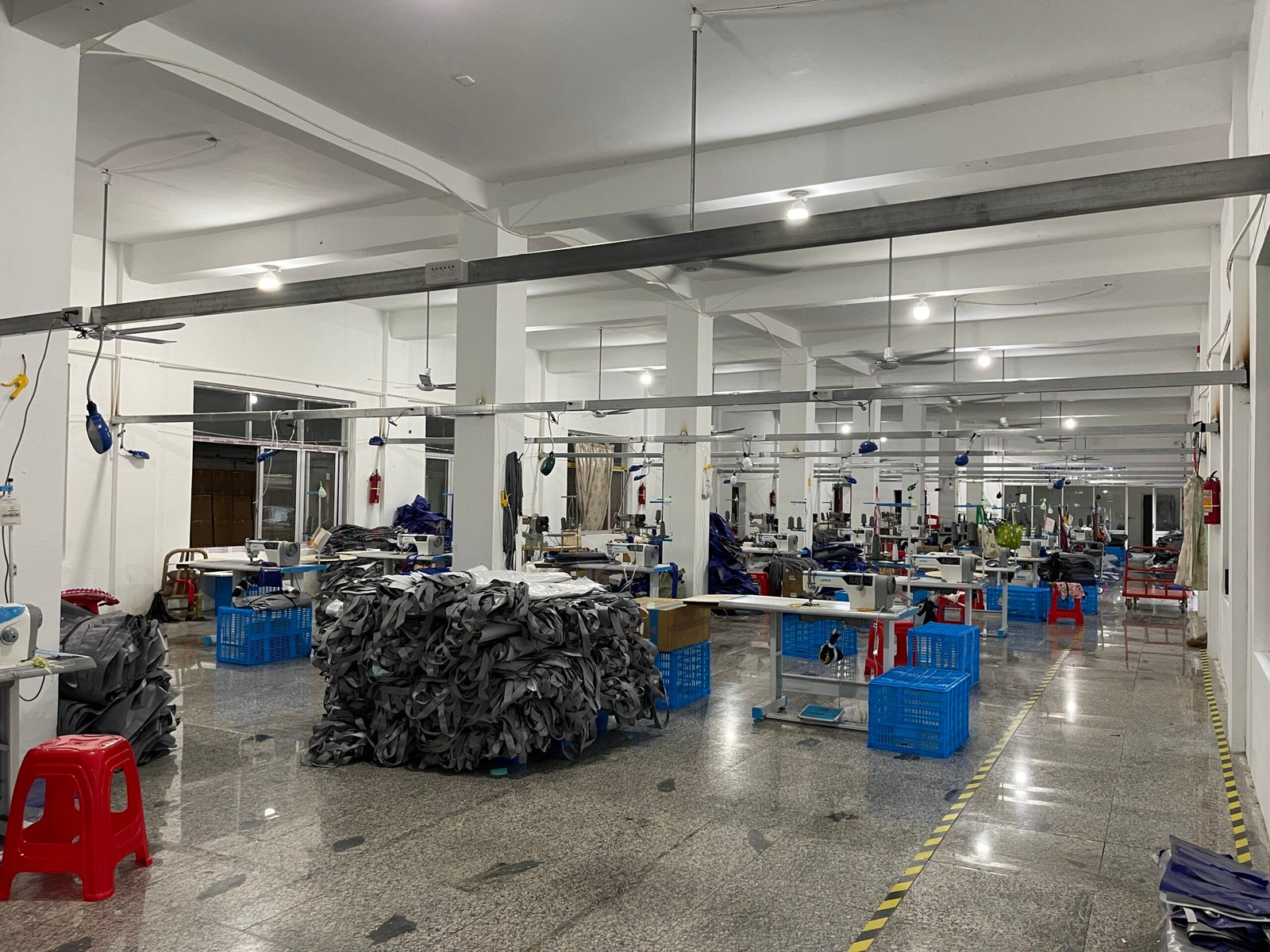
- Red flag no. 3: No in-house testing lab or designated QC staff visible on the production floor. Pre-shipment QC custom bags China cannot be subcontracted to a single inspector who shows up for five minutes.
Sample evaluation is where the gap between sample room and production line shows up. A $200–$300 sample fee is standard; it must be credited against the mass production invoice. But the sample itself only proves they can make one. You need a bulk production-spec sample: request the exact material weight, print method (CMYK screen or digital), and handle reinforcement that will run on the commercial line. Then measure stitch density with a simple seam gauge—seven stitches per inch on a non-woven tote is a minimum; anything looser fails after three uses.
Quality systems differ from audit paperwork. During a video walk-through, ignore the clean floor. Ask to see the quality defect log for the last three production orders. Any factory that doesn’t maintain a defect log will not honor a 3% defect allowance with free replacement. That allowance is the baseline of professional distributor agreements—without it written into the purchase contract, a single container of misprinted retail packaging wipes out your landed cost advantage.
Before committing to a tooling deposit, negotiate a 5% safety stock buffer clause on your top three SKUs. This is your insurance against a February rush when the factory is closed for holiday. A supplier that resists this clause does not intend to act as an extension of your warehouse—you’ll be left explaining backorders to your own retail accounts.
Step 3: Pricing, MOQ, and Payment Terms for Bulk Orders
Unit price is vanity; defect allowance is sanity.
When you import custom packaging bags from China, the single most powerful lever to slash landed cost is tiered volume pricing. At 1,000 units, a laminated non-woven tote might cost $0.85 per bag. Push the order to 10,000 units and the unit cost typically falls 30–50%, landing between $0.43 and $0.60. On a full container of 50,000 pieces, that swing represents over $21,000 in pure cost savings. This is why smart industrial distributors batch orders and negotiate a pricing table that rewards volume, not just a one-time PO.
- Tiered Discount Schedule: Negotiate clear price breaks at 1,000, 5,000, 10,000, and 25,000+ units. Each bracket should yield a 5–10% reduction from the previous tier. Without this documented in the sales contract, ‘volume pricing’ becomes a verbal promise that disappears when your order spikes.
- Defect Allowance Clause: The professional baseline is a 3% defect allowance with free replacement, measured against AQL 2.5. If you receive 1,000 bags, up to 30 can be flawed without eroding your margin—the factory replaces them at no cost or credits the value. Without this clause, a single container with 5% defects can wipe out your profit on the entire order.
- Price Validity Window: Raw material costs for custom packaging bags shift constantly. Lock supplier pricing for at least 90 days from the quote date, and include a formula for adjustments if the material index moves more than 5%. This prevents a sudden 15% increase mid-production that destroys your landed cost model.
- Sample & Mold Fee Credit: Sample fees ($200–$300) should be credited against the mass production invoice. Printing plate or mold costs must be stated upfront and amortized over the first production run so you know exactly when the breakeven point occurs.
Here’s the overlooked connection: tie the defect allowance directly to ASTM D5034 burst strength test reports. Bags that fail burst tests under heavy loads are the number one cause of return requests from end customers. If a tote tears at 40 lbs when it’s rated for 60, it’s not just a defect—it’s a relationship-killer with your own retail accounts. Insist that test results accompany every shipment, and classify any bag failing the rated strength as a defect counted toward your 3% allowance. This single requirement filters out suppliers that cut corners on fabric weight and protects your margin across every bulk order.
Step 4: Production, QC Inspections, and Pre-Shipment Checks
A 3% defect rate can wipe out a full container’s profit.
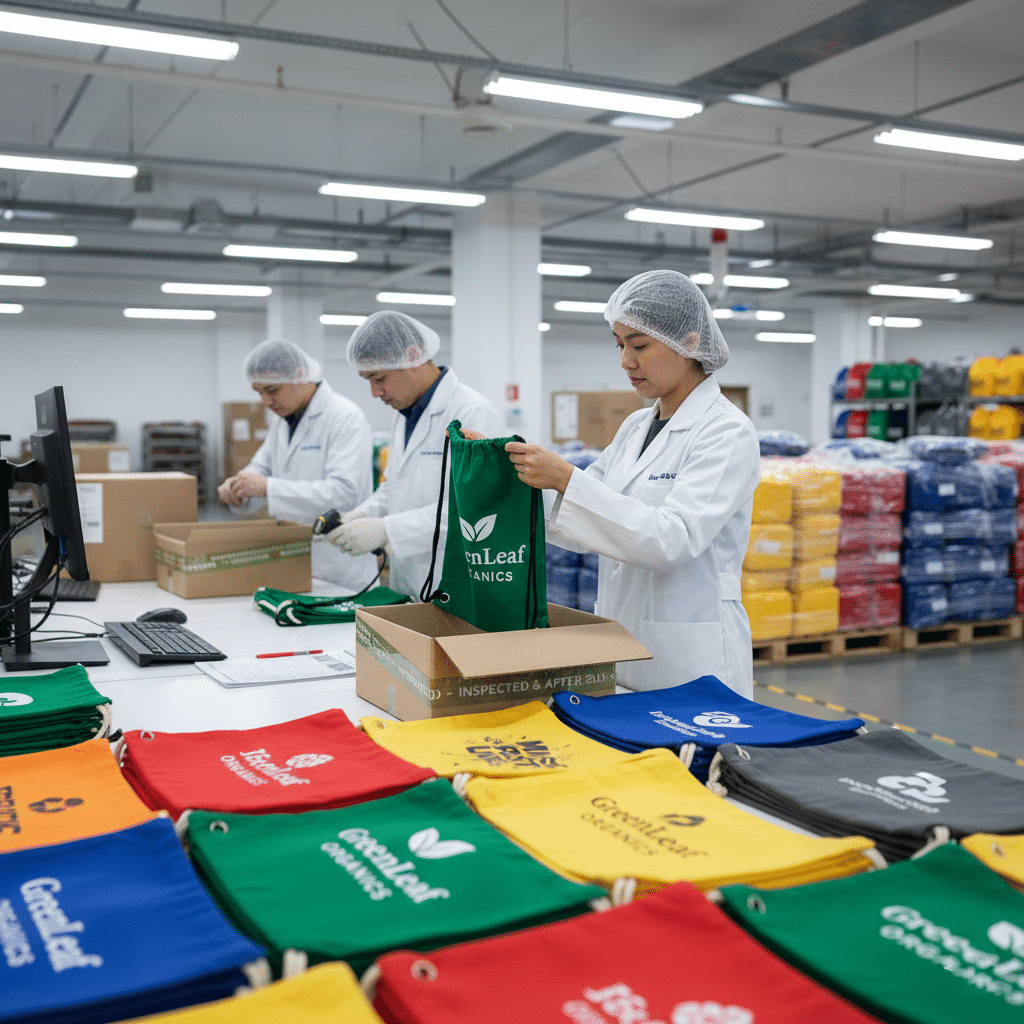
Production begins once your purchase order is confirmed and deposit paid. If quality control relies solely on a final inspection before shipping, you’re gambling with your inventory investment. Inline QC catches defects early—wrong stitch types, off-register prints, or substandard welding on laminated totes—while the run is still active, not after 10,000 units are already cut and sewn. Demand that your supplier follows AQL 2.5 sampling throughout the production line, with checkpoint reports at cutting, sewing, and printing stages. For bulk custom packaging bags from China, factory-direct suppliers that routinely provide hourly or shift-based inline data separate the professionals from the order-takers.
- ASTM D5034 Burst Strength Tests: Require test reports per batch. Bags that fail under their labeled load are the #1 return reason from end customers. This is non-negotiable for heavy-duty moving bags or storage totes. Request a copy of the lab report before the container seals.
- 3% Defect Allowance with Free Replacement: Write a 3% defect allowance into the contract with free replacement on the next order or credit. Without it, a container of bags with broken zippers or misprinted logos can erase your margin entirely. This is baseline for professional distributor agreements.
- AQL 2.5 Random Sampling: Pre-shipment QC inspections following AQL 2.5 are the industry norm for packaging bags out of China. If your supplier pushes back, find another factory. The inspection must cover visual defects, functional tests, and dimensional checks against your approved sample.
Overrun policy is the silent margin-killer. Factories routinely overproduce by 5–10% to cover defects, and then invoice you for the excess. Lock this down. Your contract must cap overruns at 5% maximum, with you only paying for what you accept. Some sharp distributors negotiate zero overrun—make the factory absorb the scrap and only deliver the exact PO quantity. Others choose to take the overrun at a slight discount as immediate safety stock, but that only works if you have warehouse space and a predictable sell-through. The key is that the overrun is your option, not an automatic charge.
Safety stock at the factory level separates distributors who never miss a peak season from those who frantically apologize to customers. Negotiate a 5% safety stock buffer specifically for your top 3 SKUs, held at the supplier’s warehouse on your behalf for 60 days post-shipment. This buffer lets you reorder instantly without waiting for a new 45-day production cycle. Combine this with FOB pricing and pallet wrap with corner protectors to keep landed cost predictable. The goal is to act like a factory-owned replenishment system rather than a distant importer. One overlooked lever: a 2% co-op marketing fund and pre-packed sample kits for your sales reps accelerate sell-through, turning the safety stock into a rapid-turn asset instead of idle inventory.
Step 5: Freight, Customs, and Last-Mile Logistics
Mess up logistics and you lose margin faster than any defective bag ever could.
Plenty of distributors leave 5 to 12 points of margin on the table simply by accepting the wrong Incoterm. FOB looks like more work on paper, but it puts you in control of freight, customs broker selection, and delivery timing. DDP can be convenient for the first container, yet the supplier’s markup to cover unknown destination charges often lands between 8% and 15%.
- FOB (Free On Board): You nominate the forwarder. Negotiate a 45-day production-and-ship guarantee. Pair it with a pallet-wrap spec and corner protectors to keep damage claims under 1%.
- DDP (Delivered Duty Paid): Supplier owns the entire chain. Suitable if you lack import history, but you pay a premium and lose visibility into actual freight cost. A single customs hold and your stock lands late with zero compensation.
Sea freight from Shanghai to US West Coast ports runs 20 to 40 days; air freight cuts that to 7 to 12 days. The real cost difference is not the freight bill alone—air freight can turn a 60-day stockout gap into a 5-day replenishment, saving repeat customer relationships that carry lifetime value. Splitting a 10,000-unit order into 8,000 by sea and 2,000 by air is a tactic industrial distributors use to buffer against peak-season demand spikes without warehousing excess.
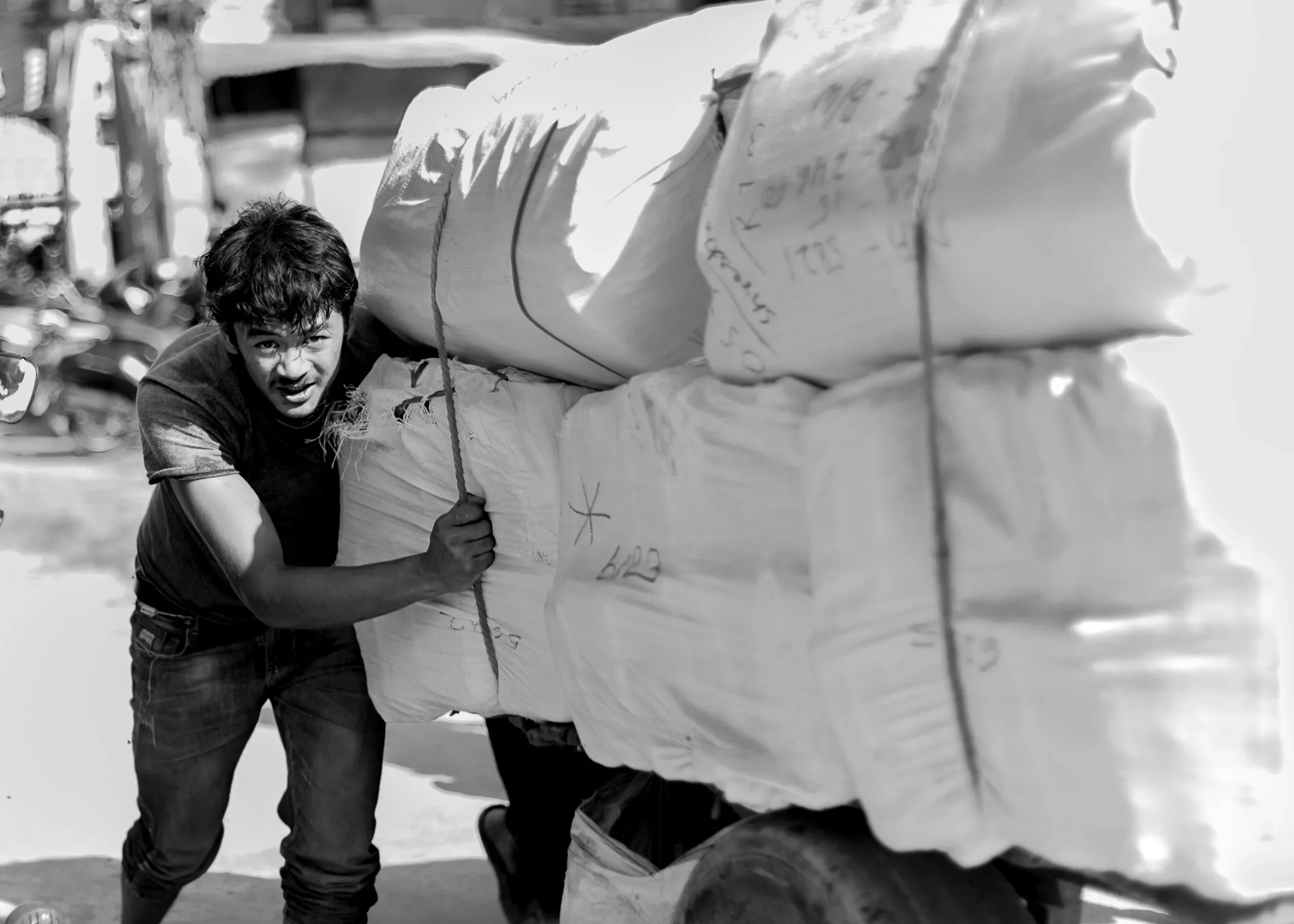
Damage during transit crushes your landed-cost math. Most freight claims originate from pallets that shift inside containers because they were loaded without corner protectors or adequate stretch wrap. Require the factory to use 3-inch corner protectors, wrap each pallet with a minimum of 5 layers of 80-gauge film, and strap pallets to prevent movement. This spec costs almost nothing to add during loading and is the single highest-ROI line in a purchase contract.
Customs clearance delays hit when HS codes are guessed, not verified. For heavy-duty moving bags and non-woven retail totes, the correct HTS classification often falls in Chapter 4202 or 6307, depending on material composition. A wrong code triggers a 25% duty versus a free-trade entry under the right chapter heading. Have your broker review the Bill of Lading against the packing list before the vessel departs—not after it docks.
Step 6: Receiving, Warehousing, and Repeat Orders
When the container lands at your warehouse, the first 48 hours determine whether this shipment protects your margin or carves a hole in it. Unload by PO line item. Pull a random sample of 50 bags per SKU immediately and run a quick burst test with a handheld gauge. If you negotiated the ASTM D5034 pass mark into your contract, you have a measurable standard—not a subjective feel—to reject a batch before any bags reach your pick shelves. Bags that split under load are the single biggest driver of end-user returns, so catching soft stock here saves you the downstream cost of processing RMAs and refunds.
Warehouse the accepted inventory by SKU with a hard rule: fast-movers get racking at shoulder height, no stacking beyond five layers unless the carton stamp says otherwise. Record the exact pallet count and date code in your WMS. Then enforce a 5% safety stock buffer above your normal reorder point for the top-velocity SKUs. This buffer isn’t dead money. It’s insurance against the 22 extra days a vessel can spend at anchor during peak season—22 days where you either ship from buffer or tell your best retail accounts you’re out of stock.
Reorder triggers must be formula-driven, not gut-feel. Calculate reorder point as (Average Daily Unit Sales × Lead Time in Days) + Safety Stock. Factor in the 45-day production lead time you locked into the contract, plus ocean transit. If your supplier offers DDP delivery, use landed dates, not vessel departure dates, to avoid a two-week blind spot. Review velocity every month; a SKU that suddenly doubles its run rate needs the reorder point adjusted within 48 hours, not at the next quarterly review.
- 3% defect allowance with free replacement: Count every defective bag upon receiving and file a claim within the agreed window. Without this clause, a container with a 4% failure rate can turn a 28% margin SKU into a 6% loser after processing costs.
- 45-day lead time guarantee with penalty: A supplier who misses the contracted ship date should compensate with a 2% price reduction or free shipping on the next order. This aligns their production scheduler with your shelf-fill rate.
- 5% safety stock at factory: Negotiate that your supplier holds 5% of your average quarterly volume as finished goods. You pay only upon release, but it cuts your emergency reorder lead time from 45 days to 5.
- Co-op marketing fund and free sample kits: A 2% co-op fund off invoice value gives your sales team branded sell sheets and buyer samples without chewing into your own SG&A. Distributors who ignore this lever leave a margin point on the table every order cycle.
Building a supplier partnership that acts like your production arm means moving beyond transactional RFQs. Share a rolling 12-month forecast every quarter, even if it’s rough. A factory that sees your projected volume will reserve capacity and, critically, will not reallocate your slot to a spot buyer willing to pay 5% more. Lock in tiered pricing with a written review clause: if your annual volume crosses 50,000 units, the unit cost retroactively adjusts on the next purchase order. Suppliers that push back on forecast sharing are signaling they view you as a one-off buyer—find one that treats your warehouse as an extension of their factory floor.
Conclusion
Sourcing custom packaging bags from China becomes a repeatable margin driver when you lock in three numbers: 30–50% lower unit costs on 10,000+ piece orders, a contractual 3% defect allowance with free replacements, and ASTM D5034 burst test reports that keep heavy-load failures off your return pile. Each step in the framework—from vetting the factory to palletizing with corner protectors—protects your landed cost and inventory turnover. Get those contracts right, and the supplier operates like an extension of your own warehouse.
Review the custom retail packaging capability overview to see how factory-direct high-grammage totes, full CMYK printing, and tiered bulk pricing can work for your next product line.
Frequently Asked Questions
Is it safe to import packaging bags from China?
Yes, it is safe when you vet factories with on-site audits, review certifications like BSCI or ISO, and conduct quality inspections before shipment. Risk lies in unverified suppliers, not the country of origin. Always lock a QC inspection clause before production begins.
What is the MOQ for custom packaging bags?
MOQ typically starts at 500–1,000 pieces for custom-printed standard bag styles. Fully custom dimensions or materials push MOQ higher, often to 2,000+ units. Negotiate MOQ only after the spec sheet and print design are final.
How long does shipping take from China for bulk packaging bags?
Ocean freight to a US port averages 25–35 days, then allow 7–10 days for customs clearance and last-mile delivery. Air freight cuts transit to under a week but multiplies cost. Use sea freight as your baseline and plan inventory 6–8 weeks ahead.
How can I reduce import costs on packaging bags?
Maximize container utilization by ordering full pallet loads and avoid split shipments. Choose FOB terms and negotiate freight independently instead of accepting factory DDP markups. Calculate true landed cost, not just unit price, before comparing quotes.
Do I need certifications for packaging bags imported from China?
Certifications depend on end use: food-contact retail bags often require FDA compliance, while heavy-duty moving bags typically need CPSIA lead/phthalate testing. Always verify with a third-party lab. Confirm exact certification needs with your compliance partner before ordering.

0 Comments