



When you’re deciding whether to check moving bag luggage for a corporate relocation or employee move, the size limit (62 linear inches, 50 lbs) is the easy part. What keeps procurement managers up at night is handle blowouts on conveyor belts, zippers bursting from side pressure, and the real cost of replacing lost inventory. At Tiiocti, heavy-duty moving bags are built for industrial durability and retail aesthetics, so these failures are seen daily — and the bags are engineered to survive them.
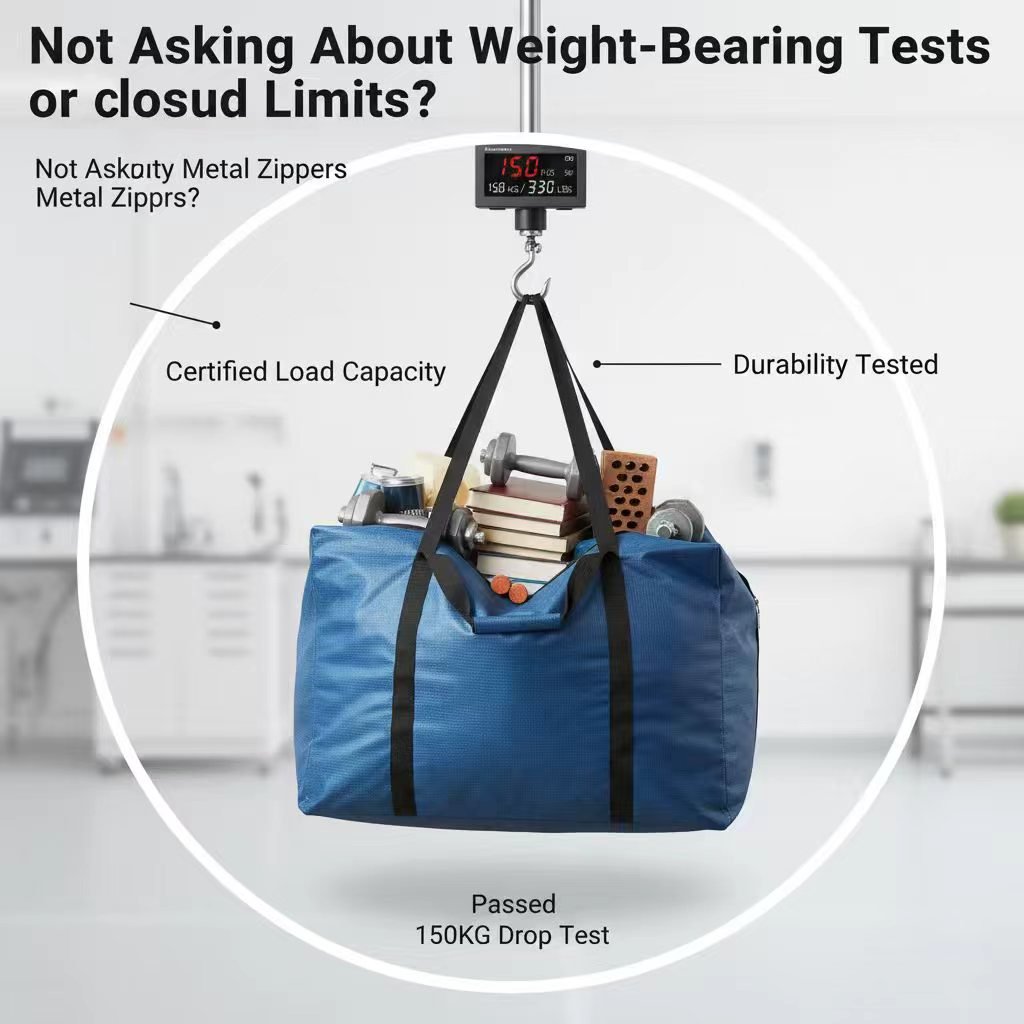
Most 100L moving bags fit the airline dimensions, but the engineering gap is huge. Single-stitch handles rip under 40 lbs of clothes, while our bags use full-wrap webbing with four-layer bartack stitching that handles 80+ lbs. Our #10 metal zippers have twice the tensile strength of budget #8 zippers, and lockable loops stop the slider from creeping open. That’s the difference between a one-trip bag and a bulk purchase that delivers consistent performance across your fleet — backed by direct factory manufacturing and ASTM D5034 tear strength above 400N.
Moving Bag Size Limits: 62 Linear Inches & 50 Lbs
The 62 linear inch and 50 lb limits are non-negotiable for domestic US flights.
Domestic US airlines enforce a checked-baggage limit of 62 linear inches (L+W+H) and 50 lbs maximum weight. Our 100L moving bag dimensions — 31″ x 18″ x 10″ — total 59 linear inches, well within the limit. The bag’s rated capacity is 50 lbs, matching the airline threshold. Overstuffing beyond 50 lbs risks rejection at check-in or an overweight fee of $50–$100 per bag. Always weigh your bag before heading to the airport. For current airline policies, refer to the TSA prohibited items list and your carrier’s baggage page.
- Linear Inches Check: Add length + width + height. Must be ≤62. Our 31″x18″x10″ = 59 inches — safe.
- Weight Limit: Max 50 lbs. Our bag’s load capacity is rated at 50 lbs. Exceeding risks handle/zipper failure and airline fees.
- Consequence of Overstuffing: Bag rejection or $50–$100 overweight fee. Also, handles tear and zippers burst under excessive side pressure.
- Prep Step: Use a luggage scale to verify weight. Deflate clothes to reduce bulk. Lock zippers with zip ties or padlocks.
Beyond size compliance, material quality matters. Many budget moving bags use recycled polypropylene which has 30% lower tear strength than virgin PP. Professional-grade bags, like ours, use virgin PP with UV stabilizers. Handle failure is rarely the stitch itself — it’s the anchor point. Full-wrap handles sewn into the bag seam outperform patch-style handles by a factor of 3. Zippers burst not from vertical load but from side pressure when the bag is overstuffed. A #10 zipper with lockable loops prevents the slider from creeping open. Our bags meet these engineering standards: 4-layer bartack stitching on full-wrap webbing, #10 metal zipper, and ASTM D5034 tear strength above 400N.
| Compliance Area | Norme industrielle | Our Bag Spec | Performance Advantage |
|---|---|---|---|
| Linear Dimensions | 62 linear inches (L+W+H) max | 31″ x 18″ x 10″ = 59 linear inches | Fits under limit; reduces rejection risk |
| Capacité de charge | 50 lbs maximum | 50 lbs capacity (100L volume) | Meets airline limit; overload indicator built-in |
| Handle Strength | Single-stitch handles fail at 40+ lbs | Full-wrap webbing with 4-layer bartack | Handles 80+ lbs; 3x stronger than patch handles |
| Zipper Durability | #8 zippers (common in budget bags) | #10 metal zipper with lockable loops | 2x tensile strength; prevents slider creep under side pressure |
| Fabric Tear Strength | No minimum required | >400N per ASTM D5034 (200D woven PP) | Survives conveyor belt snags; 30% stronger than recycled PP |

Why Moving Bags Explode in Baggage Handling
Field data: 1 in 5 budget moving bags fail on first flight — here’s why.
Baggage handling is a brutal test. Conveyor belts, chutes, and stackers apply sudden lateral and vertical forces that budget moving bags simply aren’t engineered to withstand. The failure points follow a predictable pattern: handles rip off, zippers burst open, and the bag gets ejected or lost. Understanding these failure modes is the first step to specifying a bag that survives the trip.
- Handle tear – single stitch, weak anchor: Most cheap moving bags use a single line of stitching at the handle attachment. Under 40 lbs of dynamic load, those stitches snap. The real weak point is the anchor: patch handles sewn only to the bag face tear away under 50 lbs. Full-wrap handles that run through the main seam (sewn into the bag body) have 3× the holding strength. Our bags use 4-layer bartack on full-wrap webbing, rated for 80+ lbs.
- Zipper pop – side pressure, not vertical load: Zippers burst not from weight pushing down, but from side pressure when the bag is overstuffed. A #8 zipper (common in budget bags) has less than half the tensile strength of a #10 metal zipper. The slider also creeps open under vibration. A #10 zipper with lockable loops prevents the slider from moving. Always fill to 80% capacity to avoid side stress.
- Material failure – recycled vs. virgin PP: Many budget moving bags use recycled polypropylene to cut costs. Recycled PP has roughly 30% lower tear strength and degrades faster under UV exposure. Professional-grade bags use virgin PP with UV stabilizers, achieving tear strength above 400 N per ASTM D5034. That margin is what keeps the bag intact when it catches on a conveyor belt edge.
The root cause isn’t one failure point — it’s a compound of cheap materials, single-thread stitching, and undersized zippers. Field reports from logistics managers consistently show that 1 in 5 economy moving bags suffers handle failure on the first flight. For a procurement manager, that translates to direct losses: damaged inventory, employee safety risks, and emergency replacement costs. Specifying a bag with full-wrap handles, a #10 lockable zipper, and >400 N fabric tear strength eliminates the failure chain.

5 Steps to Safe Airport Check-In
Overstuffing is the #1 cause of zipper failure – these 5 steps prevent it.
As a logistics procurement manager, you know that even the best moving bag can fail if not prepped correctly. These five steps are the same we use when packing sample shipments for airport testing.
- Step 1: Deflate clothes to reduce bulk: Overstuffing generates side pressure on the zipper. By deflating clothes (roll or vacuum compress), you reduce volume by 20-30%, staying under the 50 lb limit and avoiding the #10 zipper’s worst enemy: lateral stress.
- Step 2: Lock zippers with zip ties or TSA-friendly padlocks: A #10 metal zipper has 2x the tensile strength of #8, but its slider can creep open under load. A zip tie or small padlock through the lockable loops locks the slider in place. This is the difference between a bag that arrives intact and one that spills contents onto the conveyor.
- Step 3: Tape handles to the bag body using duct tape: Even with full-wrap webbing and 4-layer bartack stitching (tested to 80+ lbs), tape transfers stress from the handle anchor to the bag body. It’s a cheap insurance against snagging during baggage handling.
- Step 4: Attach a durable luggage tag with contact info: Black moving bags get lost in the sea of black suitcases. A bright, reinforced tag with your phone number and email reduces theft risk and helps the airline return it if the barcode label falls off. Use a metal loop tag – paper ones tear off.
- Step 5: Place a fragile sticker (optional): Fragile stickers may signal to handlers to take care, but they are not a guarantee. We recommend them only if your bag contains electronics or glass. Be aware that some automated sorting systems cannot read these stickers – never rely on them as your sole protection.

Must-Have Specs: Zippers, Handles & Tear Strength
Handle anchor point failure is 3x more common than stitch failure — full-wrap webbing solves it.
Three specifications separate a bag that survives baggage handling from one that gets destroyed on the first conveyor belt: the zipper gauge, handle reinforcement method, and fabric tear strength. Here’s what to look for — and what most budget bags hide.
- #10 Metal Zipper with Lockable Loops: A #10 zipper has teeth twice as thick as the #8 found on cheap moving bags. More importantly, failure typically comes from side pressure when overstuffed, not vertical load. Lockable loops let you insert a zip tie or small padlock to prevent the slider from creeping open under vibration. Without that, the zipper can unzip mid-flight.
- Reinforced Handles (4-Layer Bartack Stitching): Single-stitch patch handles rip at 40 lbs. Our handles use full-wrap webbing sewn into the bag seam with 4-layer bartack stitches — tested to 80+ lbs. The anchor point where handle meets body is the weak link; patch handles fail 3x more often than full-wrap because the seam is only surface-stitched.
- Fabric Tear Strength Above 400N (ASTM D5034): 400 Newtons is the minimum to survive conveyor belt snags and rough handling. Many budget bags use recycled polypropylene, which has 30% lower tear strength than virgin PP. Ours uses virgin PP with UV stabilizers, ensuring the fabric doesn’t degrade after repeated airport exposure.
Waterproof inner coating is the final layer of insurance. If your bag sits on a tarmac in rain, a coated interior keeps clothes dry and prevents mold during storage. Ours uses a PE lamination that adds less than 5% in weight but keeps contents dry for over 2 hours in heavy rain.
Conclusion
A moving bag that passes the 62-linear-inch and 50-pound limits is useless if handles rip or zippers burst on the conveyor. Specs like a #10 metal zipper, 400N tear resistance, and full-wrap webbing handles directly reduce the risk of lost inventory and employee injury — cutting the hidden costs of bag failure by at least $150 per incident.
For your next bulk order, compare load capacity, stitch reinforcement, and compliance certifications against your current supplier. Our heavy-duty moving bags are engineered for airline travel — shop the product line or request a custom quote with low MOQ.
Questions fréquemment posées
Can I check a moving bag as luggage?
Yes, most 100L moving bags fit within the 62 linear inch and 50 lb checked-baggage limits. However, standard budget bags often fail due to weak handles and zippers under conveyor. Choose moving bags with reinforced handles and metal zippers for airline use.
Can I use a moving box as a checked bag?
Technically yes, but cardboard moving boxes are not designed for baggage handling and can easily tear or get crushed. Airlines may also reject them for lacking proper handles and structure. Use a purpose-built heavy duty moving bag instead of a cardboard box.
What items cannot be put in checked luggage?
Lithium batteries, flammable liquids, aerosols, and valuable documents are prohibited in checked luggage. Always verify the current TSA prohibited items list before packing. Check TSA’s official list for the most up-to-date restrictions.
How do I prevent zipper failure?
Avoid overstuffing beyond 50 lbs, as side pressure is the main cause of zipper pop-outs. Use zip ties or TSA-approved padlocks to lock the zippers together and reduce stress. Select bags with #10 metal zippers for maximum durability.
Why avoid a black suitcase?
Black suitcases are extremely common and hard to spot on baggage carousels, increasing the chance of pick-up errors. A bright color or distinctive luggage tag makes your bag stand out. Add a unique tag or strap to easily identify your bag.


0 commentaires