




I learned the hard way that a bag factory audit checklist isn’t a paperwork exercise. Six years ago, a $50,000 order of heavy-duty moving bags landed at a Rotterdam warehouse. The pre-production sample had passed every visual check—clean double lockstitch, even tension on the handles, GSM right on spec. The mass production run that arrived three months later? The handles tore at 32 kg when the sample had held 55 kg without fraying. The spec sheet and the container told two completely different stories. That gap between what gets approved at sample stage and what rolls off the line at 2:30 PM on a Thursday is exactly where your margin disappears.
Capacity questions belong in the audit too; the capacity verification guide lists the ten questions.
Most logistics procurement managers I work with don’t get burned on obvious defects. They get burned on quality tolerance drift—small, incremental shortcuts that accumulate across 10,000 units. A thread tension that creeps from 3.5 to 2.8 on the dial. A fabric roll from a secondary supplier that slips into batch three because the primary mill was short. The factory’s own QC might catch 40% of these shifts. The rest end up on your dock. That’s why a proper moving bag quality control checklist has to go deeper than scanning an ISO 9001 certificate and nodding at the sample room wall. You need to see the stitching floor at mid-shift when the supervisor isn’t guiding the tour. You need to pull three random bags from the last production run that wasn’t staged for your visit. You need to ask for a live burst test on the spot—not a lab report from six months ago.
I’ve walked through 14 factories across Wenzhou, Gujarat, and Ho Chi Minh City in the last decade auditing suppliers who quote FOB pricing on heavy-duty woven PP and Oxford fabric bags. A few patterns keep repeating. The raw material warehouse tells you more in ten minutes than the conference room does in two hours. The calibration logs on sewing machines reveal whether maintenance is reactive or preventive. And the factory’s willingness to simulate a 50 kg dynamic load over 50 full cycles—not just a static pull test—separates suppliers who understand logistics-grade durability from those who’ve only made retail totes. If you write down one benchmark from this article, make it that one: 50 kg, 50 cycles. Say it on your next supplier call and watch how they respond. The hesitation tells you everything.

Why a Factory Audit Is Critical for Heavy-Duty Bag Procurement
If you trust a lab report, you’re trusting a staged performance.
A logistics procurement manager I worked with signed off on a 50,000-unit order of heavy-duty moving bags. The pre-production sample handled a 40 kg static load without a seam pop. Six weeks later, the container landed, and out of the first pallet, 12 bags failed at 22 kg. The root cause? Inconsistent thread tension across the stitching floor — a detail no ASTM D5034 certificate ever required the factory to disclose. That single oversight turned a $50,000 shipment into a warranty nightmare.
Most sourcing playbooks tell you to review test reports and ISO 9001 certifications before placing an order. That advice is not just incomplete — it’s dangerous. A factory can pass a document audit and still ship garbage, because certificates only prove a controlled sample passed a single test on a single day. What you need to verify is whether material integrity, stitch quality, and load-cycle durability hold up during actual production, when margins are tight and nobody is watching.
- Material traceability beats certification: Blending recycled polypropylene offcuts into new fabric is a common cost-cutting move. A live burn test on the factory floor — PP melts like candle wax instead of producing acrid black smoke — instantly flags contaminated batches. Without that, you’re buying bags that might fail after three moves.
- Stitch tension inconsistency: A factory quoting ASTM D5034 compliance can still run 20 sewing machines, four of which are off-spec. Hand-held tension meters, applied mid-shift on random stations, reveal whether double lockstitch consistency meets your quality tolerance before mass production starts.
- Static vs. dynamic load testing: Factories certified for retail bags rarely own a dynamic cycle tester. Insist on witnessing a 50 kg load lifted and dropped 50 times — not a single static pull test — to simulate a mover yanking handles on a staircase. If they can’t show it, their bags haven’t been validated for real-world logistics.
Skip the factory audit, and you’re accepting FOB pricing terms without knowing whether the goods will ever leave the warehouse intact. A physical walkthrough — especially the stitching floor at mid-shift, when operators are under pressure — exposes throughput bottlenecks and material shortcuts that sample approval alone never will. In heavy-duty bag procurement, a certificate proves you asked the right questions. An on-site audit proves you got the right answers.

Pre-Audit Preparation: Documents, Samples & Communication
Documents expose factory truth before you step on a plane — ask for raw data, not polished summaries.
I’ve walked into a supplier meeting holding an ASTM D5034 certificate that looked perfect, only to discover the lab report was three years old and the factory had switched polyester suppliers twice since then. A test report only matters if it’s tied to the material lot you’ll actually receive.
- ASTM D5034 fabric grab test: Request the most recent report, verify it uses 300 mm/min pull speed, and check the date. If the report is older than 12 months or doesn’t reference the specific 600D Oxford or woven PP you’ve spec’d, treat it as expired.
- ISO 9001:2015 certification: Don’t accept the wall certificate. Ask for the internal audit schedule from the last two quarters. A factory that can’t show corrective action logs for stitching defects or material fraying is running a paper compliance program, not a quality system.
- Third-party lab correlation: If possible, benchmark their in-house tensile tester against an ILAC-accredited lab. Tension calibration drift of 5-8% is common on aging Chinese universal testing machines; a factory that never cross-checks will ship weak handles.
- Material scope: Demand a live burn test for polypropylene vs. polyester mix. If the factory won’t pull raw material from the warehouse floor with you present, assume they’re hiding regrind.
- Stitching scope: Bring a hand-held tension meter. Walk the line mid-shift and measure thread tension on at least five random machines. If tension varies more than 20% between stations, the batch will fail dynamic load testing.
- Capacity scope: Don’t ask for maximum daily output; ask for sustained daily output over the last 90 days. Compare that against your order size and buffer time. A factory quoting 50,000 bags/day but shipping 20,000 on its best month is lying at your expense.
- Compliance scope: Include heavy-load simulation capability: factory must demonstrate a 50 kg bag cycled 50 times without stitch elongation > 3 mm. Many retail-oriented suppliers simply don’t have the jigs; without it, you’re gambling on handle integrity.
- Spec sheet must include stitch type and SPI: Don’t let them write ‘double stitched.’ Specify exactly: lockstitch ISO 4915 No. 301, 8-10 stitches per inch for all handle attachment points. Vague specs invite corner-cutting on stitch density.
- Material traceability in sample tag: The sample should arrive with a fabric swatch certificate showing the exact GSM and composition. Retain that swatch; during the on-site check, compare it against bulk rolls to catch mid-production material drift.
- Quality tolerance agreement upfront: Negotiate a paper tolerance before samples ship: for every 1,000 bags, no more than 2% deviation in stitched handle length and no loose threads over 5 mm. Put it in the purchase order — not just a verbal promise.
Scope creep during a factory audit is a budget killer. Before I visit a heavy-duty moving bag facility, I lock down exactly what we’re testing: fabric GSM compliance (not just the label), double-needle lockstitch tension on all load-bearing seams, real daily capacity not just machine count, and social compliance documentation. Without a defined scope, you’ll spend four hours discussing color pantones and miss the conveyor that breaks down every Tuesday.
Pre-production samples aren’t a courtesy — they’re your contract in physical form. I require three identical PP samples delivered against the same spec sheet we’ll use for production, complete with FOB pricing breakdown, fabric mill name, and color lot number. If the sample approval process takes more than two weeks, the factory’s sample-to-production alignment is weak.

On-Site Inspection Checklist: Materials & Production Line
Walk the floor at 2 PM, not 9 AM—that’s when real throughput becomes visible.
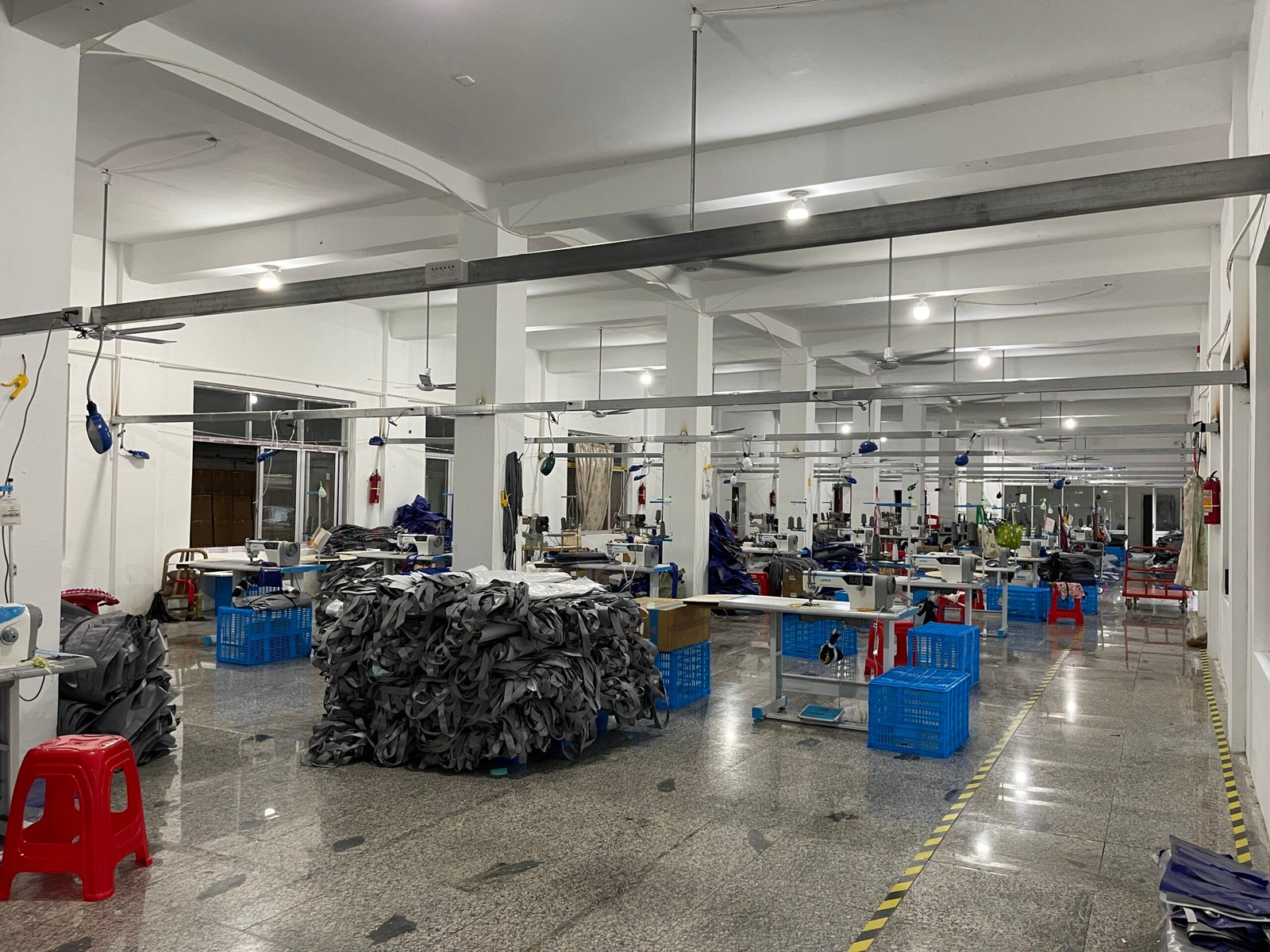
A spec sheet can claim anything. The factory floor tells the truth. On a heavy duty moving bag factory audit, I start in the raw material warehouse, then move to stitching, printing, and finally capacity. Each stop has specific checks that separate suppliers who can handle a 10,000-unit order from those who will burn you before the third container.
- Raw Material Warehouse: Verify fabric GSM with a portable scale. A 180 GSM Oxford fabric that feels thin under thumb is often 160 GSM or less—cut a 10cm x 10cm swatch and weigh it. For recycled content claims, demand batch-specific mill certificates; if the factory can’t produce them, ask for a live burn test. Real polypropylene melts and smells like paraffin; excessive black smoke or hard residue means fillers or regrind from rejected batches.
- Stitching Floor: Check seam strength at the needle—not from a lab report but with a hand-held tension meter on a freshly sewn seam. A factory quoting ASTM D5034 compliance can still run inconsistent thread tension. Look at the double-stitch protocol: the two rows should be parallel, 3-5mm apart, with no skipped stitches. If the sewing line uses needles past the 8-hour change mark, you’ll see visible burrs on the point under a loupe; burred needles tear the fabric core and cause handle failures under dynamic load.
- Printing & Labeling: Color matching isn’t a monitor check—it’s a spectrophotometer reading against your approved physical swatch. For a heavy duty moving bag, the logo must survive a loaded fold test: print a panel, fill the bag to 70% of its rated load, then cycle it through 50 lifts. If the ink cracks or the label delaminates before 50 cycles, reject the batch. Most low-cost printers skip the adhesion promoter step on polypropylene—ask to see the primer station in action.
- Capacity & Machinery: Ignore quoted ‘maximum daily output.’ Audit actual throughput by counting finished bags during the floor walk and multiplying by shift hours. A factory with one automatic cutting line and no backup compressor is one motor failure away from missing your ship date. Check if the facility has a dedicated heavy-load testing jig—not just a static pull rig—capable of running a 50 kg load through 50 lift-and-drop cycles. Facilities that only make retail bags often lack this; their quality tolerance collapses under logistics-level stress.
During a supplier verification visit for a moving bag order, I once spotted reclaimed material pellets hidden behind new stock in the warehouse. The burn test exposed it in 30 seconds. That order would have started splitting at the bottom seams three months into warehouse rotation. The audit checklist isn’t about ticking boxes—it’s about seeing what the spec sheet omits.
| Area | Checkpoint | Standard | Audit Method | Red Flags |
|---|---|---|---|---|
| Raw Material Warehouse | Fabric Weight & Composition | GSM tolerance ±5% (e.g., 200 gsm Oxford); 100% virgin PP verified by burn test | On-site GSM cutter & scale, live burn test with melt/drip observation, lot traceability records | Rolls without mill certificates, regrind odor, GSM deviates >5%, refusal to demonstrate burn test |
| Recycled Content / Sustainability Claims | GRS 4.0 or equivalent chain-of-custody for recycled fibers; documented input percentage | Review transaction certificates, verify physical separation of recycled vs. virgin stock | Pre-consumer scrap passed as post-consumer, mixed bales without labeling, no mass-balance records | |
| Stitching Floor | Seam Construction & Stitch Protocol | Double lockstitch with 8–10 SPI; reinforced bar-tacks at handle attachments (≥3 cm width) | Hand-held tension meter on 5 random machines, stitch gauge, pull-test on in-line samples | Single-needle chainstitch on load-bearing seams, skipped stitches, missing back-tacks |
| Needle & Thread Calibration | Needle size #18–#21 for 600D+ fabrics; bonded nylon thread (≥210 denier); needle change log every 8 hours | Inspect needle logbooks, check needle eyes for burrs, review thread tension settings at mid-shift | Mixed thread brands on one line, bent needles in use, no schedule for preventive needle replacement | |
| Printing & Labeling | Color Accuracy & Logo Durability | Pantone delta E ≤2.0; logo withstands 50-cycle dynamic load of 50 kg without peeling or cracking | Spectrophotometer reading on 3 production samples, visual inspection after loaded drop-test | Ink rub-off in dry state, visible color shift across batches, water-based ink on outdoor-use bags |
| Capacity & Machinery | Daily Output & Bottleneck Visibility | Published daily capacity of ≥5,000 units per shift; automated cutting/hemming lines with ≥1 backup motor per cell | Audit at mid-shift (2–4 PM), count actual pieces/hour at bottleneck station, review last 4-week production logs | Staged morning demonstrations, no redundant power supply, single cutter serving all lines |
| Heavy-Load Testing Rig Availability | Dynamic cycle tester capable of 50 kg load for 50+ cycles; records force-deflection curves | Request live demonstration with a filled bag; verify machine calibration certificate | Static pull test only, no in-house rig (relying on third-party), max load capacity <50 kg |

Quality Control & Testing Protocols to Witness
No live 50 kg cycle test?
I’ve seen too many logistics buyers accept a test report without ever watching the actual test. Certificates are easy to print. The real question is whether the factory can replicate claimed strength on a random bag from the line, not a pre-conditioned sample. Demand to witness burst and tear resistance on their own equipment, and bring a hand-held tension meter to spot-check thread consistency. If they hesitate, you have your answer.
- Live Burst Test: Ask to see a Mullen Burst Tester (ASTM D3786) on woven PP fabric. Record the reading. For 200–250 GSM Oxford fabric used in heavy-duty moving bags, typical burst should exceed 900 kPa. Any bag that pops below 700 kPa under live conditions indicates recycled filler or inconsistent yarn quality.
- Tear Resistance: Demand an Elmendorf Tear Test (ASTM D1424) on a seam sample, not just raw fabric. The handle attachment point is where 80% of field failures occur. A reading below 25 N for woven PP or 30 N for laminated Oxford means the handle will tear out under a 30 kg load after repeated lifting.
- Dynamic Load Cycle: This is non-negotiable. Most factories only do static pull tests. Insist on a custom jig that lifts and drops a 50 kg bag 50 times. Watch for stitch elongation or handle detachment after cycle 30. If they don’t have this jig, they’ve never validated a bag for moving-duty use.
- Thread Tension Spot Check: Walk the stitching floor with a hand-held tension meter. Check the needle thread tension on three random lockstitch machines. A variance over 15% between stations means the factory is not calibrating thread tension daily. This is the hidden cause of inconsistent seam strength, even if the fabric passes the lab.
- Sampling Protocol: Select at least 20 bags per batch from different cartons, not top-layer boxes. Cut open sealed cartons yourself. Factory staff will try to guide you to ‘audit samples’ — politely refuse and pick blind.
- Defect Log Review: Request the defect tracking system records for the last 90 days. Look for raw scrap rates above 2% in cutting and stitching rejects above 1.5%. If data is only on paper with no trend analysis, their ‘quality system’ is theater.
- Corrective Action Records: Ask to see one Closed CAPA (Corrective and Preventive Action) report from the last month. It should trace a real defect (e.g., handle stitching skipped on 15 bags in Batch #2026-112), show root cause analysis, and document verified rework. No such record means defects are buried, not fixed.
- Red Flag Inventory: Check the quarantine area. If rejected material sits without identification or is being re-ground near the raw material bins, material substitution is active. Insist on a burn test of random fabric scraps to confirm polypropylene content and exclude recycled contamination.
Batch consistency separates a supplier who cares from one who ships whatever the line produces. Ask to pull random samples from the finished goods inventory of the last three production runs — not the same batch, not the same day. Measure fabric GSM with a portable cutter and scale on the spot. Check stitch count per inch with a simple pick glass. If the GSM varies more than 10 g/m² between batches, or the SPI drops below 7 in any sample, the factory’s internal QC cannot hold a tolerance. This is how you catch material dilution before it reaches your container.


Post-Audit Evaluation: Scoring the Factory
A passing audit isn’t a green light—it’s raw material for a negotiation.
I stood in a warehouse in Rotterdam two years ago, staring at 12,000 heavy-duty moving bags that were supposed to ship to a logistics client in Frankfurt the next morning. The pre-production sample had passed with flying colors. The mass production run? The GSM of the Oxford fabric was 15% lighter than the approved sample, and the stitching tension was so loose you could pull the double-lockstitch apart with your thumbs. That was a $50,000 lesson in why the post-audit evaluation matters more than the on-site walkthrough itself. The real work starts when you leave the factory floor and sit down with the scorecard.
You walk a factory for three hours and you see machines, fabric rolls, and busy operators. But what you actually observed was a snapshot curated for your visit. The post-audit evaluation is where you separate the performance from the theater. You need to map what you saw against a red-flag checklist that has nothing to do with the nice lunch the factory owner bought you.
- Material Substitution Risk: Check the raw material warehouse inventory tags against the incoming inspection records. I often find rolls of 600D Oxford fabric sitting next to unbranded 420D stock. Ask for full batch traceability from yarn source to finished roll. If the factory hesitates, push for a live burn test on a random swatch from the cutting table—pure polypropylene burns differently than recycled filler blends, and a factory recycling rejected batch material into new production will flinch at this request.
- Untrained or Rotated Inspectors: Look at the corrective action log from the past six months. If the same three inspectors signed off on every batch and there are zero defect entries, someone is pencil-whipping the forms. A healthy QC system has variance. Probe whether the inline inspectors are dedicated to the bag line or rotated from the garment department this morning. A brand-new inspector who cannot tell 10 stitches per inch from 8 stitches per inch is a latent liability.
- Rushed Production Timelines: During the audit, the floor manager likely quoted you a daily output of 5,000 units. But ask to see the last three production daily reports and compare the figures from mid-shift, not the morning setup shift. Many stitching floors hide the real bottleneck in the afternoon when operators fatigue and needle calibration drifts. If the factory tries to compress a 25-day run into 18 days to meet your deadline, the double-stitch is the first thing that gets sacrificed.
- Warranty Duration: If the audit revealed minor GSM variance or inconsistent seam strength, lock in an 18-month warranty instead of the standard 12-month window. The added margin protection typically costs the factory nothing upfront but anchors them to their quality claims.
- Quality Tolerance on Replacement Rate: Negotiate a 2% defect allowance cap within the warranty period, with a penalty of 110% replacement cost above that threshold. This converts a vague quality promise into a measurable financial obligation. Factories that push back hard on any replacement cap are often the ones that know their internal reinspection rate is already above 5%.
- FOB Pricing Adjustment Clauses: Use adverse audit findings—such as a lack of heavy-load testing jigs that simulate a 50 kg load over 50 cycles—to anchor a discount or a deferred payment schedule. A factory that only demonstrates a static pull test instead of a dynamic fatigue test has not proven real-world durability. You should not pay full FOB pricing for unproven load capacity. Tie the final 10% payment to passing a third-party fatigue test on the first production batch.
One item that does not appear on standard audit templates is thread tension consistency. A factory flashing a valid ASTM D5034 certificate can still churn out bags that fail after 15 cycles under a 50 kg load because the sewing machine tension drifted during the shift. When I audit a sewing floor, I bring a hand-held tension meter and spot-check three machines halfway through the shift. A reading that varies by more than 15% from the morning calibration tells me the QC team is sleeping, and your bag handle stitch failure test results are about to get expensive.
This brings us to the cost-quality balance. You are not scoring a factory to pass or fail them like a driver’s exam. You are collecting leverage to negotiate commercial terms that protect your margin. If the lab shows a burst strength of 280 PSI against your contracted 300 PSI, do not immediately kill the order—pivot the conversation to an extended warranty. A factory that is confident in their process will extend the standard 6-month warranty on stitch and fabric to 12 months. A factory that hesitates knows something about their material sourcing they are not telling you.
The factories that earn my long-term business are not the ones with spotless checklists. They are the ones who openly shared a corrective action record from six months ago and walked me through exactly how they re-engineered the needle calibration schedule to fix a recurring stitch skip problem. That level of transparency is rare, and it is worth more than a flawless ASTM report.
Here is the decision framework I use before signing off on any supplier. Open your notebook and ask the factory manager these three questions before you walk out the door: 1. ‘Show me the material batch certificate for the roll sitting on cutting table four, and match it to the spec sheet you sent last month.’ 2. ‘Will you go on record that your standard needle replacement frequency is every 4 hours of run time, and can I observe the next change?’ 3. ‘If we run a 50-cycle fatigue test on the first 100 bags off the line and 5% fail, do we stop production for root cause analysis, or do you adjust the tension and keep shipping?’ If the answers are evasive, you have your score. If the answers are specific, uncomfortable, and measured, you have a partner.
2026 Supplier Verification Checklist (Downloadable PDF)
If a factory can’t demo a 50‑kg cyclic load test on their own jig, walk—no matter the price.
You already know the pain: a pre‑production sample that looks perfect, then a container of 15,000 units where seams split the first month. That $50K order you fought to get approved? Written off. This checklist isn’t generic—it’s the same one I’ve used after audits in 12 countries, calibrated for heavy‑duty moving bags where stitching, fabric, and handles must survive real abuse.
- 1. Material Traceability & Burn Test: Don’t just accept mill certs. Insist on a live burn test of raw fabric—polypropylene (PP) burns with a waxy drip and faint petroleum odor; polyester melts into a hard bead. If the supplier mixes regrind or rejected batch material, the flame behavior changes. Document batch traceability from the extruder through the weaving/coating stage.
- 2. Pre‑Production Sample Lock‑Down: Agree that the signed‑off PP sample is the Golden Standard. No mass production until the factory replicates it within ±5% color tolerance (check with portable spectrophotometer) and identical stitching pattern. Any deviation triggers a new sample round—at their cost. Clarify FOB pricing implications: does sample approval include tooling amortization or not?
- 3. Stitching Floor Audit at 2:00 PM: Morning demos are staged. Walk the stitching floor mid‑afternoon. Watch actual throughput, not the speed‑up for visitors. Check thread tension with a handheld meter; ASTM D5034‑compliant factories can still have tension drift that creates 30% weaker seams. Look for double‑lockstitch protocol on handles and stress points—single stitching there is a red flag.
- 4. Heavy‑Load Cyclic Testing Jig (Not Just Static Pull): Many factories certify retail bags but lack a jig for moving‑bag abuse. Demand to see a jig that simulates 50 kg loaded inside the bag and cycles it through lifting, carrying, and dropping—50 full cycles. Measure elongation and seam integrity after cycles. A static pull test alone guarantees nothing in real‑world logistics.
- 5. Batch Consistency Sampling: Pull 3 random bags from the last 3 finished production runs (different days, different shifts). Measure fabric GSM, stitch density (minimum 10 stitches per 5 cm for heavy‑duty), and handle pull strength. If GSM varies by more than 5% between samples, their material control is broken.
- 6. Print & Logo Durability Under Load: A logo that cracks when the bag is stretched to capacity is a brand fail. Request a filled‑bag flex test: stuff the bag to rated capacity, then manually twist and squeeze the printed area 20 times. If ink adhesion fails, the print process isn’t suitable for moving bags. Also verify Pantone match before bulk.
- 7. Quality Tolerance & AQL Agreement: Define acceptance quality limits before the order. For heavy‑duty moving bags, I set AQL 2.5 for major defects (stitch skips, open seams) and AQL 0 for critical (handle detachment). Anything stricter without a documented QC system is theatre.
- 8. Capacity Verification & Backup Equipment: Ask for the production schedule of the three preceding weeks. Verify daily output isn’t exceeding machine uptime capacity. A factory without at least one backup stitching line is a single point of failure for your 3,000‑unit order with hard deadline.
- 9. Defect Tracking & Corrective Action Records: Audit their reject log—not just a sanitized summary. Look at how recurring handle‑stitch failures were handled. If there’s no root‑cause analysis or the answer is ‘we changed the thread,’ that factory doesn’t prevent problems—it ships them.
- 10. Final Commercial Guardrails: Confirm sample approval is linked to payment milestones. Ensure your contract states that any post‑approval material substitution voids the batch without recourse—and that your inspector can hold shipment at FOB port until corrective action is verified.
Conclusion
A proper factory audit verifies raw material integrity, stitching consistency, and true capacity—but experienced buyers know that the inspection report alone does not protect a deal. The last 10% is locking your audit data into the purchase contract: define your FOB pricing terms up front to eliminate freight surprises, detail the exact sample approval that production must match, and set a write-in quality tolerance that reflects what your customers will actually accept.
Download the full 2026 Supplier Verification Checklist and check every line against your current supplier’s FOB quote, their sample approval records, and the quality tolerance they are willing to guarantee. Align those documents and you catch the gap between promise and delivery before a container ever leaves the dock.
Frequently Asked Questions
What should I verify before visiting a bag factory?
Verify raw test reports and certifications like ASTM D5034 and ISO 9001 first. That data, not shiny marketing sheets, uncovers the factory’s real quality baseline. Confirm the test reports are dated within the last 6 months.
How can I spot material quality issues during an audit?
Check the raw material warehouse for fabric GSM and recycled content against your spec sheet; discrepancy here means the entire order is at risk. Demand a sample of the incoming rolls and compare labels on-site.
What’s the best way to evaluate stitching strength on-site?
Witness live seam strength testing using a tensile tester, or pull-test seams manually. If they are using uncalibrated needles or single stitches where double-stitch was spec’d, that’s a red flag. Confirm needle change logs to verify calibration frequency.
What’s the biggest red flag in a heavy-duty bag factory audit?
Material substitutions in the warehouse are the deadliest red flag. If incoming fabric GSM is lower than the approved pre-production sample, the entire production batch is compromised. Check raw material intake records for the last three production runs.

0 Comments