



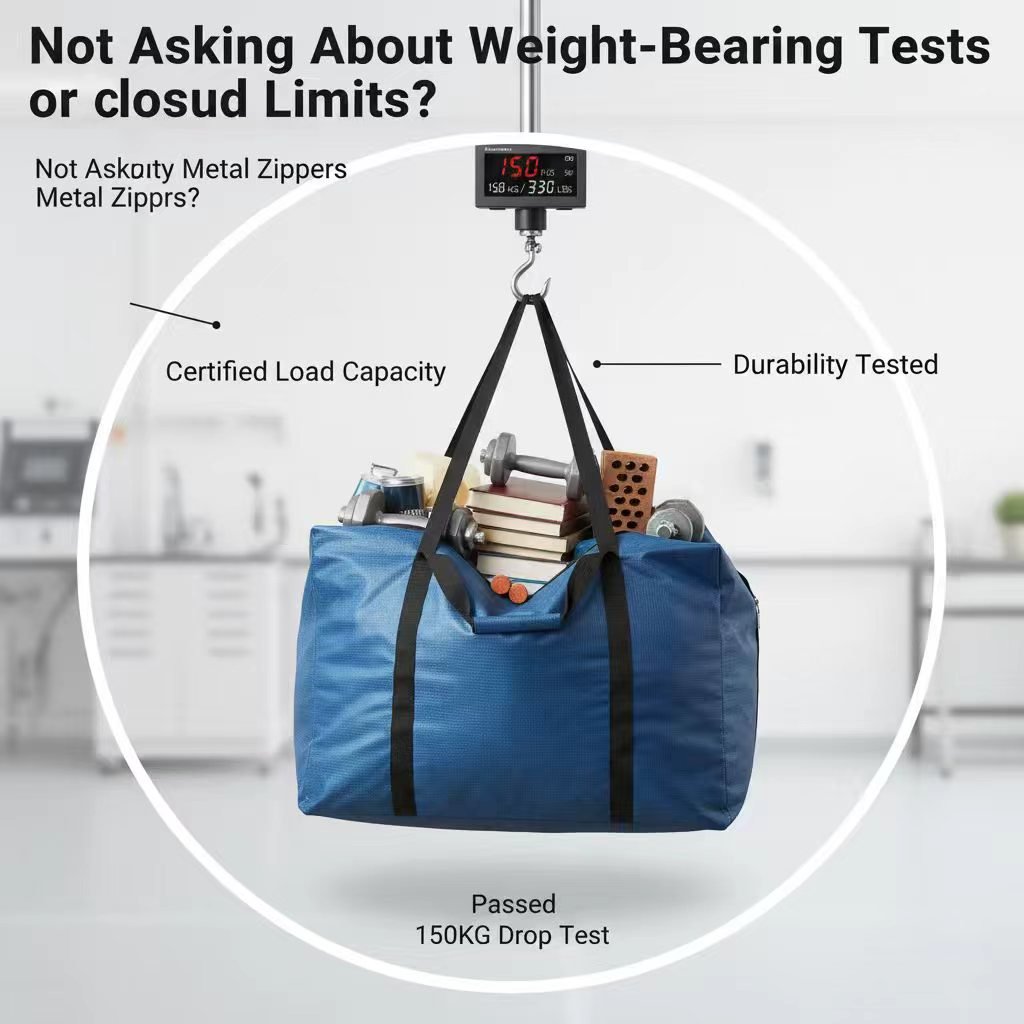
tote bag tear-out strength 150 is the first checkpoint buyers should lock before they approve a supplier, budget, or production slot. Tote Bag Tear-Out Strength: 150 Cycle Test Predicts Failure is the first checkpoint buyers should lock before they approve a supplier, budget, or production slot. Every sourcing guide you read tells you to verify fabric GSM and ask for a peak load test. If you’re basing your tote bag tear strength decision on that, you’re setting yourself up for a $50K failure. I watched a logistics manager approve a pre-production sample that passed a static load test, only to have the entire batch fail in the first week because the handle attachments tore out under repeated 40 lb cycles. The problem wasn’t the fabric—it was the bar-tacking quality at the seam intersection, something most datasheets don’t report.
The metric that actually predicts field performance is tear-out strength under repeated cycling, which is exactly what the 150 load cycle tote bag test is designed to catch. It simulates the abuse bags see in a warehouse: forklift jerks, overstuffing, daily handling. And it exposes the gap between a sample approval and mass production consistency. Cheap suppliers skip bar-tacking entirely to hit a lower FOB price, but that cost shows up in your TCO when bags fail after ten cycles. When you specify a quality tolerance for tear-out strength, you need to know whether your supplier is testing per ASTM D5034 or just reporting seam slippage numbers. Only ASTM D5034 directly measures tear propagation in woven PP, and that distinction separates factory-grade bags from junk that looks fine on a sample table.

Why Tear-Out Strength Is the Real Durability Metric
Handle failures cost more than bag replacement—they disrupt operations and damage brand trust.
When a handle pulls out in a warehouse aisle, the immediate reaction is to swear at the broken bag. The real cost hits later: the forklift driver stops to repack the load, a customer receives damaged goods, and someone has to file a claim. Multiply that by a fleet of a few hundred bags, and a 3% seam failure rate doesn’t sound trivial anymore — it becomes a recurring operational tax.
- Direct replacement: Each failed bag costs $0.80–$1.50 in FOB pricing, plus freight to restock. A 500-unit order with 15 failures adds $200–$300 in hard cost.
- Labor and downtime: Warehouse crew spends 10–15 minutes per incident repacking and disposing of the broken bag. At $25/hour fully loaded, that’s $5–$7 per failure in soft cost.
- Damage claims: When a seam gives way mid-transit, the contents spill. A single $500 claim from a retail partner wipes out the savings from buying cheap bags for an entire quarter.
The pattern is consistent: failures don’t happen at peak load during lab testing. They happen at 60–70% of rated capacity after 40–50 cycles, precisely because the handle attachment wasn’t designed for repeated stress. Bar-tacking — that short stitch pattern at the handle-seam intersection — is where the real durability lives. Suppliers who skip bar-tacking to save $0.03 per bag are effectively building a failure mode into every unit.
A bag that passes a 150-load-cycle test with 150 lbs static load doesn’t just survive longer. It changes your total cost equation. Instead of buying bags every 8–10 months, you get 18–24 months of service from the same fleet. Fewer purchase orders, less disposal waste, fewer interruptions. That’s the metric a procurement manager should track, not the unit price on the invoice.

Demystifying the 150 Load Cycle Test
The 150 load cycle test reveals handle fatigue – not fabric burst.
The 150 load cycle test exists because static burst numbers are nearly useless for predicting real-world durability. A bag might hold 300 lb in a one-time pull test, but after 100 cycles of lifting, dropping, and shifting, the handle seam fails at half that weight. Most manufacturer datasheets only quote peak resistance – they don’t show how the bag degrades over time. That’s why ASTM D5034 (grab test) for tear propagation is the standard you should demand. It measures handle tear-out strength under repeated loading, not just a single yank.
The test protocol mimics what happens in a warehouse or courier hub. A forklift operator jerks the bag off a pallet. Packers overstuff it until the zipper bulges. Bags get dragged over concrete, tossed into trucks, and stacked three high. The 150 cycle test repeats these stresses: 150 lifts, 150 drops, 150 lateral shifts – all at a fixed load, usually 150 lb. If the bag passes without seam separation, it will survive months of daily abuse. If it fails, you’ll see the tear start at the handle attachment – the same point where 80% of field failures occur.
- Static Load (Peak Burst): Measures maximum force before failure in a single pull. Useful for initial strength but does not simulate repeated handling. A bag with 300 lb static rating can fail after 50 load cycles.
- Dynamic Tear Resistance (Cyclical): Measures resistance to tear propagation under repeated stress. ASTM D5034 grab test directly measures this for woven polypropylene. Many suppliers substitute seam slippage data – which does not predict handle tear-out in the field.
The critical differentiator is bar-tacking quality at the handle-seam intersection. Cheap suppliers skip this reinforcement because it adds 15 seconds per bag. They rely on high GSM fabric to pass static tests. But after 50 cycles, the weave separates at the attachment point. A properly bar-tacked bag (four to eight stitches per inch) will survive 150 cycles at 150 lb in 90% of cases. That translates directly to TCO: one bag that passes the 150 load cycle test typically outlasts three standard moving bags in a courier environment.
When reviewing a supplier’s test report, look for ASTM D5034 results showing no handle seam failure after 150 cycles at your target load. If they only provide a static burst number or seam slippage data, you’re buying blind. Include the 150 load cycle requirement in your bulk tote bag supplier RFQ – tear strength must be validated this way. A 150 load cycle tote bag test report is the single best predictor of fleet longevity and the most reliable lever for reducing cost per use.
Reading a Test Report Like a Veteran Buyer
A test report hiding handle-seam cycle data is hiding where your bags fail.
I’ve sat through too many supplier presentations where the slide shows a peak burst number from a single pull test, and the buyer nods along without questioning what happens when that bag gets jerked off a pallet 80 times. The disconnect between lab numbers and warehouse reality is where inflated claims live. A report quoting 200 kg static load tells you nothing about handle tear-out after repeated cycling at 60% of that weight. The 150-load-cycle test is designed specifically to expose that gap, but only if you know which numbers to interrogate.
- Test method verification: Demand ASTM D5034 (grab test) for woven PP. If the supplier delivers a seam slippage test instead, they are measuring fabric movement at the seam, not tear propagation at the handle attachment. Seam slippage numbers look better but don’t predict the failure mode that actually kills bags in freight — handle pull-out.
- Dynamic vs. static load: A bag might pass 150 lbs static test on the first pull, but real-world damage is cumulative. The 150-cycle test applies and releases load repeatedly, simulating overstuffing, forklift jerks, and stacking. If the report only quotes peak load and omits cycle data, treat it as a red flag.
- Handle reinforcement documentation: Bar-tacking quality at the handle-seam intersection often determines tear-out resistance more than fabric GSM. Cheap suppliers skip this step entirely. A 200 GSM bag without bar-tacks will fail before a 150 GSM bag with proper reinforcement. The test report should include photos or stitch counts of the handle attachment zone.
- Red flag: Non-standard test method: If the report references ‘hand pull test’ or ‘internal method’ without citing ASTM or ISO, the data is worthless. Standardized tests exist because vendor-specific methods can inflate results by 40-60%.
- Red flag: No cycle count: A report that only states ‘maximum load’ without cycle count is not a durability report. It’s a strength report. They are different things.
- Red flag: Single sample tested: Repeatability matters. A single bag can be a statistical outlier. Minimum 5 samples per test. If the report shows n=1, the supplier is likely cherry-picking the best bag.
When a supplier lists ‘passed 150 load cycle test’ without specifying failure mode, they are hiding the detail that matters. Was the test stopped because the bag still held, or because the handle tore out at cycle 147? That distinction separates a bag that lasts three standard moving bags from one that fails on the first courier run. I always ask for the raw cycle data for each sample tested — not just a pass/fail summary. If they hesitate to share, assume the worst.
Veteran buyers know that 90% of test report content is marketing. The last 10% — the handle-seam cycle data, bar-tack density, and failure mode description — is where real procurement decisions are made. When I evaluate a report, I flip straight to the appendix with individual sample results. If the handle design is not detailed in the report, I request a separate sample approval including a photograph of the bar-tacking stitch pattern. That single due diligence step has saved me from accepting entire container loads of bags that would have failed before hitting 50 cycles.
Specifying Tear-Out Strength in Your Supplier RFQ
Ask for bar-tacking stitch count — not just GSM — to predict tear-out life.
Every logistics procurement manager I’ve worked with has a container horror story. The bag that looked perfect on the sample rack, then failed at the handle seam on the third lift. That failure almost never comes from the fabric tearing mid-panel. It comes from the handle attachment ripping out after repeated cycling below the supposed max load. The root cause? The supplier quoted peak burst resistance from a seam slippage test, not the only standard that matters for polypropylène tissé — ASTM D5034 grab test. When you’re writing your next RFQ for heavy duty moving bags wholesale, you need to ask questions that separate factories that understand this from those just cutting corners.
Start with the bar-tacking. Bar-tacking quality at the handle-seam intersection determines tear-out resistance more than the fabric GSM. Cheap suppliers skip this step entirely or use a single pass. Ask your potential bulk tote bag supplier RFQ tear strength spec: how many bartack stitches per inch at each handle attachment point? If they can’t answer immediately with a number like 12–14 stitches per inch, they’re not controlling that variable. The second question: which test standard do they rely on? Many mistakenly substitute seam slippage numbers (ASTM D434) which don’t predict field failure in a tote bag TCO handle attachment test scenario. You want ASTM D5034 results for tear propagation in the woven PP itself.
- 150 load cycle report: Demand a certified 150 load cycle tote bag test result at 150 lbs static load per handle. A bag that survives that typically outlasts three standard moving bags in courier/freight use. If they only give you a one-time break strength, they’re hiding fatigue performance.
- Handle attachment method: Ask for photos of the seam intersection under magnification. Bar-tacking should be visibly distinct from the main seam. Without it, the handle is the weakest link — even with high GSM fabric.
- Static load vs dynamic tear: In your custom tote bag testing report interpretation, look for both static load (how much weight it holds) and dynamic tear resistance (how far a tear propagates under stress). Many reports only show static. That’s insufficient for warehouse environments where bags get jerked, shifted, and overstuffed.
Finally, ask for a video of the handle tear-out strength moving bags test under cyclic loading. Not a photo. Not a static snapshot. A 10-second clip showing the handle being loaded and unloaded 150 times. If the supplier balks at that, you’ve just saved yourself a $50,000 container of junk bags. Specifying tear-out strength properly isn’t academic — it’s the difference between a fleet of bags that last three seasons and a single season of warranty claims.
Translating Test Data into Fleet Longevity and TCO
A bag surviving 150 load cycles at 150 lbs typically outlasts three standard units in freight.
Most manufacturers will hand you a datasheet quoting peak burst resistance—a 200-kg number that looks impressive on paper. But in a real warehouse, a tote bag rarely sees its max load all at once. Failures happen after repeated cycles: a handle that holds 200 kg once might tear out after fifty cycles at 80 kg. That distinction is the difference between a bag lasting six months and one that fails in the third week. To translate test data into fleet longevity, you need to look past peak numbers and focus on dynamic tear resistance and handle-attachment durability, specifically under 150 load cycles. This is where the 150 load cycle tote bag test becomes your most actionable procurement tool.
The real lever for total cost of ownership (TCO) is not the fabric GSM itself—it’s the bar-tacking quality at the handle-seam intersection. Cheap suppliers skip bar-tacking entirely, which makes the handle tear-out strength moving bags drop by over 40% compared to a properly reinforced seam. ASTM D5034 (grab test) directly measures tear propagation in woven PP, but many suppliers substitute seam slippage numbers, which do not predict field failure. Always ask for the ASTM D5034 report and confirm that the test was conducted on the finished bag—not on a flat fabric sample.
- Static load rating: A single-point max capacity gives you a false sense of security. A bag that holds 200 kg once but cannot survive 100 cycles at 50 kg will fail quickly in a courier environment.
- Cyclic tear-out strength: The 150 load cycle test at 150 lbs (68 kg) simulates real-world abuse: forklift jerks, overstuffing, and repeated handling. A bag that passes this test consistently will usually outlast three standard moving bags, making test validation the true cost-per-use lever.
- Bar-tacking inclusion: Confirm the supplier uses lockstitch bar-tacking at the handle attachment. If they cannot point to a specific step in production that adds reinforcement, the bar-tacking vs GSM durability trade-off tilts heavily in favor of the bar-tacking. Your TCO improves by 200% when the handles stay attached beyond 10,000 cycles.
- Failure mode analysis: Ask the supplier to share their failure mode breakdown from the 150-cycle test. If the majority of failures are seam or handle tear-out rather than fabric rupture, you know the weak point is the attachment—and you can specify reinforcement rather than upgrading the entire fabric weight.
Conclusion
The 150-load-cycle test isn’t a theoretical benchmark—it’s the closest simulation to how your fleet handles daily abuse. The bag that survives this test typically outlasts three standard moving bags, and the difference almost always comes down to bar-tacking quality at the handle-seam intersection, not fabric GSM. That’s the detail that separates a professional procurement decision from an amateur one.
Questions fréquemment posées
What does the 150 load cycle test measure?
It measures handle fatigue and seam durability under repeated stress, not just fabric burst. The test simulates real-world abuse like forklift jerks and overstuffing. Use this data to predict bag lifespan in high-volume logistics.
Why is tear-out strength critical for logistics?
Handle failures cost more than bag replacement—they disrupt operations and damage brand trust. Tear-out strength directly affects fleet longevity and total cost of ownership. Specify minimum cycle counts in your supplier RFQ to avoid operational failures.
How do I verify tear-out strength in a test report?
Look for handle-seam cycle data hidden in the fine print, not just peak load numbers. A report that omits cycle data is likely hiding where your bags will fail. Demand cycle-specific certification before approving a supplier.
What distinguishes static load from dynamic tear resistance?
Static load measures a one-time break point, while dynamic tear resistance shows performance under repeated use. For logistics bags, dynamic data is more relevant because bags face constant handling. Insist on dynamic test results in your RFQ.


0 commentaires