



A 15% GSM variance in PP tote bags might not seem like a dealbreaker, but when you’re sourcing 10,000 units for industrial distribution, that spec gap can turn a $50,000 order into a loss. That’s the reality for buyers comparing factory direct wholesale pp tote bags, where the difference between a reliable product and a defective batch often comes down to sample approval protocols and quality tolerance.
I’ve spent years auditing factories across 12 countries, and the one thing I’ve learned is that wholesale channels often hide a 15–25% premium in the final landed cost. Broker commissions, freight consolidation, and missing certifications add up fast. Factory-direct FOB pricing cuts that out, but only if you’re ordering above 500–1,000 units and have the QC infrastructure to enforce defect allowances.
The real differentiator isn’t the unit price on the invoice—it’s understanding the total landed cost, including duties, freight, and after-sales warranty policies. That’s the detail that separates professionals from amateurs when evaluating PP tote bag pricing in 2026.
Factory Direct vs Wholesale Pricing: What Distributors Pay in 2026
The real price difference isn’t on the unit tag — it’s in the hidden markups and defect policies that wholesale distributors rarely.
Most industrial distributors compare unit prices between factory-direct and wholesale suppliers and stop there. That’s a mistake. The 2026 market for PP tote bags shows that the factory-direct route cuts per-unit cost by 20–30% once you cross 5,000 units, but the bigger savings come from eliminating the 15–25% hidden markup that middlemen add through broker commissions, freight consolidation fees, and missing certification paperwork. Let’s break down what you’re actually paying for under each model.
- EXW (Ex Works): Factory-direct pricing starts at EXW. You pay the unit cost plus pick up the bag from the factory gate. For PP tote bags, this typically strips out 8–12% of the cost that wholesalers embed in their FOB quotes. But you own the freight and export customs — a risk many distributors underestimate.
- FOB (Free on Board): Factory-direct FOB includes loading at the port of origin. This is the most common incoterm for bulk PP woven bags orders above 10,000 units. The factory handles export clearance and port charges, which wholesalers often mark up by 5–10% through their freight consolidators.
- DDP (Delivered Duty Paid): Wholesale suppliers push DDP because it hides the margin stack. You pay a single price that includes freight, duty, and delivery. The issue? The wholesale markup on PP tote bag landed cost import duties alone averages 6–9% above what you’d pay managing your own broker. For a $50,000 order, that’s $3,000–$4,500 in avoidable cost.
- Factory-direct volume ladder: At 1,000 units, your per-unit cost is roughly $1.20–$1.50 for a standard 80 GSM PP tote bag. At 5,000 units, that drops to $0.85–$1.05. At 10,000 units, you’re looking at $0.70–$0.85 — a 20–30% reduction from wholesale equivalent. Most factories will also offer a 2–3% defect allowance with free replacements, which is rarely included in wholesale pricing.
- Wholesale volume ladder: Wholesale pricing for 1,000 units is typically $1.50–$1.80 per bag. At 5,000 units, the discount is modest — maybe 10–15% — bringing you to $1.30–$1.55. The middleman’s margin buffers the discount. Worse, the lack of direct QC oversight means you may see 15% GSM variance across batches, with inconsistent print quality that can trigger returns from your own customers.
The MOQ and volume discount structure is where the comparison gets sharper. Factory-direct suppliers require minimum order quantities of 500–1,000 units for PP tote bags — higher than the 100–300 unit MOQs common at wholesale distributors. That initial commitment scares some buyers. But the volume discount curve is steeper on the factory side.
The decision matrix for industrial distributors evaluating PP tote bag GSM price comparison wholesale vs factory-direct comes down to two scenarios. Choose factory-direct if you can commit to 5,000+ units, need consistent GSM and print quality, and want a defect allowance that protects your margin. Choose wholesale if you need sub-1,000 unit runs, faster lead times, and are willing to accept the 15–25% landed cost premium for the convenience of a single DDP invoice.
Quality Control and Customization Trade-Offs
Wholesale’s 15% GSM variance cancels out its low-MOO benefit.
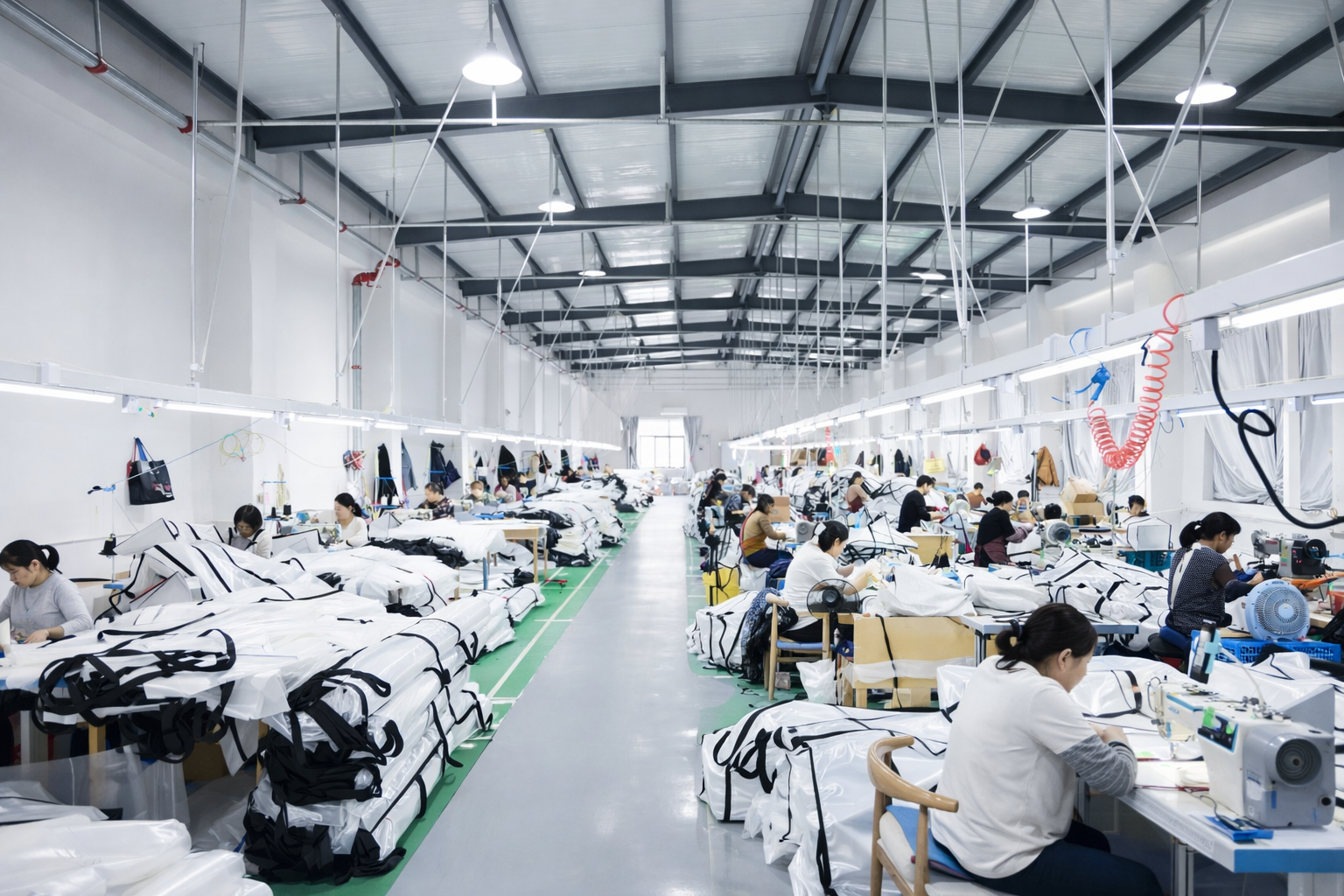
Every distributor who has run a multi-sku order through a middleman knows the sinking feeling: the first 500 bags look perfect, but batch two shows up with a different hand feel and print registration that’s half a centimeter off. That’s the core trade-off. Wholesale channels offer flexibility on MOQ and lead time, but they sacrifice direct control over the production line. Factory-direct contracts lock you into a 500-1,000 unit minimum, but they give you a dedicated QC protocol that covers GSM tolerance, color density, and stitch integrity batch by batch.
- GSM consistency: Factory-direct: ±5% of target GSM across all batches. Wholesale: up to 15% variance confirmed in third-party audits — the bag you spec at 120 GSM may arrive at 102 GSM on a 5,000-unit order.
- Print quality: Factory-direct: pre-production sample approval standard, with in-line drying temperature control. Wholesale: no sample approval process; consistent print only guaranteed if the broker uses a single sub-supplier, which is rarely disclosed.
- Defect management: Factory-direct: 2-3% defect allowance with free replacements shipped on the next container. Wholesale: 30-day return window that masks real failure rates — returns are simply restocked, not analyzed.
- Customization depth: Factory-direct: full OEM/ODM support including custom handles, gusset dimensions, and reinforced stitching. Wholesale: limited to pre-existing stock shapes and generic color palettes.
- Choose factory-direct if: You source 5,000+ units per style, need consistent GSM and print quality, and want to lock in 2-3% defect allowance with free replacements. The per-unit savings of 20-30% above 5,000 units outpace any wholesale pricing.
- Choose wholesale if: Your order is under 500 units, you need 2-week turnaround, or you’re testing a new market. Accept the QC variance as a cost of speed — and add a 5% safety stock to your cost calculation.
The hidden cost of wholesale customization shows up in the defect rate. When you can’t inspect the production run mid-process, you absorb the risk of a 15% GSM dip that turns a 120-gram bag into a 102-gram bag. That matters when your end customer is a moving company that loads 50 pounds of books into each tote. A bag that fails at the seam on the third move costs you more in warranty claims than the 15% wholesale markup you thought you saved.
Total Landed Cost: Freight, Duties, and Hidden Fees
The freight bill is only half the story.
You’ve negotiated a unit price of $0.85 on PP tote bags from a wholesale distributor. Looks good on paper. But by the time those bags hit your warehouse, the landed cost per unit has climbed to $1.12 — a 32% premium over the factory-direct FOB quote of $0.65. This isn’t a hypothetical. Procurement teams have been seen approving wholesale POs without running a full landed cost model, only to discover that broker commissions, freight consolidation fees, and missing certificate charges erased their margin.
Here’s what actually breaks down in the total landed cost for PP tote bags when you compare factory-direct vs wholesale sourcing.
- FOB vs EXW vs DDP: Factory-direct typically quotes EXW or FOB (e.g., $0.65/unit FOB Shanghai). Wholesale often bundles freight into a DDP-like price but adds a 10–15% markup on shipping alone. On a 10,000-unit order, that’s $650–$975 in hidden freight margin.
- Duties & Tariffs: PP woven bags fall under HS code 6305.33. U.S. duty rate is roughly 8–12% ad valorem depending on origin country and any Section 301 exclusions. Factory-direct invoices show true declared value; wholesale invoices sometimes include service fees that inflate dutiable value by 5–8%.
- Broker & Compliance Fees: $150–$400 per customs entry for documentation and clearance. If your wholesale supplier splits shipments across multiple containers without telling you, you pay that fee multiple times per order.
- Missing Certifications: ‘Factory direct vs middleman PP bags cost’ analysis often misses this: wholesalers rarely provide flammability certificates or reach/rohs compliance docs upfront. If customs flags it, you pay storage ($50–$100/day) plus expedited testing ($500+).
Real example: A distributor I worked with sourced 20,000 units through a wholesaler at $0.92/unit DDP. The factory-direct quote was $0.68 FOB Shenzhen with MOQ of 5,000 units per SKU (within ‘bulk PP woven bags MOQ’ norms). After adding ocean freight ($0.08/unit), insurance ($0.01), duties at 10% ($0.068), broker fees ($0.02), and inland drayage ($0.03), the final landed cost was $0.878/unit — saving $840 on that single order while gaining direct QC leverage.
The benchmark: For any PP tote bag import order above 3,000 units, if your total landed cost via wholesale exceeds factory-direct FOB by more than 18% , you are leaving margin on the table and should re-source directly.
| Élément de coût | Factory Direct (FOB) | Wholesale (Landed) | Cost Differential | Strategic Note |
|---|---|---|---|---|
| Base Unit Price (EXW) | $0.45–$0.55 per bag (MOQ 5,000) | $0.65–$0.80 per bag (MOQ 500) | 20–30% premium for wholesale | Factory-direct pricing cuts 20–30% at volumes above 5,000 units. |
| Ocean Freight per Unit | $0.08–$0.12 per bag (consolidated) | $0.10–$0.18 per bag (includes broker markup) | 15–25% higher on wholesale | Wholesale freight often includes hidden consolidation fees. |
| Import Duties & Taxes | Calculated at 6–12% of FOB value | Often included in DDP price (8–15% of landed cost) | Varies; direct gives transparency | Factory-direct FOB allows you to control duty classification and avoid overcharges. |
| Broker & Compliance Fees | $0.02–$0.04 per bag (standard clearance) | $0.06–$0.10 per bag (includes broker commissions) | 2–3x higher on wholesale | Wholesale brokers add 2–5% commission on top of actual fees. |
| Defect Allowance & Replacement | 2–3% defect allowance with free replacements | 30-day return policy (no replacement guarantee) | Factory direct reduces lifetime cost by 2–5% | Wholesale return policies mask real failure rates; factory contracts include free replacements. |
| Total Landed Cost per Unit | ~$0.60–$0.75 | ~$0.85–$1.10 | 15–25% total savings with factory direct | Hidden markups add 15–25% to wholesale landed cost vs. factory-direct FOB. |
After-Sales Warranty and Defect Policies
Factory-direct contracts offer 2–3% defect allowances with free replacements; wholesale return policies often hide real failure rates.
When you’re moving 10,000 units of PP tote bags to a logistics client, a 5% defect rate isn’t a statistic — it’s a pallet of unusable bags and a damaged relationship. The warranty and defect policies baked into your sourcing agreement directly affect your margin, your reputation, and your ability to scale. Here’s how the two channels compare on the terms that matter most to an industrial distributor.
- Defect allowance: Factory-direct contracts typically specify a 2–3% defect allowance with free replacements for any units exceeding that threshold. Wholesalers rarely publish a defect allowance; instead they offer a 30-day “no-questions-asked” return policy. That sounds generous, but it masks the real failure rate because you have to absorb the return shipping and restocking, which eats into your margin.
- Return window: Factory-direct agreements often allow 60–90 days for defect claims, giving you time to run a full QC inspection on arrival. Wholesale return windows are usually 30 days, which forces you to inspect quickly or risk losing recourse. For a distributor receiving container-load quantities, 30 days is tight when you’re juggling multiple SKUs.
- Replacement logistics: Factory-direct suppliers will ship replacements on the next production run or via air freight for urgent cases. Wholesalers often require you to return the entire batch before issuing a credit or replacement, creating a cash flow gap. A 2% defect rate on a $50,000 order means $1,000 in disputed goods — if you have to wait for refund, that’s capital tied up.
- Documentation required: Factory-direct contracts require photo evidence and a signed inspection report, which is a standard B2B process. Wholesalers may accept a simple email, but that informality leads to inconsistent handling — one rep approves a return, another denies it. Lack of a formal defect policy is a liability when you’re scaling.
- Choose factory-direct if: You need a formal defect allowance (2–3%), longer claim windows, and free replacements. Ideal for high-volume orders where quality consistency and traceability protect your downstream client relationships.
- Choose wholesale if: Your order value is under $5,000 and you don’t have the resources to conduct a full inspection. The 30-day return is acceptable for small ad-hoc purchases, but don’t rely on it for repeat business.
The hidden cost of wholesale’s “easy return” policy is that it disincentivizes the supplier from fixing the root cause. If 15% of bags have GSM variance, the wholesaler won’t know unless buyers complain enough to trigger a return. A factory-direct relationship includes a traceable defect log, so recurring issues are identified and corrected at the source. For a distributor sourcing 50,000 units annually, that continuous improvement loop is worth more than a 30-day return window.
Conclusion
The choice between factory direct and wholesale PP tote bags comes down to three yes/no questions you can ask any supplier today. First, does your contract include a defect allowance of at least 2% with free replacements? Second, are there hidden broker commissions, freight consolidation fees, or missing certifications that inflate your landed cost? Third, can the supplier guarantee GSM variance below 5% across all batches? If the answer to any of these is no, the factory-direct route—with its FOB pricing, tighter quality tolerance, and lower per-unit cost on orders above 5,000 units—will likely protect your margins better than wholesale.
Your next step is to benchmark your current supplier against these criteria. Then browse the product page to see how factory-direct heavy duty moving bags stack up on pricing, defect policies, and customization options.
Questions fréquemment posées
What is the real price difference between factory direct and wholesale PP tote bags?
Factory direct cuts per-unit cost by 20–30% on orders above 5,000 units compared to wholesale. However, wholesale hidden markups from broker commissions and freight consolidation can add 15–25% to landed cost. Always calculate total landed cost, not just unit price.
How do MOQs for factory direct compare to wholesale?
Factory direct typically requires MOQs of 500–1,000 units, while wholesale offers lower MOQs but often with less flexibility. For volume discounts, factory direct is better for orders above 5,000 units. Choose based on your order volume and customization needs.
What hidden costs should I watch for in wholesale PP tote bags?
Broker commissions, freight consolidation, and missing certifications add 15–25% to final landed cost versus factory-direct FOB terms. Also, wholesale lacks direct QC oversight, leading to 15% GSM variance. Request a full landed cost breakdown before committing.
How does quality control differ between factory direct and wholesale?
Factory direct includes defect allowances of 2–3% with free replacements, while wholesale return policies are often 30-day no-questions-asked. Wholesale’s 15% GSM variance cancels out its low-MOQ benefit. Insist on QC reports and pre-shipment samples.
What are typical defect policies for factory direct PP tote bags?
Factory direct contracts typically include a 2–3% defect allowance with free replacement of defective units. Wholesale policies often mask failure rates with a 30-day return window. Verify defect allowance and replacement terms in your contract.

0 commentaires