



A delivery of insulated bags can hold temperature for 12 hours or lose it in 3, and the deciding spec is one number: foam thickness. Moving from 3 mm to 8 mm EPE foam roughly doubles ice retention and adds 0.40 to 0.90 dollars per bag. Programs that pick thickness by budget rather than by required hold time buy complaints.
This guide maps foam thickness to hold time, explains the five-layer wall the foam sits inside, compares heat-sealed and stitched closures, sizes the thickness choice to bag volume, and gives the ice test that verifies the number before an order ships.
Hold times depend on ice load, ambient temperature and packing density; the ranges below come from cooler bag testing at 25 to 30 degrees ambient and should be re-verified per program.
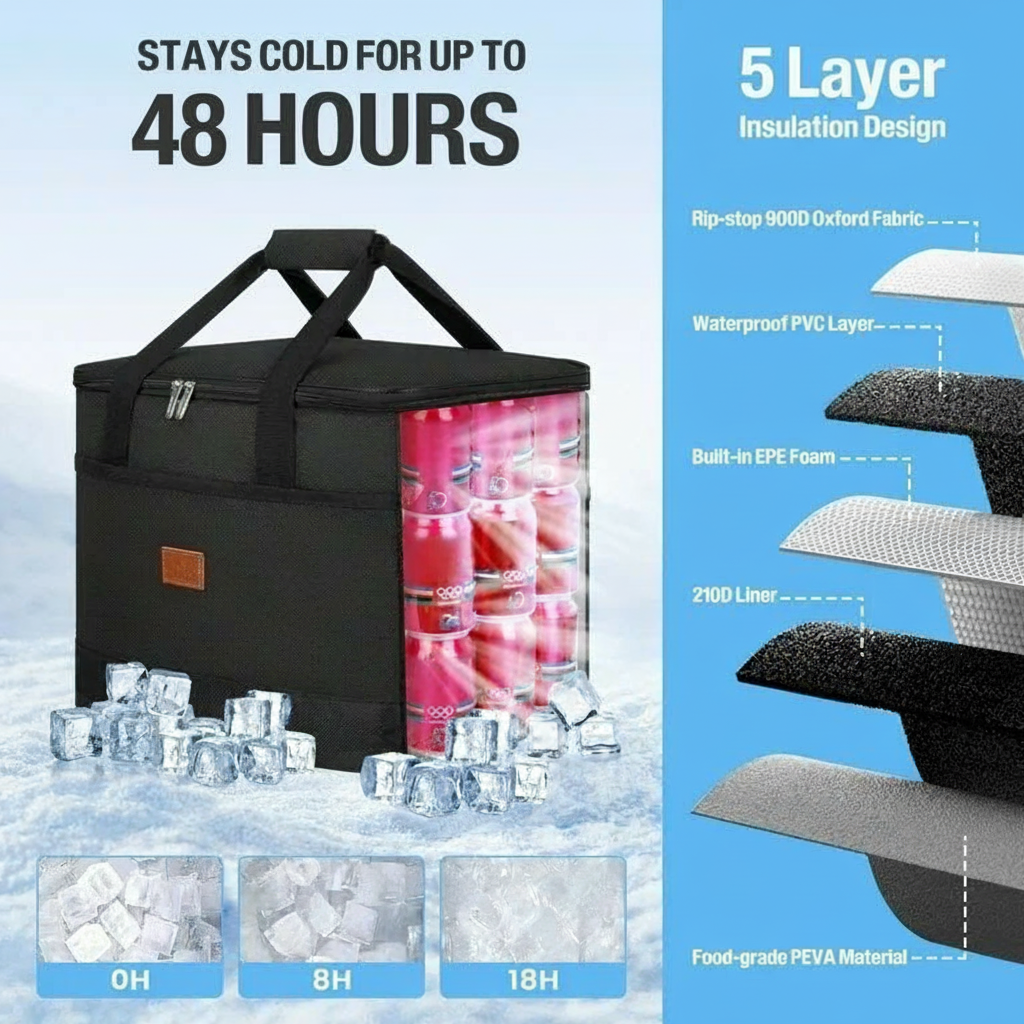
Thickness to hold time: the working table
EPE foam thickness maps to hold time in a pattern production testing repeats reliably. A 2 mm wall holds cold 3 to 4 hours at 25 to 30 degrees ambient, enough for a lunch run or a 30-minute last-mile drop. A 3 mm wall reaches 5 to 6 hours, the grocery and meal-kit default. A 5 mm wall carries 8 to 10 hours, covering a full shift or an overnight pharmaceutical window. An 8 mm wall reaches 10 to 12 hours and beyond with gel packs, the territory of shipping box liners. Each step up adds 0.15 to 0.30 dollars per bag at 1,000-piece orders, and doubling from 3 to 8 mm, through 5, costs 0.40 to 0.90 dollars total, the pricing our insulated bag range quotes per thickness class. The physics of the gradient across the wall is maintained on Wikipedia.
The five-layer wall
Thickness works only inside the correct stack. The working wall runs five layers: an outer fabric, typically 600D polyester or laminated woven PP, that carries structure and print; the EPE foam core that provides the conductive resistance; an aluminum foil radiant barrier that reflects 95 percent or more of radiant heat; a PE film that seals the foam against moisture and ice melt; and an inner lining, food-grade PE or aluminum, that wipes clean between runs. Skipping the radiant barrier to save 0.10 to 0.20 dollars per bag costs 2 to 3 hours of hold time, because radiation crosses a bare foam wall faster than conduction crosses 8 mm of it. The cross-section view shows why the layers must be continuous, gaps and crushed corners leak disproportionately.
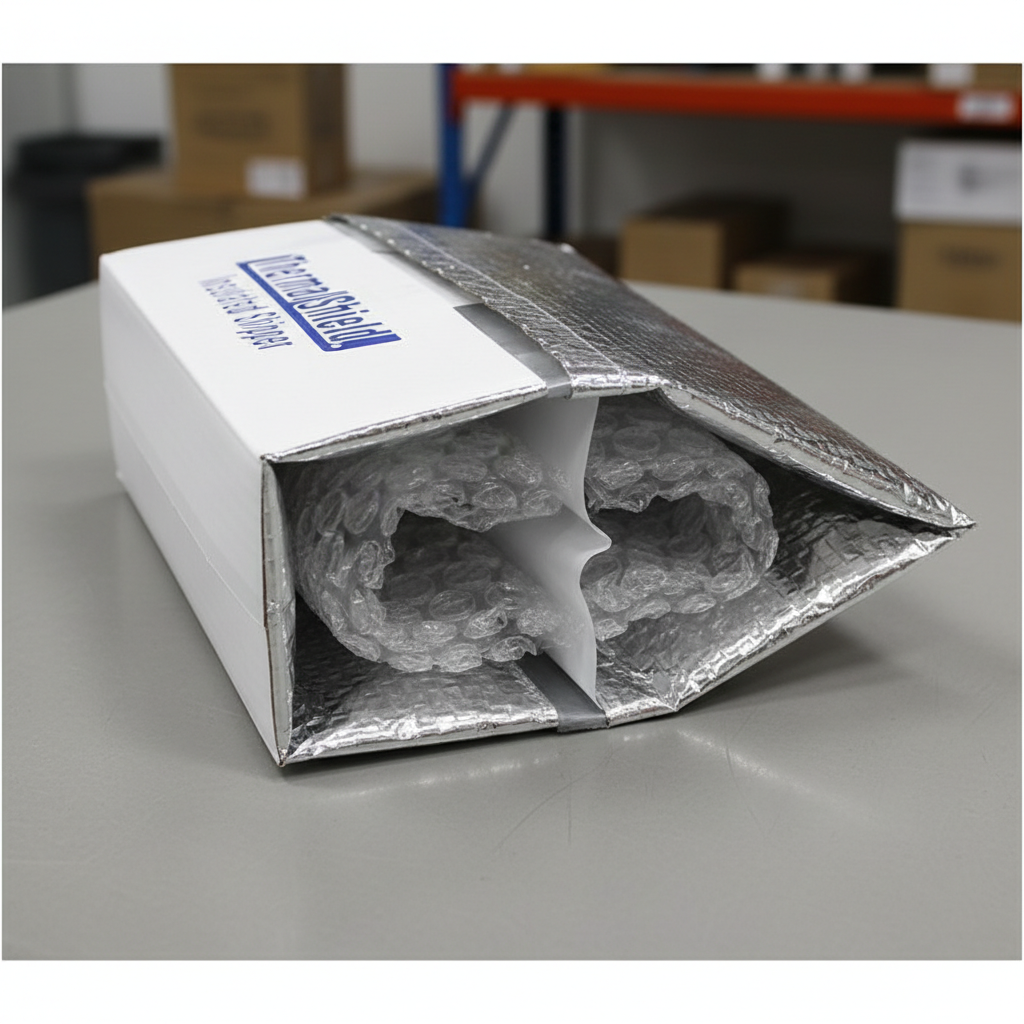
Closures: where thickness goes to waste
A wall is only as good as its opening. Stitched closures leak at every needle hole, losing 15 to 25 percent of theoretical hold time, which is why high-spec bags heat-seal the inner lining and confine stitching to the outer fabric layer. Zippers are the other leak: a standard coil zipper transfers heat along its full length, while a covered or waterproof zipper adds 0.30 to 0.60 dollars per bag and recovers 1 to 2 hours of hold. Roll-top closures, borrowed from dry-bag construction, seal best of all and suit programs where the bag travels locked in a vehicle rather than opened at stops. The seam-strength side of these closures is graded separately, by the methods in our ASTM seam testing guide.
Size changes the answer
Thickness requirements scale with volume, because hold time depends on the ice-to-surface ratio, not the wall alone. A 6 to 20 liter bag at 3 mm often outperforms a 40 liter bag at 5 mm on the same run, since the small bag packs more ice per square centimeter of wall. Working guidance: 3 mm serves volumes under 20 liters for 5 to 6 hours, 5 mm covers the 20 to 35 liter grocery class for 8 to 10 hours, and box liners above 35 liters need 8 mm or double 5 mm walls to hold overnight. Sizing a program’s bag volume to its real cargo load, the method in our bag sizes guide, frequently fixes a hold-time problem without adding foam cost at all.
The test before the order
Every quoted hold time should be verified with the same 30-dollar test. Pack the sample bag at its intended cargo ratio with a known ice load, place a logger reading to 0.5 degrees inside, and record the interior temperature curve against ambient for 12 hours at 25 to 30 degrees, then repeat at 35 to 40 degrees for summer routes. Programs shipping temperature-sensitive goods, pet food, pharmaceuticals, frozen protein, run the same curve against their regulated minimum, the discipline our pet food transport guide applies. A factory that declines to run the test on a production sample is declining to stand behind its own spec sheet.
Frequently asked questions
What foam thickness do I need for 8 hours of cold?
5 mm EPE in the five-layer wall holds 8 to 10 hours at 25-30 degrees ambient; move to 8 mm or add gel packs for summer routes.
How much does thicker foam add to bag cost?
0.15-0.30 dollars per step at 1,000 pieces; the 3 to 8 mm upgrade totals 0.40-0.90 dollars per bag.
Does the aluminum foil layer or the foam matter more?
Both, doing different jobs: foam blocks conduction, foil reflects over 95 percent of radiant heat; skipping foil costs 2-3 hours.
Why does my small bag outlast my large one?
Ice-to-surface ratio: under 20 liters at 3 mm often beats 40 liters at 5 mm, because smaller walls see less melt per liter of ice.
Buy the hold time, not the wall
Thickness is an input; the output programs actually buy is hours of safe temperature. Specify the hold time and ambient condition first, then let the wall build backward from it, 3, 5 or 8 mm, foil included, closures sealed, volume sized to cargo. The thickness classes in our insulated bag range quote against hold-time targets, and production samples ship for the ice test before the order runs.
An insulated delivery bag switch paid for itself over the reuse count; our coffee roaster insulated bag case study walks through the cost and damage math.
For more detail, see our Handle Webbing 101.


0 Comments